Clear Sky Science · en
Radar-based observation of a lava tube on Venus
A Hidden Tunnel on Our Sister Planet
Venus is often called Earth’s twin, but its surface is hidden beneath thick clouds and crushed by intense heat and pressure. This makes it hard to know what really shapes its landscape. In this study, scientists used radar data from NASA’s Magellan spacecraft to uncover strong evidence that a giant underground lava tunnel – a lava tube – lies beneath the Venusian surface. Finding such a structure not only changes how we picture Venus’s volcanoes, it also hints at sheltered environments that future robotic explorers might one day visit.
What Lava Tubes Are and Why They Matter
Lava tubes are long, natural tunnels that form when flowing lava on a volcano crusts over and drains away, leaving behind hollow passageways. On Earth, these caves can stretch for many kilometers and preserve clues about past eruptions. Similar features have been spotted on the Moon and Mars, where collapsed roofs form deep pits called skylights. These skylights act like windows into the underground. Because lava tubes may protect against radiation and harsh surface conditions, they are of great interest for planetary science and, in other worlds, even for potential future habitats.
Looking Through Clouds with Radar
Venus’s dense carbon dioxide atmosphere blocks ordinary cameras, so researchers must rely on radar, which uses radio waves instead of visible light. Between 1990 and 1992, the Magellan spacecraft mapped almost the entire planet with a special radar system that looked sideways at the surface. The authors applied a recently developed radar analysis method, first tested on lava tubes on Earth and on the Moon, to these old Magellan images. They searched places where the surface appears to have collapsed locally, forming pits that could mark the roofs of buried lava tubes. 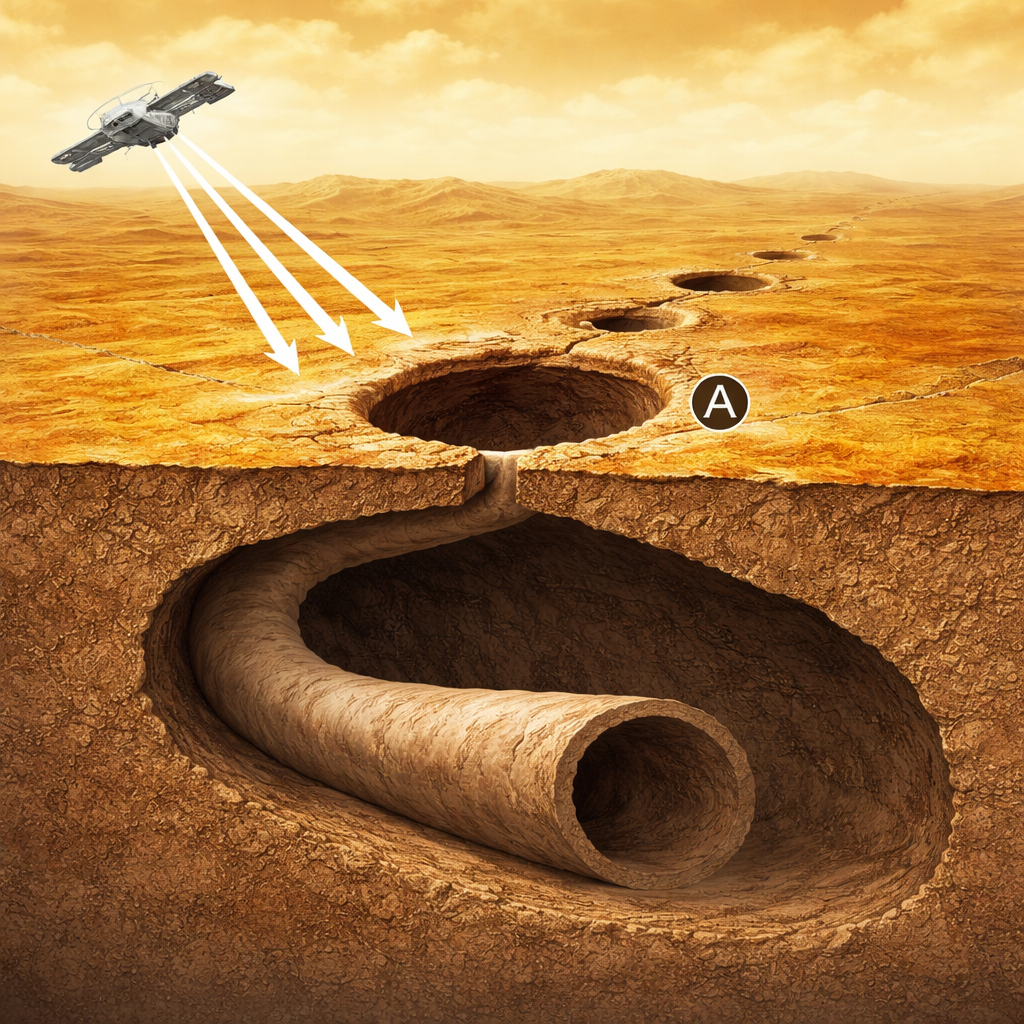
A Strange Pit at Nyx Mons
The team focused on a region near Nyx Mons, a large shield volcano known for its chains of collapse pits. One particular pit, labeled A, stood out. In Magellan’s images, nearby pits behave like simple craters: they show a sharp radar shadow and a bright rim, suggesting steep walls but no open tunnel. Pit A, however, shows a bright radar signal that stretches well beyond the pit’s edge and an asymmetric pattern that closely matches what is seen when radar beams travel into a cave and bounce around inside. Using the radar geometry and brightness pattern, the researchers estimated that the skylight is about 1.5 by 1.1 kilometers across, with a collapse depth of roughly 450 meters and an underground conduit at least 300 meters long that the radar waves can “see” into.
How Big Is This Venusian Tunnel?
By inverting the radar measurements, the authors infer that the subsurface conduit beneath pit A is likely a lava tube about 1 kilometer wide on average, with a roof at least 150 meters thick and an open void at least 375 meters high. A sloping mound of collapsed rock appears to sit on the floor directly under the skylight. Compared with lava tubes on Earth, which are usually only tens of meters wide, this Venusian tube is enormous. Its size is closer to the largest tubes inferred on the Moon and larger than those estimated on Mars. The pit also fits the size and shape trends seen in other planetary skylights thought to mark lava tubes, reinforcing the interpretation that it is part of a long, partially collapsed tunnel system stretching perhaps 45 kilometers beneath the surface. 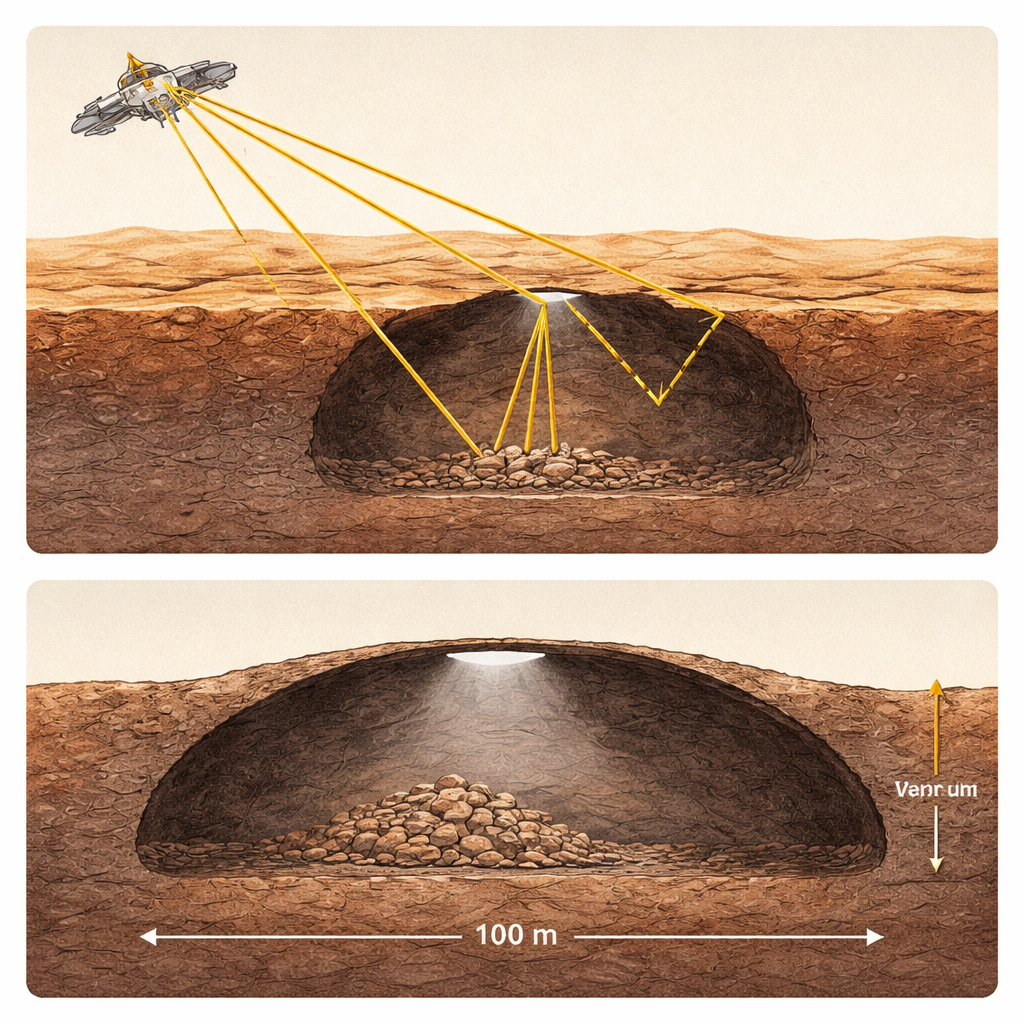
Ruling Out Other Explanations
The authors carefully considered and rejected several alternative ideas. Impact craters would leave debris deposits all around, which are not seen here. Simple deep pits or volcanic vents without open tunnels produce radar patterns different from the extended bright region linked to pit A. Chains of pits formed by cracks fed by underground magma sheets, known as dykes, also tend to lack the distinctive asymmetric radar brightening that signals a horizontally continuous void. Comparisons with high-resolution radar images of lava tubes and pits on Earth, especially a well-studied system in Lanzarote, Spain, show strikingly similar signatures, lending further support to the lava tube explanation.
Why This Discovery Matters
To a non-specialist, the conclusion is straightforward: the radar image of pit A behaves exactly as expected if a huge, open tunnel lies beneath the surface of Venus. This is the first strong radar-based evidence of an accessible lava tube on the planet. Because Magellan’s images are relatively coarse, many smaller skylights may have gone unnoticed. Upcoming Venus missions such as EnVision and VERITAS, equipped with sharper radar instruments and even a subsurface sounder, could find additional tubes and map them in detail. Together, these systems of hidden tunnels may rewrite our understanding of how Venus’s volcanoes work and offer rare, sheltered environments in one of the most extreme landscapes in the Solar System.
Citation: Carrer, L., Diana, E. & Bruzzone, L. Radar-based observation of a lava tube on Venus. Nat Commun 17, 1147 (2026). https://doi.org/10.1038/s41467-026-68643-6
Keywords: Venus lava tube, radar remote sensing, volcanism, planetary caves, Magellan spacecraft