Clear Sky Science · en
Intensity-asymmetric wavefront shaping in nonlocal meta-lens
Shaping Light Differently in Each Direction
Most optical devices treat light the same no matter which way it travels, but many emerging technologies would benefit if light going forward behaved differently from light going backward. This paper reports a new ultra-thin lens that can bend and refocus light in an intentionally unbalanced way, doing so more efficiently in one direction than the other while remaining completely passive and compact. Such control could help make future systems for ranging, sensing, and optical computing smaller, faster, and more energy-efficient.
A Flat Lens That Prefers One Way
The heart of the work is a “meta-lens,” a flat optical element made from an orderly array of tiny silicon structures sitting on a glass (silica) chip. Each unit, called an integrated-resonant unit, looks like a crescent carved from a microscopic cylinder. When near‑infrared light shines through this patterned surface, the meta-lens focuses the light—similar to a curved glass lens—but with a twist: the strength of the focused beam strongly depends on whether the light arrives from the air side (forward) or from the glass side (backward). 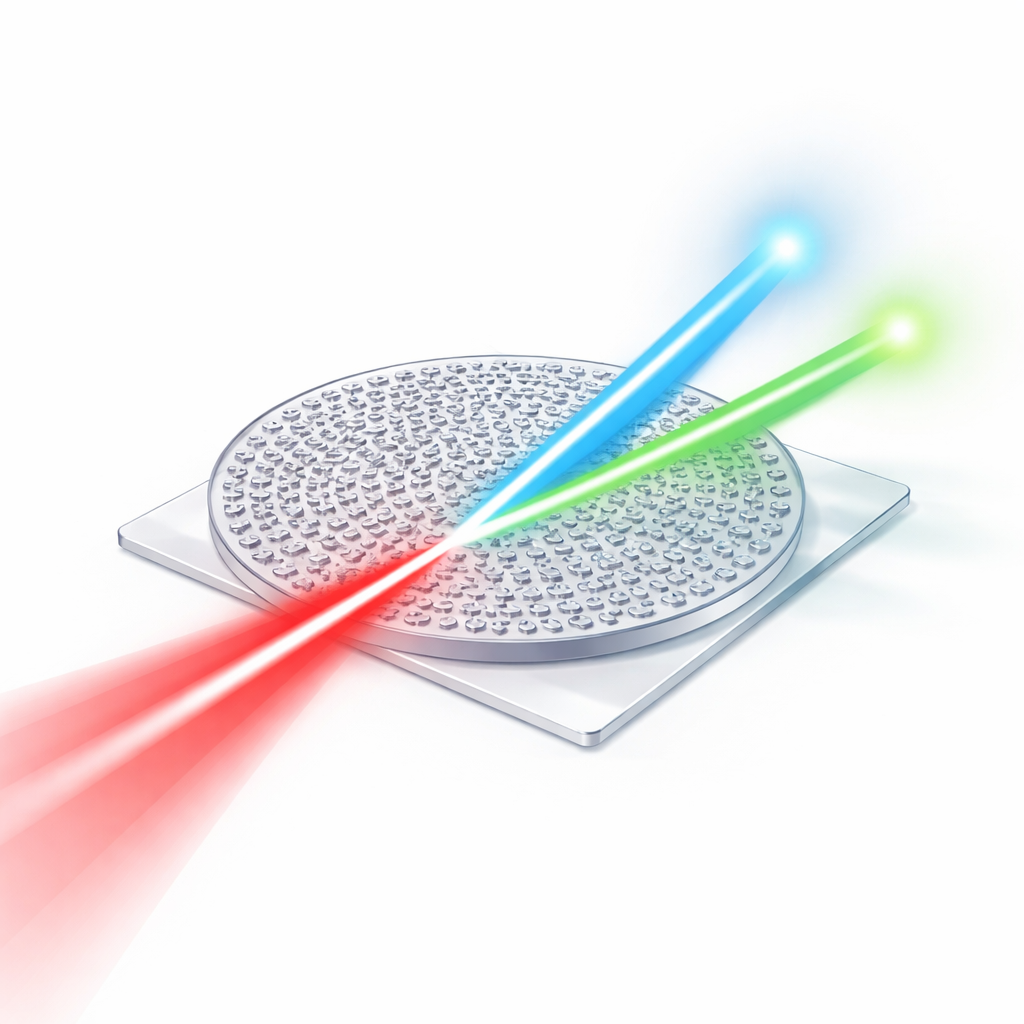
Combining Two Ways of Trapping Light
This directional behavior comes from a careful balance between two different kinds of optical resonances supported by each tiny crescent. One is a local Mie-type resonance, where light swirls mainly inside each individual nanoresonator, giving precise control over the phase of the transmitted light—how far its wavefront is “ahead” or “behind.” The other is a nonlocal quasi-bound state in the continuum, a collective mode extending over many resonators that traps light for a relatively long time, boosting its intensity. On their own, local resonances are good at shaping wavefronts but only mildly directional, while nonlocal ones are excellent for strengthening nonlinear effects but less flexible and still nearly symmetric.
Turning Asymmetry into Stronger Signals
By tuning the geometry—especially the offset that defines the crescent shape—the authors cause these two resonances to interact in a Fano-like fashion, where one resonance subtly reshapes the other. This interaction leverages the small up–down difference created by the silica substrate and turns it into a strong difference in the internal electromagnetic fields for forward versus backward illumination. Although the far-field transmission looks almost the same in both directions, the local fields inside the nanoresonators are much stronger when light comes from the forward side. This hidden imbalance is exactly what is needed to boost directional nonlinear effects, where new colors of light are generated from an intense input beam.
Directional Focusing at Multiple Colors
Experimentally, the team demonstrates that the meta-lens can not only focus the original near‑infrared beam, but also its second and third harmonics—new light at roughly half and one‑third the wavelength. These harmonic beams are sharply focused spots whose sizes approach the fundamental diffraction limit, meaning the flat lens performs nearly as well as an ideal curved lens. Yet the intensity of the focused harmonic beams is far from symmetric: for the second harmonic, the forward direction carries more than five times the power of the backward direction, and for the third harmonic the contrast exceeds a factor of ten. 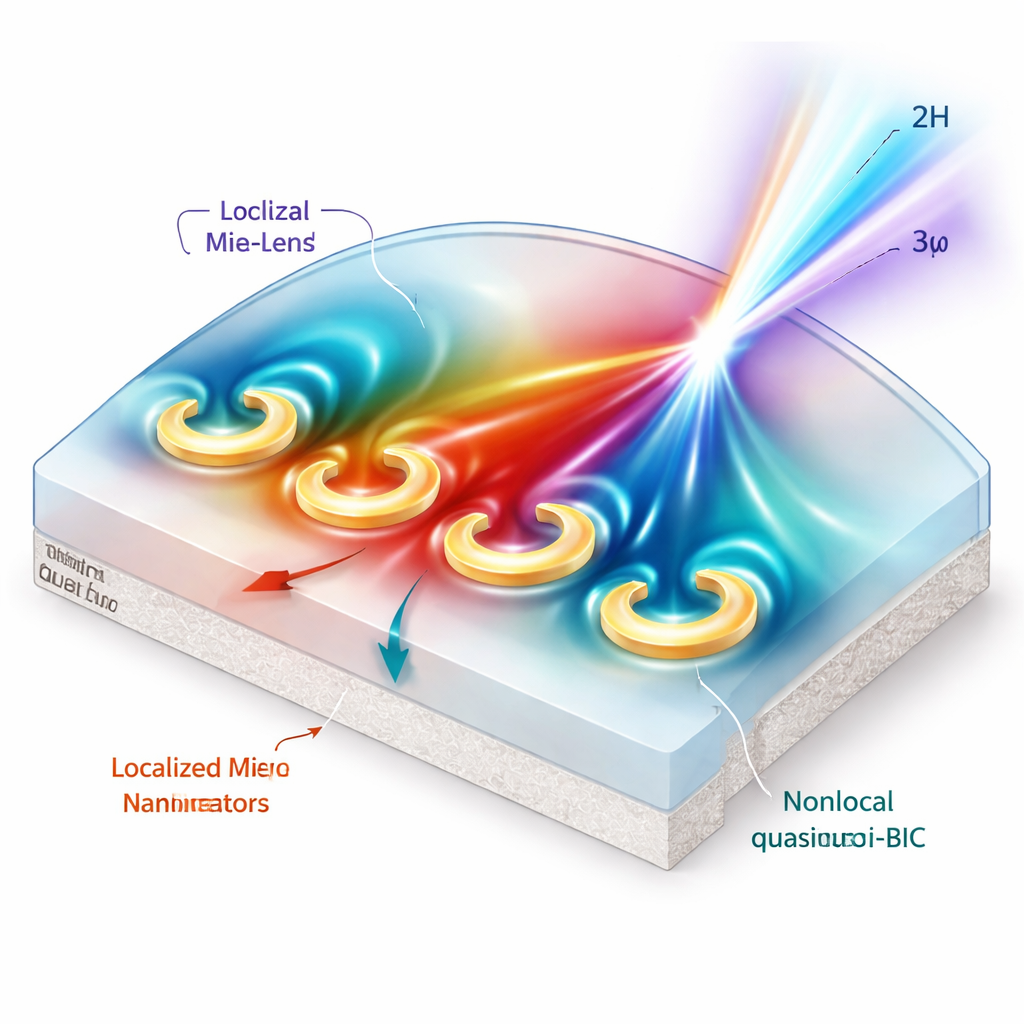
Why This Matters for Future Photonics
To a non-specialist, the key message is that the authors have built an ultrathin optical element that steers and strengthens light in a preferred direction without moving parts, magnets, or complex stacks of layers. By artfully combining local and nonlocal resonances in a single metasurface, they overcome a long-standing trade-off between efficiency, precise control of the beam shape, and strong directional behavior. This intensity-asymmetric meta-lens concept could become a building block for next-generation LIDAR units that see better in one direction, optical computers that route signals without bulky isolators, and communication systems that control light pathways on a chip with unprecedented finesse.
Citation: Yao, J., Wang, Z., Fan, Y. et al. Intensity-asymmetric wavefront shaping in nonlocal meta-lens. Nat Commun 17, 2039 (2026). https://doi.org/10.1038/s41467-026-68638-3
Keywords: metasurface lens, nonlinear optics, directional light control, harmonic generation, nonreciprocal photonics