Clear Sky Science · en
Scalable and programmable topological transitions in plasmonic Moiré superlattices
Why twisting patterns of light matter
Modern electronics and photonics increasingly rely on “topological” effects—robust patterns of motion or fields that cannot be easily disturbed. These ideas underpin ultra-stable electronic states, exotic superconductors, and new ways of guiding light. Yet, in most existing systems, changing from one topological state to another is difficult, because it depends on fixed materials or rigid structures. This article shows how carefully patterned light on a metal surface, arranged in Moiré superlattices, can be used as a flexible and scalable playground where topological states can be programmed almost like software.
From abstract math to tangible patterns
Topology, in this context, describes how a vector field—arrows showing direction and strength of a quantity—wraps and twists through space. Certain swirling patterns, called skyrmions, are topological structures: they can be stretched or deformed but not removed without passing through a singularity, a point where the field vanishes. The authors focus on optical skyrmions, realized using evanescent light waves bound to the surface of a metal. They engineer six surface waves arranged in a hexagonal pattern and precisely control their phases, the optical “timing” of the waves. By tuning a single phase parameter, they can morph the lattice of arrows from one skyrmion configuration to another and measure how many times the field wraps around a sphere—a quantity known as the topological invariant.
Watching topological jumps in real space
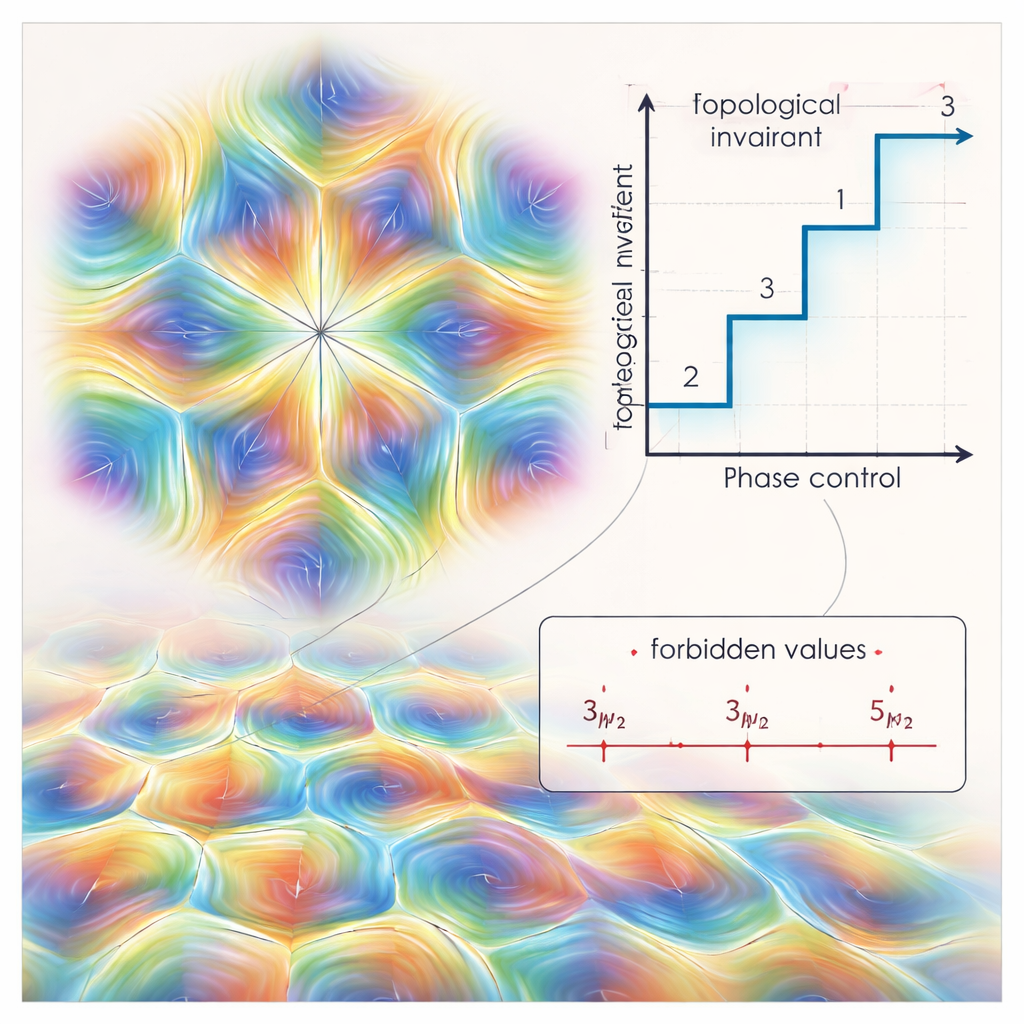
As the phase parameter is varied, the overall pattern of the light field changes smoothly, but the topological invariant stays locked at discrete values such as +1, 0, or −1 over broad ranges. Only when the field develops a true singularity—where the electric field momentarily drops to zero—does the invariant jump to a new value, marking a topological transition. The authors show that this behavior mirrors the way electron bands in topological insulators change character: there, too, a gap in allowed energies must close and reopen at a critical point. Here, an “energy-band-like” picture can be drawn directly in real space, where the magnitude of the electric field plays the role of energy, letting researchers visualize these abstract transitions in a more intuitive way.
Building giant topological playgrounds with Moiré patterns
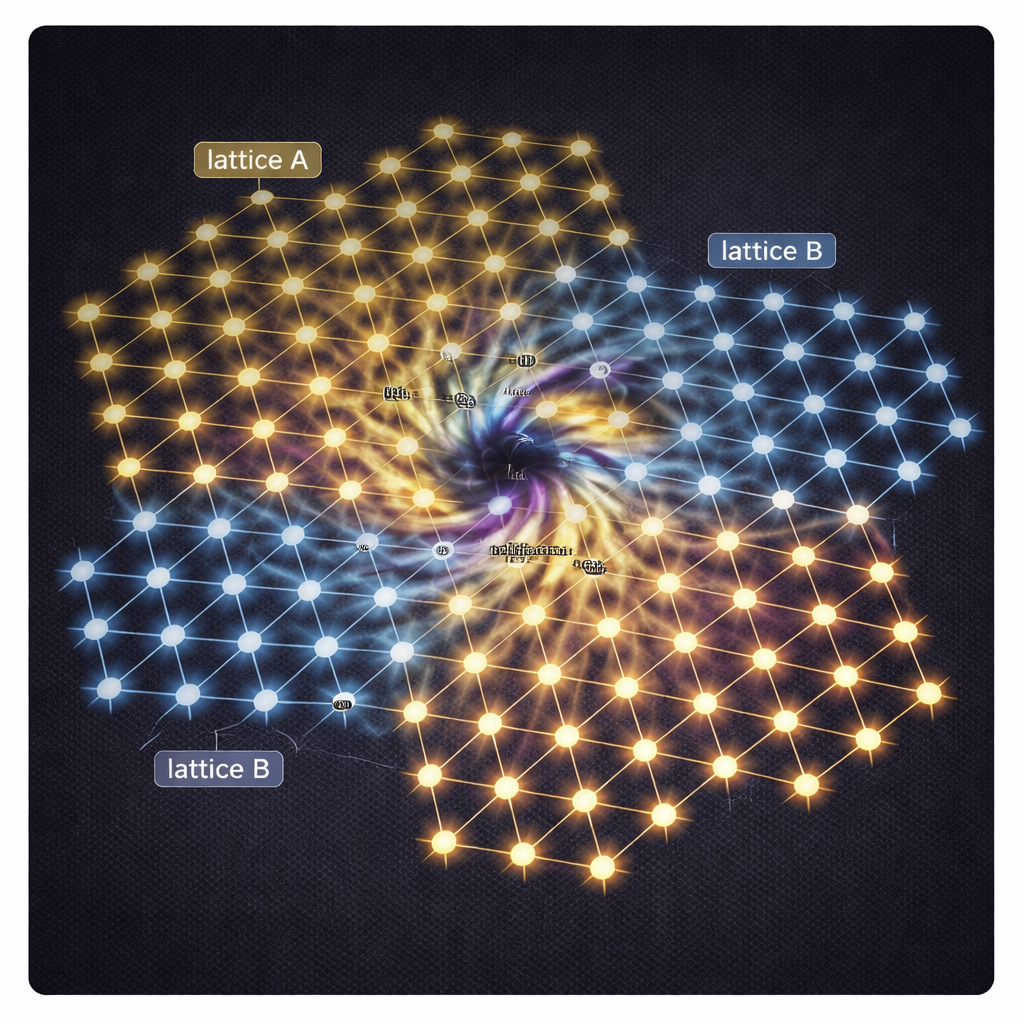
To greatly expand the range of accessible topological states, the team stacks two such hexagonal light lattices with a slight twist, forming a Moiré superlattice—a large-scale interference pattern familiar from overlaid screens or printed halftones. In this optical version, two independent phase parameters control the relative configurations of the two layers. The resulting field forms a much larger hexagonal cell packed with complex skyrmion structures. Calculations show that, by scanning these two phase knobs, the system can realize topological invariants spanning from −8 to +8 for a modest twist, and, with different geometric choices, as broadly as −58 to +58. This is one of the widest continuous ranges of tunable topological states reported in any physical platform.
Symmetry rules and forbidden topological values
A striking discovery is that not all integer or half-integer values are allowed. Because the Moiré lattice has a threefold rotational symmetry, singularities fall into two categories: those at special symmetric points and those at general positions. Symmetric singularities flip the sign of the topological invariant (for example, from −8 to +8), while generic ones change it only in steps of three. Together, these rules prevent the system from ever settling into states whose invariant is a multiple of three, or even a multiple of three-halves when transient states are considered. In other words, topology and symmetry combine to carve out a discrete, highly structured set of allowed values, a kind of selection rule for real-space topology that persists even when the lattice design is scaled up or modified.
From programmable light patterns to future devices
Experimentally, the authors realize these ideas using surface plasmon polaritons—waves of electrons and light traveling along a gold film—whose phases are programmed by a spatial light modulator. By reconstructing the full vector fields, they confirm multiple, controllable topological transitions in both simple lattices and twisted Moiré superlattices. For a lay reader, the key message is that topological states need not be fixed properties of a material; they can be dynamically written, erased, and reshaped in patterns of light. This opens a route toward reconfigurable optical circuits, robust information encoding in skyrmion lattices, and a unified way of thinking about topological transitions across electronics, photonics, acoustics, and other wave-based technologies.
Citation: Tian, B., Zhang, X., Wu, R. et al. Scalable and programmable topological transitions in plasmonic Moiré superlattices. Nat Commun 17, 1931 (2026). https://doi.org/10.1038/s41467-026-68635-6
Keywords: topological transitions, optical skyrmions, Moiré superlattices, plasmonics, structured light