Clear Sky Science · en
Contextual conditions define maximum energy-use threshold in low-carbon controlled environment agriculture for agri-food transformation
Why indoor farms and greenhouses matter for the climate
As cities grow and weather becomes more extreme, controlled environment agriculture (CEA) – think high‑tech greenhouses and indoor vertical farms – promises fresh food close to consumers, using less land and water. But these systems can use a lot of electricity. This article asks a simple but crucial question: under what conditions can CEA actually help the climate instead of making emissions worse?
Setting a practical energy limit
The authors introduce a new yardstick called the Maximum Energy‑use Threshold, or MET. It is an upper limit on how much energy a CEA facility can use per kilogram of crop while still producing less climate pollution than today’s way of getting that food. Instead of focusing on a single technology or farm design, MET looks outward at context: how dirty or clean the local electricity grid is, how far food is currently transported, and whether switching to CEA could free up farmland to be restored to nature. If a farm’s real energy use comes in below the MET, it is likely on the right side of the climate equation and worth examining in more detail with full environmental assessments. 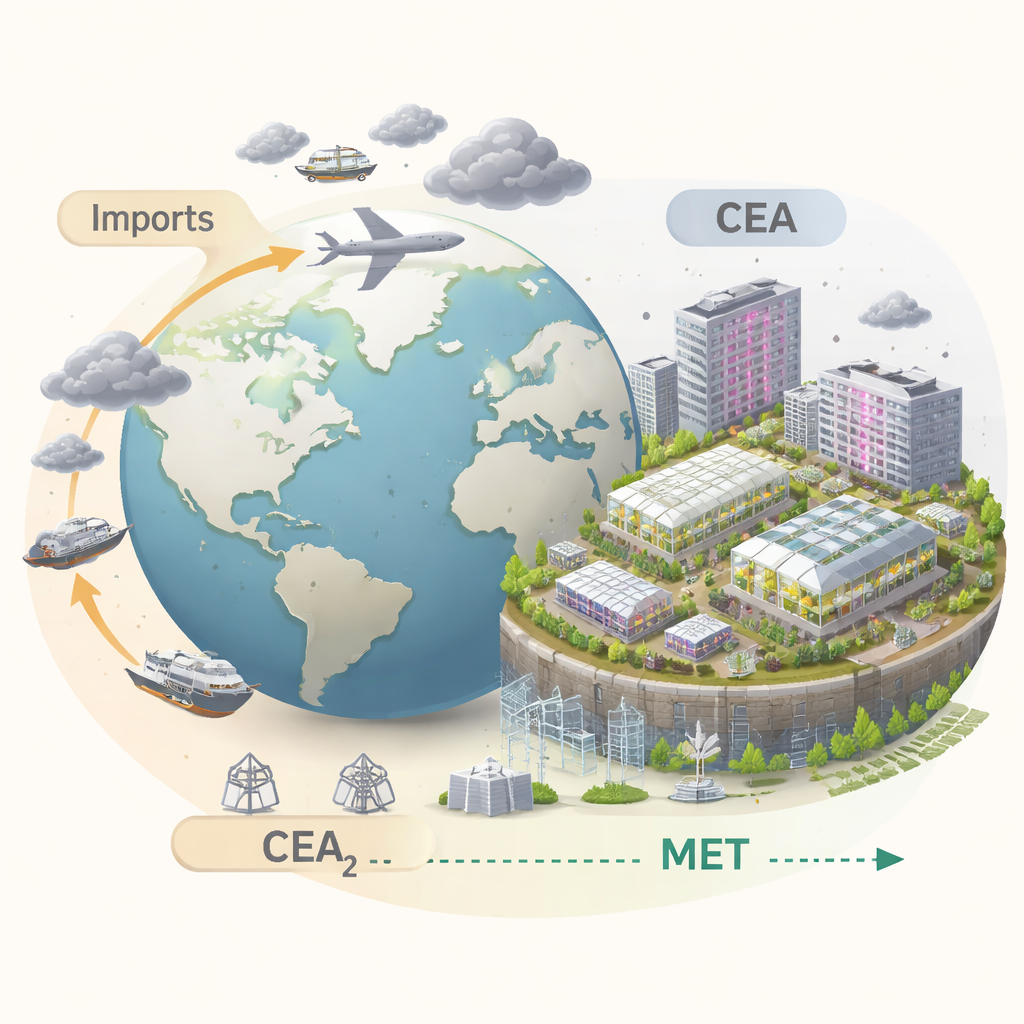
When replacing imports makes sense
One part of the study compares the emissions from growing leafy greens, tomatoes, strawberries, wheat, and soybeans in CEA to the emissions from importing them. Using global trade statistics and transport emissions for ships, trucks, and planes, the authors estimate the average carbon footprint per kilogram of imported produce for each country. They then divide this value by the local electricity emission factor to get the MET – essentially, the maximum kilowatt‑hours per kilogram that CEA can spend and still beat imports. The results show that for most countries, today’s indoor farms use several times more energy than the threshold allows, especially for energy‑hungry crops like wheat and soy. There are promising exceptions, though: leafy greens grown in land‑locked countries with very low‑carbon electricity, such as those rich in hydropower, and short‑shelf‑life fruits like strawberries that would otherwise be flown in by air.
Looking ahead to cleaner power
The researchers then explore what happens if the energy system itself becomes cleaner. They model scenarios where CEA facilities run on today’s solar panels and on future power grids expected in 2050 under different climate policy pathways. Cleaner grids and better solar technology raise the MET, giving CEA more room to operate without exceeding the climate budget. However, the study finds that efficiency still matters: even under optimistic low‑carbon energy scenarios, typical indoor farms often remain above the threshold. In some cases, switching from a very clean existing grid, such as one dominated by hydropower, to solar actually lowers the MET because manufacturing solar panels still has a measurable carbon footprint. 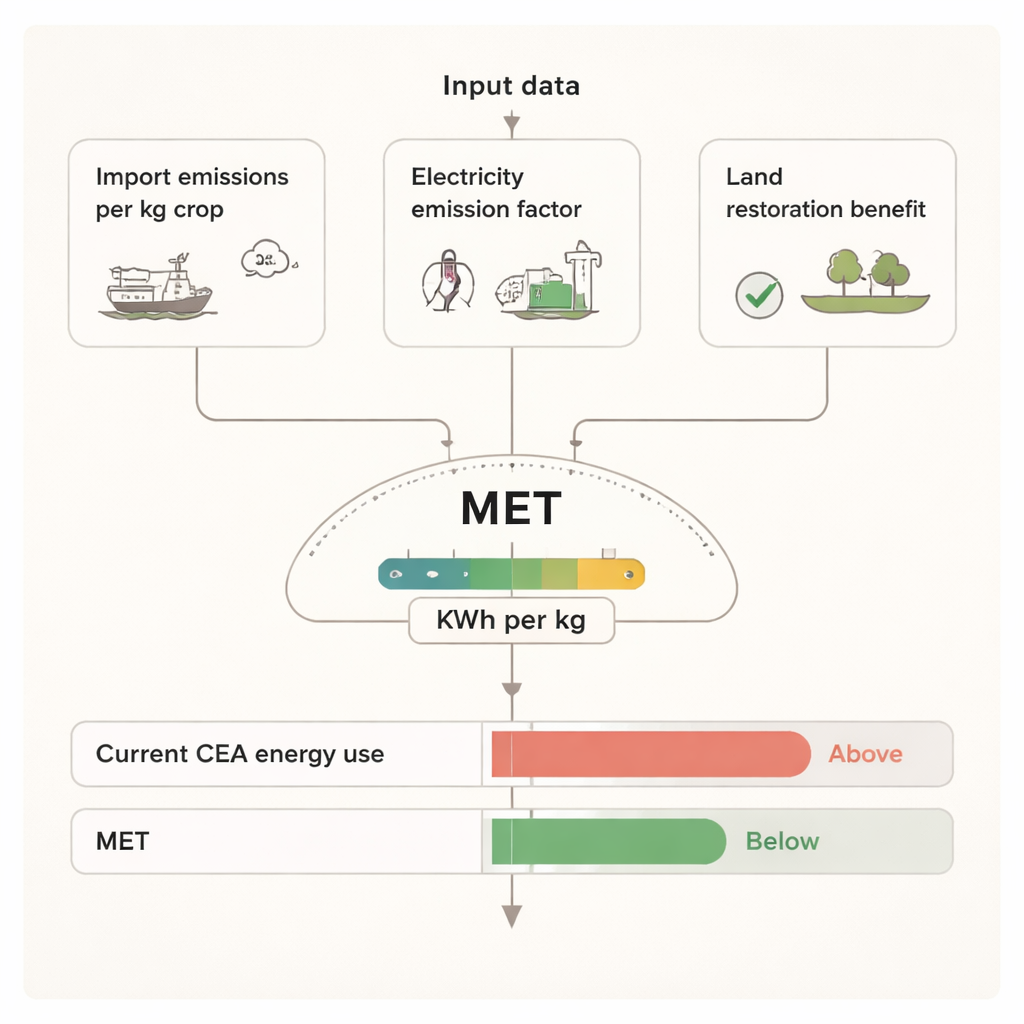
Freeing land for nature as a hidden benefit
Beyond high‑value vegetables, the article also asks whether it could ever make climate sense to grow staple crops like wheat and soy in CEA, even though they need a lot of energy. Here the authors add another piece to the puzzle: the “carbon opportunity cost” of land. If CEA could replace fields of cereals, that land might be restored to native vegetation, storing more carbon over time. By estimating how much carbon could be absorbed if existing cropland were given back to nature, they convert this benefit into an extra allowance in the MET. Under this wider view, a few tropical countries with very productive ecosystems and low‑carbon electricity emerge as places where CEA for cereals could, in principle, help both food security and climate mitigation—though today’s CEA systems are still generally too energy‑intensive to take full advantage.
Guiding policy and industry choices
Finally, the authors propose using MET as a transparent benchmark for industry and policymakers. Because it is calculated from public data on trade and electricity rather than company claims, MET can help identify where new CEA projects are most promising and where they are likely to be climate‑damaging. Regulators could, for example, allow only small‑scale operation for facilities that exceed the MET, while offering grants, favorable electricity rates, or access to carbon markets for those that both fall below the threshold and pass more detailed environmental checks. In plain terms, the study argues that indoor farming and advanced greenhouses are not climate solutions by default; they become climate solutions only when they are carefully matched to local conditions and designed to use energy sparingly.
What this means for future food systems
To a layperson, the article’s message is straightforward: indoor farms can help cut emissions and secure food supplies, but only if they are built in the right places, grow the right crops, and keep their energy use under a scientifically defined limit. The MET offers a simple, context‑aware number that shows when CEA genuinely improves on today’s food system. It does not replace full sustainability studies, but it can quickly flag when a project is almost certainly too energy‑hungry to be climate‑friendly. As countries experiment with new ways to grow food, this kind of pragmatic filter can steer investment and policy toward controlled environment agriculture that truly supports a low‑carbon future.
Citation: Ng, S., Hinrichsen, O. & Viswanathan, S. Contextual conditions define maximum energy-use threshold in low-carbon controlled environment agriculture for agri-food transformation. Nat Commun 17, 880 (2026). https://doi.org/10.1038/s41467-026-68631-w
Keywords: controlled environment agriculture, indoor farming, greenhouse emissions, food security, low carbon energy