Clear Sky Science · en
Modulation of Nudt21 levels reveals dose-dependent roles of alternative polyadenylation in tissue regeneration
How cells keep our tissues young
Our bodies constantly repair themselves. Stem cells tucked away in the skin, gut, bone marrow, and muscles quietly replace worn-out cells so tissues stay healthy. This paper explores an invisible layer of control inside these stem cells—how they finish off their RNA messages—and shows that small shifts in this process can decide whether tissues regenerate smoothly, stall, or fail. 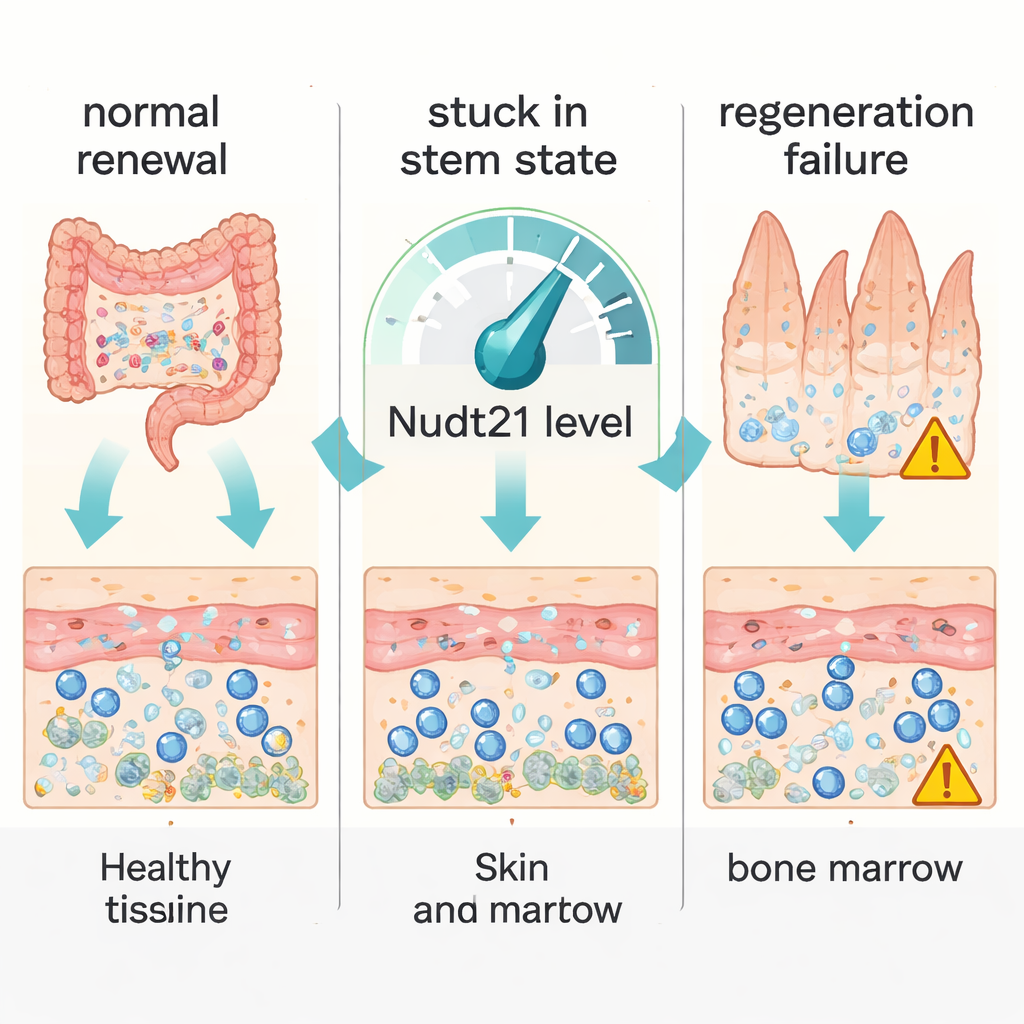
Snipping the tail of genetic messages
Every gene that is turned on in a cell is first copied into an RNA message. Before that message can be used to make protein, it gets a chemical “tail” added to its end, a process called polyadenylation. Many genes have more than one possible cutting site, so the same message can end in a longer or shorter tail region. These tail regions, known as 3’UTRs, do not code for protein but act as landing pads for other regulators, including microRNAs that fine-tune how much protein is made. The protein Nudt21 helps the cell choose where to cut, and thus how long these RNA tails will be.
A single control knob with two very different effects
The researchers engineered mice in which Nudt21 could be dialed down or completely switched off in adult tissues. When Nudt21 was fully removed throughout the body, animals rapidly became sick and died, but not because their “static” organs like heart or kidney failed. Instead, high-turnover tissues—such as the lining of the intestine and esophagus, the blood-forming system in bone marrow, and muscle stem cells called satellite cells—lost their ability to renew themselves. Stem and progenitor cells in these tissues stopped moving through the cell cycle, failing to copy their DNA and divide. In contrast, when Nudt21 levels were reduced only partway, stem cells could still multiply but no longer matured properly into specialized cells, revealing that self-renewal and differentiation respond to different dosage thresholds of the same control factor.
Shortened messages that dodge the brakes on differentiation
To see what changed inside the cells, the team mapped where RNA messages were cut and how protein levels shifted. With moderate Nudt21 reduction, about a thousand RNA messages switched from longer to shorter tail regions. Because many of the lost segments carried microRNA binding sites, these shortened messages became harder to silence. Key regulators of cell identity and development, including enzymes that remodel DNA packaging and transport proteins, were made in excess. This overproduction disturbed delicate “competing RNA” networks in which many messages share the same microRNA regulators. The net effect was that stem cells were locked in an immature state: they kept their stem-cell markers but failed to turn on genes needed for full differentiation, even when given strong pro-differentiation signals.
When the cell’s machines fall apart
Complete loss of Nudt21 had a more severe and unexpected consequence. In addition to the differentiation block, many messages encoding parts of essential multi-protein machines gained shortened tails. These messages, in contrast, tended to make less protein, not more. The most striking example was the nuclear pore complex, the large gateway that spans the nuclear envelope and allows RNAs to exit the nucleus. Nearly half of the pore’s building blocks showed altered tail lengths and fell in abundance, causing pores to disappear from the nuclear surface, RNA to pile up in the nucleus, and signs of DNA damage to appear. By selectively deleting only the long-tail region of a single pore component, Nup160, the researchers could mimic much of the full Nudt21 loss: nuclear pores became unstable, genetic material broke during cell division, and stem cells stopped renewing. Similar disruptions were seen in other critical complexes involved in protein synthesis and RNA processing, suggesting that proper tail choice helps coordinate how these large machines are assembled. 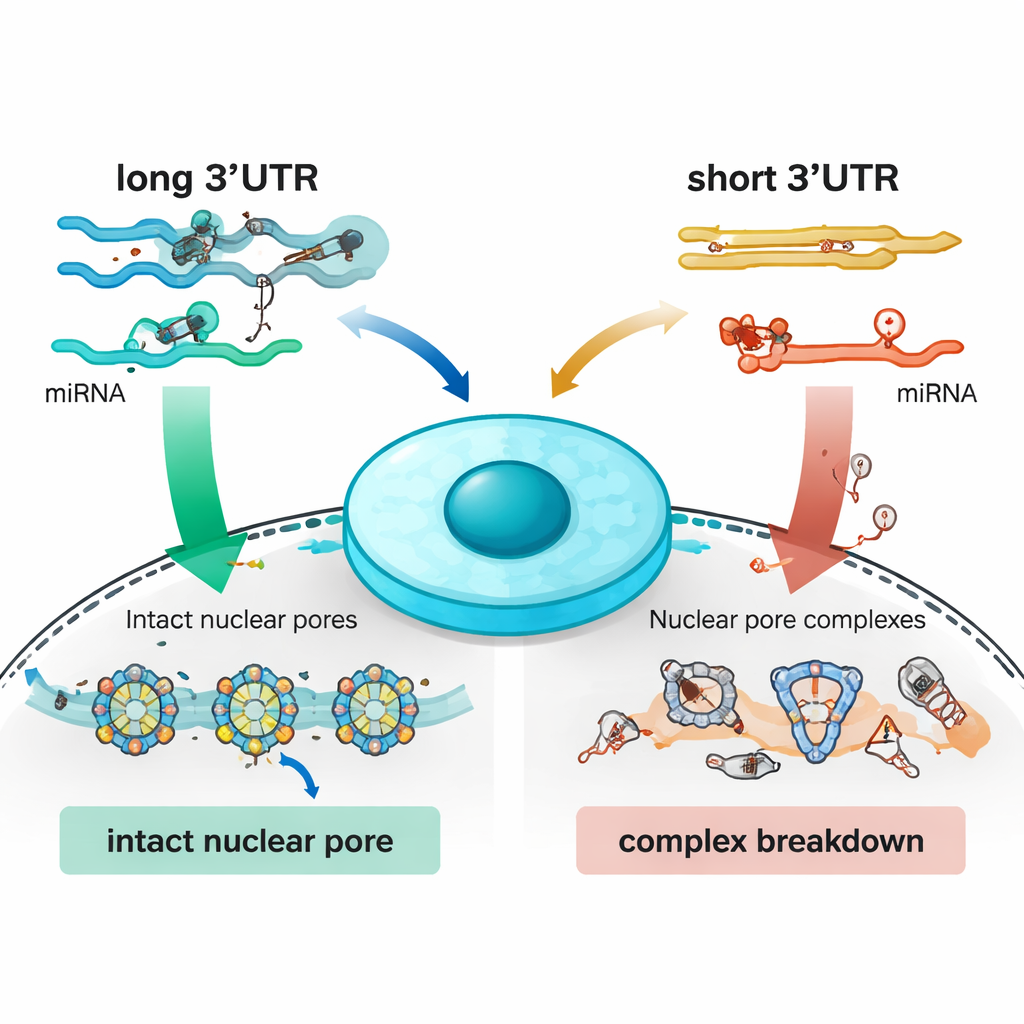
Why this matters for health, aging, and cancer
For a non-specialist, the main message is that stem-cell-driven repair does not depend only on which genes are turned on or off, but also on exactly how their RNA messages are finished. Nudt21 acts like a dosage-sensitive master tuner of this finishing step. Turning it down a little lets stem cells keep dividing but traps them in an immature, hard-to-differentiate state—a situation that may resemble certain aggressive cancers. Turning it down too far causes core cellular machines, such as nuclear pores, to fall apart, leading to DNA damage and loss of regenerative capacity. Understanding and eventually controlling this RNA tail-cutting machinery could open new ways to boost tissue regeneration, protect genome stability during aging, or selectively push cancer cells into a lethal shutdown.
Citation: Tsopoulidis, N., Yagi, M., Brumbaugh, J. et al. Modulation of Nudt21 levels reveals dose-dependent roles of alternative polyadenylation in tissue regeneration. Nat Commun 17, 2005 (2026). https://doi.org/10.1038/s41467-026-68630-x
Keywords: stem cells, tissue regeneration, RNA processing, nuclear pore complex, alternative polyadenylation