Clear Sky Science · en
Observation of strong spin-orbit couplings in plasmonic spin-twistronics topological lattices
Twisting Light on a Metal Surface
When two thin crystal layers are rotated with respect to each other, they form large, slowly varying “moiré” patterns that can radically change how electrons move. This work shows that a similar idea can be applied not to electrons, but to light itself confined to a metal surface. By twisting patterned “spin” textures of light, the authors uncover new ways to sculpt light at the nanoscale, with potential uses in data storage, sensing, and delicate control of tiny particles and molecules.
From Twisted Graphene to Twisted Light
Over the past decade, “twistronics” has transformed how physicists think about two-dimensional materials like graphene. By rotating one atomic sheet slightly relative to another, researchers discovered magic angles where electrons slow down, form unusual insulating states, or even flow without resistance. Scientists have since transplanted this idea into many wave systems, including sound and conventional optical lattices. In each case, a simple geometric twist generates new large-scale patterns and surprising behavior. The present work extends this logic into a very specific and powerful setting: surface plasmon polaritons—electromagnetic waves that hug a metal surface and can trap light far below the usual diffraction limit.
Spins of Light and Their Twisted Lattices
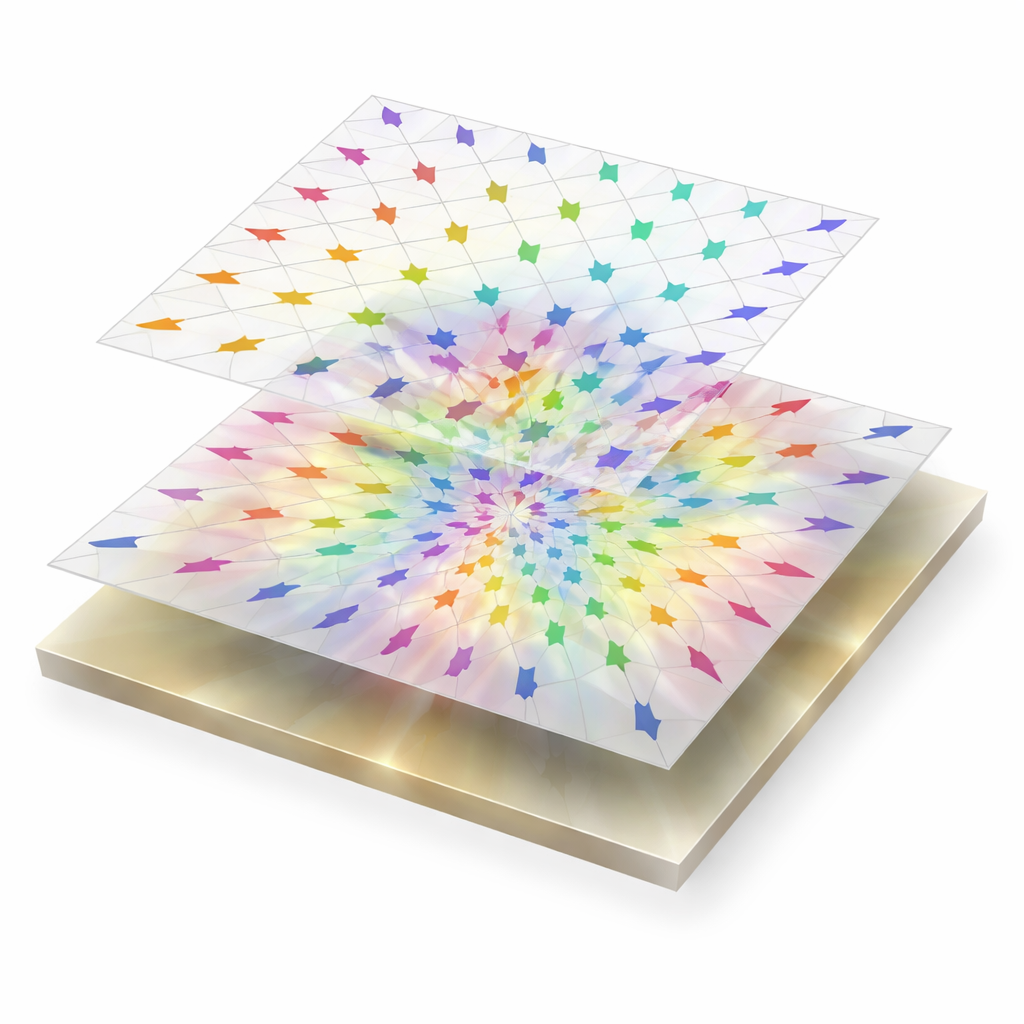
Light carries angular momentum, which can be thought of as a kind of “spin” and “orbit” combined. On a metal surface, tightly bound surface waves naturally link the direction in which they travel with the orientation of this spin, a phenomenon known as spin–orbit coupling. The authors first engineer regular lattices of spins of light—ordered arrangements where the local spin direction swirls and twists in space. Some of these patterns resemble known topological objects called skyrmions and merons, where the spin gradually wraps around like the surface of a sphere. These intricate patterns are created and probed on a flat gold film using precisely shaped laser beams and a high-resolution near-field microscope.
Building Moiré Superlattices of Spin
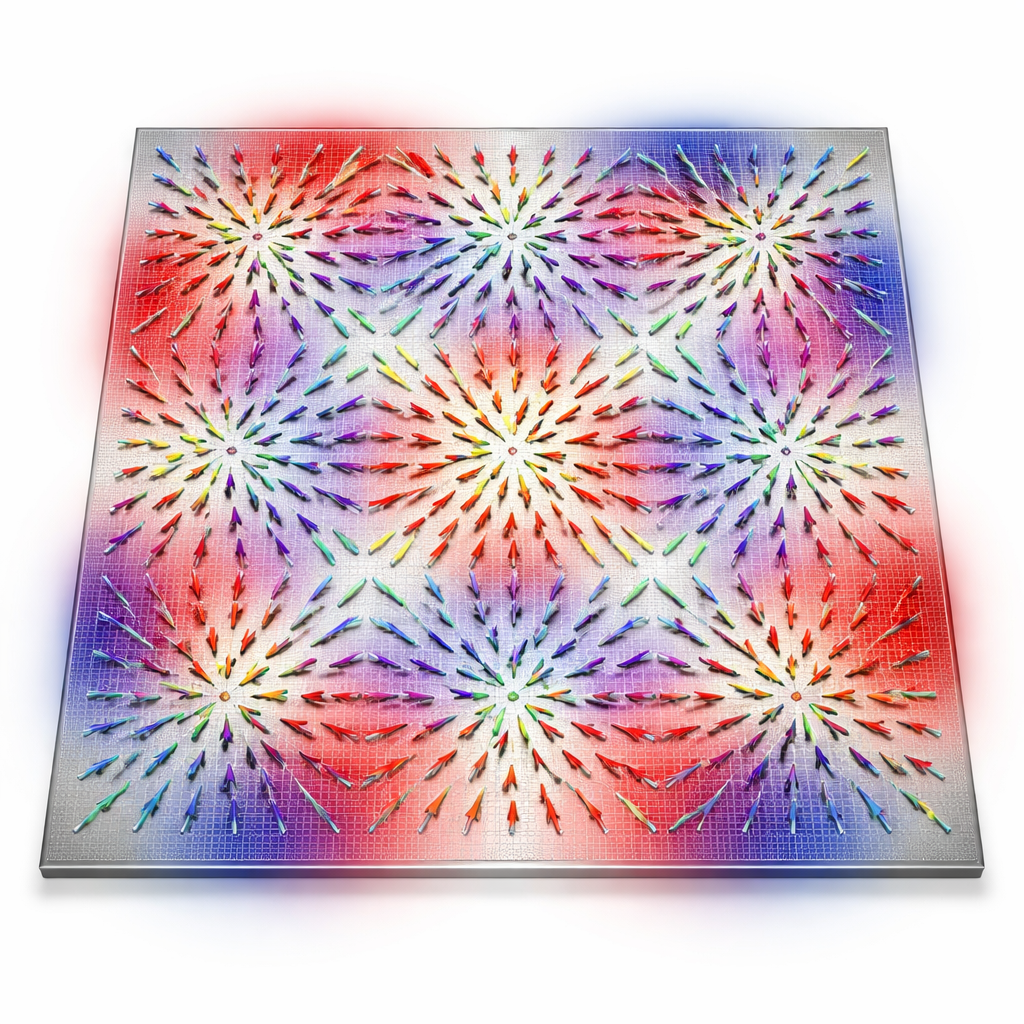
Instead of stacking two physical layers, the team stacks two spin patterns on the same surface plasmon platform by rotating their underlying wave patterns by controlled angles. When the conditions of both rotation and translation symmetry are satisfied, the overlap produces moiré “spin superlattices”: large-scale patterns in which the local spin texture repeats in complex ways. By choosing special twist angles and tuning the total angular momentum carried by the light, the researchers can transform underlying meron patterns into lattices of full skyrmions, assemble clusters of merons, and generate multilayered fractal-like arrangements that repeat at several different length scales. These effects rely on exceptionally strong spin–orbit coupling in the plasmonic system and do not appear in more ordinary optical lattices.
Fractals and Naturally Slow Light
One striking outcome of these twisted spin lattices is the appearance of fractal structures: self-similar spin patterns that can be decomposed into several nested lattices, each with its own characteristic spacing and orientation. By analyzing the patterns in Fourier space—a way of looking at the underlying spatial frequencies—the authors identify four distinct lattice layers, more than previously observed in optical systems. Just as remarkable, certain moiré configurations cause the flow of optical energy to slow dramatically. Even though the waves propagate on a smooth metal surface without fabricated nanostructures, interference between many spin-coupled waves creates local vortex–antivortex pairs where the group velocity of light can drop by orders of magnitude compared with a simple surface wave.
Why Twisted Spin Light Matters
For a non-specialist, the key message is that by carefully twisting patterns of light on a metal, one can dial in a wide range of robust, particle-like spin textures and regions where light naturally crawls instead of races. These features are promising building blocks for future technologies: high-density optical data storage that encodes information in spin textures, new ways to trap and sort tiny chiral molecules, and ultra-sensitive optical probes that exploit slow light and nanoscale structure. In essence, this work opens a new branch of twistronics—“spin-twistronics” for light—showing that geometry and angular momentum together offer powerful knobs for designing the flow of energy and information on a chip.
Citation: Shi, P., Gou, X., Zhang, Q. et al. Observation of strong spin-orbit couplings in plasmonic spin-twistronics topological lattices. Nat Commun 17, 1905 (2026). https://doi.org/10.1038/s41467-026-68629-4
Keywords: twistronics, plasmonics, spin–orbit coupling, skyrmion lattices, slow light