Clear Sky Science · en
Tailoring Australian carbon farming can realise greater co-benefits
Farms Under Pressure
Across Australia, sheep farmers are being asked to do more than ever with the same patch of land: grow food and wool, earn a decent living, store more carbon, and look after wildlife. This study asks a simple but vital question: if farms try to cut their climate impact, can they also stay profitable and even improve nature on their properties?
Balancing Many Needs on One Farm
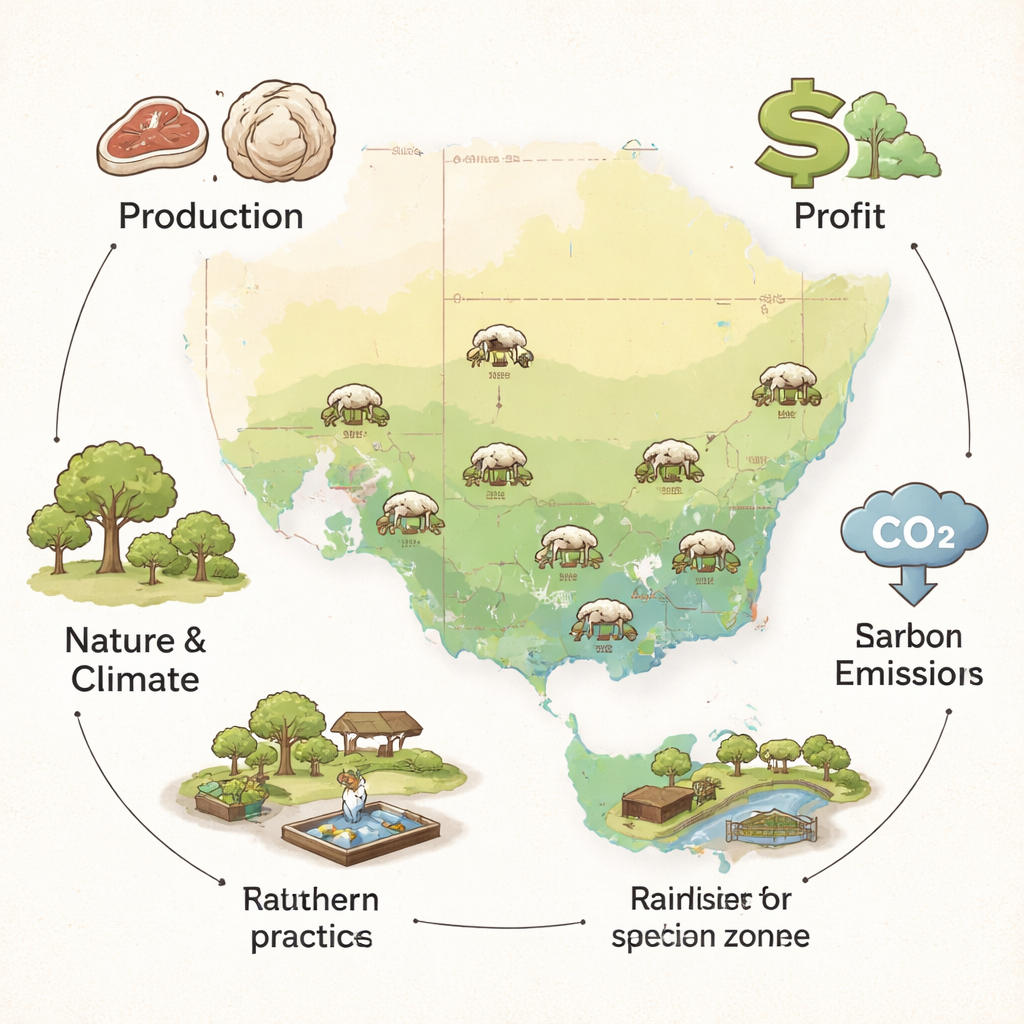
The researchers worked closely with seven real sheep farms spread across southern Australia, from dry Western Australia to wetter parts of Victoria and New South Wales. Rather than testing ideas in isolation, they rebuilt each farm inside computer models, checking the results with the farmers until the simulations behaved like the real businesses. This allowed them to track how grazing, feed, vegetation and weather combined to shape meat and wool output, farm profits, greenhouse gas emissions and habitat for native species. They then tested different future options against each farm’s own history, recognising that what works for one property may fail on another.
Different Tools in the Climate Toolbox
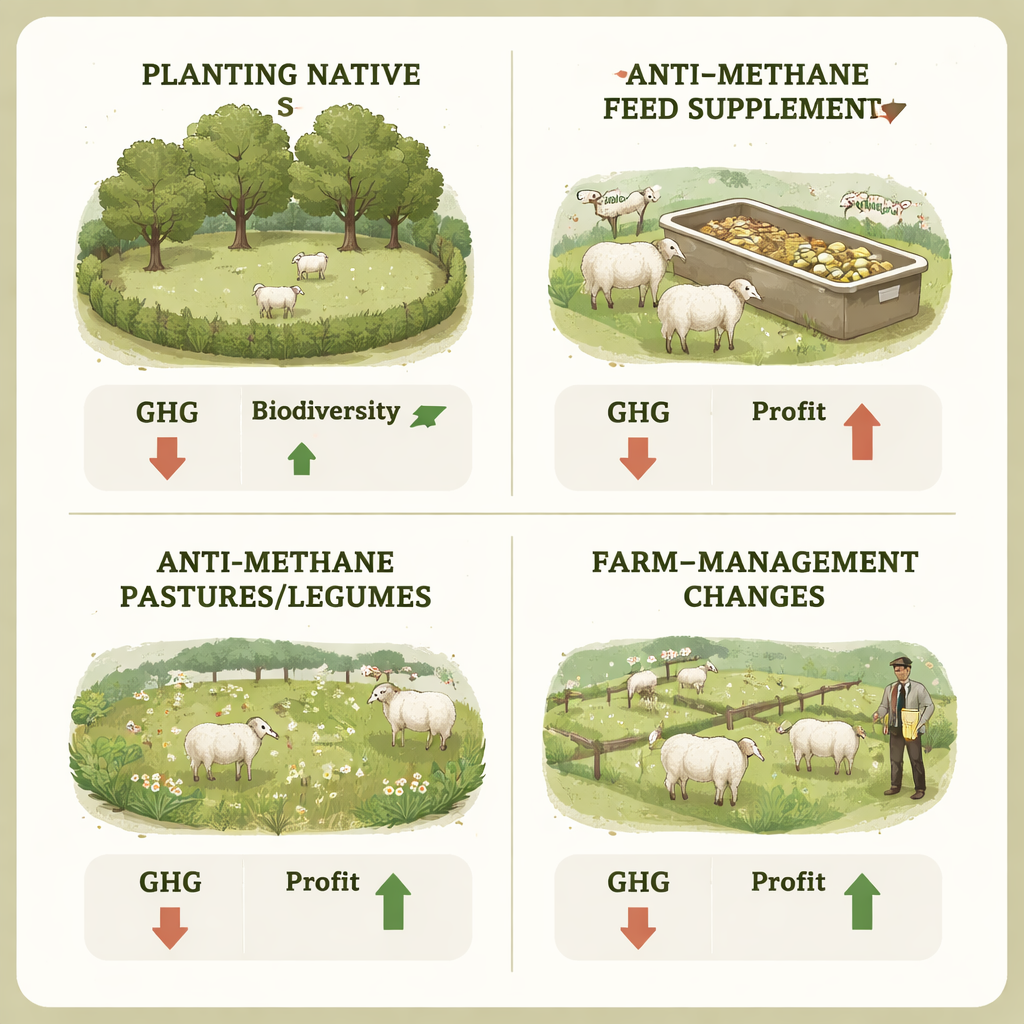
On these virtual farms, the team explored both broad "theme" interventions and farmer-designed changes. The common options included planting native trees on 10% of grazing land, feeding anti-methane additives, sowing special pasture species that naturally curb methane, and speeding up young animals’ growth so they leave the farm sooner. Farmers themselves suggested adjustments such as changing lambing dates, tweaking when older ewes are bought and sold, shifting to cell grazing, fencing off riverbanks and swapping fertiliser types. For every scenario, the models tracked not just total emissions, but also emissions per kilogram of protein, biodiversity indicators and annual gross margin—the farm’s operating profit.
Trees, Feeds and Pastures: Who Wins What?
Planting blocks or strips of native trees often gave the largest drop in net farm emissions, in some cases turning properties into net carbon sinks. Tree belts also improved habitat for threatened species and increased the amount and quality of native vegetation on farms. Yet trees were not a free win: they reduced grazing area, cost money to establish and maintain, and could cut profits under low carbon prices, especially on already productive land. Anti-methane feed additives, such as seaweed-based products or synthetic compounds, delivered strong and permanent cuts in methane whenever animals ate them, but were so expensive that they slashed farm profits by roughly half or more in most price settings. By contrast, renovating pastures with anti-methane legumes and herbs tended to offer modest emissions reductions while slightly increasing profit, because animals grew better on the improved feed without major new costs.
Fine-Tuning Management and Stacking Changes
Management tweaks often delivered quieter but more reliable gains. Adjusting when lambs are born, when ewes are purchased and sold, or how long animals spend in confinement yards could nudge both emissions and profits in better directions. In one case, reducing twin lambs and focusing on finer wool lowered emissions a little but lifted profit considerably thanks to higher wool prices. Fencing off riparian strips to keep stock out of creeks looked costly when considered alone, yet when combined with boosted feed supply and improved weaning rates, the same intervention raised production and profit while cutting emissions and improving biodiversity. Across all farms, no single practice consistently improved climate, profit, production and wildlife at once. The best outcomes came from choosing interventions that fixed each farm’s specific weak points and from stacking several complementary changes together.
What This Means for Farmers and the Climate
For non-specialists, the key message is that there is no one-size-fits-all climate fix for agriculture. Nature-based measures like tree planting and methane-cutting pastures can deliver real climate and biodiversity benefits, but their value depends heavily on where and how they are used, and on whether carbon and nature are paid for fairly. Expensive feed additives can cut methane sharply yet are unlikely to spread widely without strong financial support. The study shows that smarter, tailored carbon farming—built around each farm’s climate, soils, finances and goals, and combining several well-chosen actions—is far more likely to deliver a win–win: lower emissions, healthier landscapes and viable rural livelihoods.
Citation: Bhattarai, G., Christie-Whitehead, K.M., Drake, A. et al. Tailoring Australian carbon farming can realise greater co-benefits. Nat Commun 17, 1889 (2026). https://doi.org/10.1038/s41467-026-68628-5
Keywords: carbon farming, sheep production, greenhouse gas mitigation, biodiversity on farms, Australian agriculture