Clear Sky Science · en
Recreating viable YYh genotype uncovers the role of CpYYL underlying YY lethality in papaya
Why papaya sex matters to your breakfast
Papaya may seem like a simple tropical fruit, but behind every slice lies a genetic balancing act that shapes how reliably farmers can produce those sweet, orange-fleshed berries. This study uncovers a single crucial gene that makes certain papaya seed combinations die before they sprout. By pinpointing and repairing this gene, scientists not only explain a long‑standing mystery in plant sex chromosomes but also open a path toward more predictable, efficient papaya production.
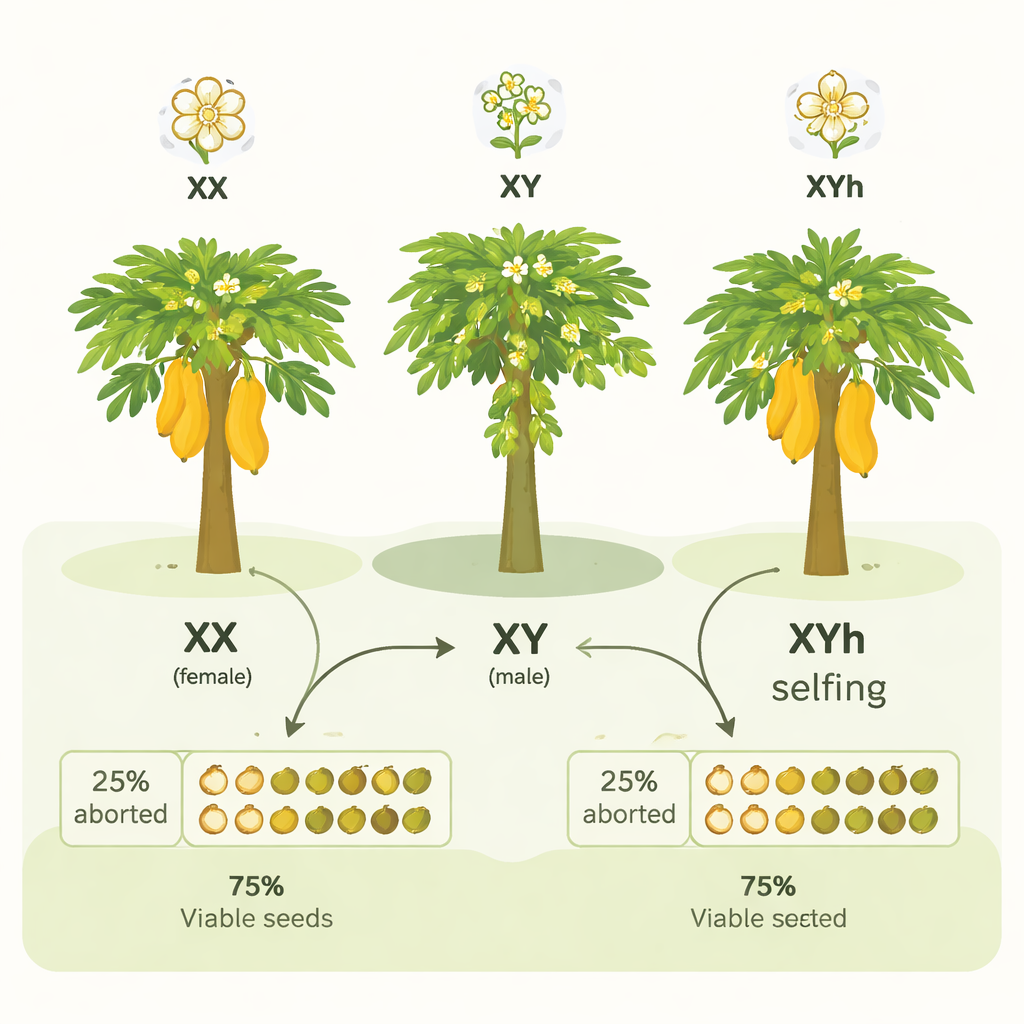
Three kinds of trees, one stubborn problem
Papaya plants come in three sex types: females (XX), males (XY), and hermaphrodites (XYh), which have both male and female parts and are favored in orchards for their compact trees and well‑shaped fruits. The catch is that when hermaphrodites fertilize themselves, a quarter of the resulting seeds carry two copies of the modified Yh chromosome (YhYh) and invariably abort. Farmers cannot see which seedlings will survive until plants flower months later, so they overplant and thin heavily—an age‑old practice that wastes seed, water, fertilizer, and labor. Geneticists suspected that a damaged but essential gene on the Y and Yh chromosomes causes this lethality, but they had never been able to identify it or directly test the idea.
Finding the hidden survival gene
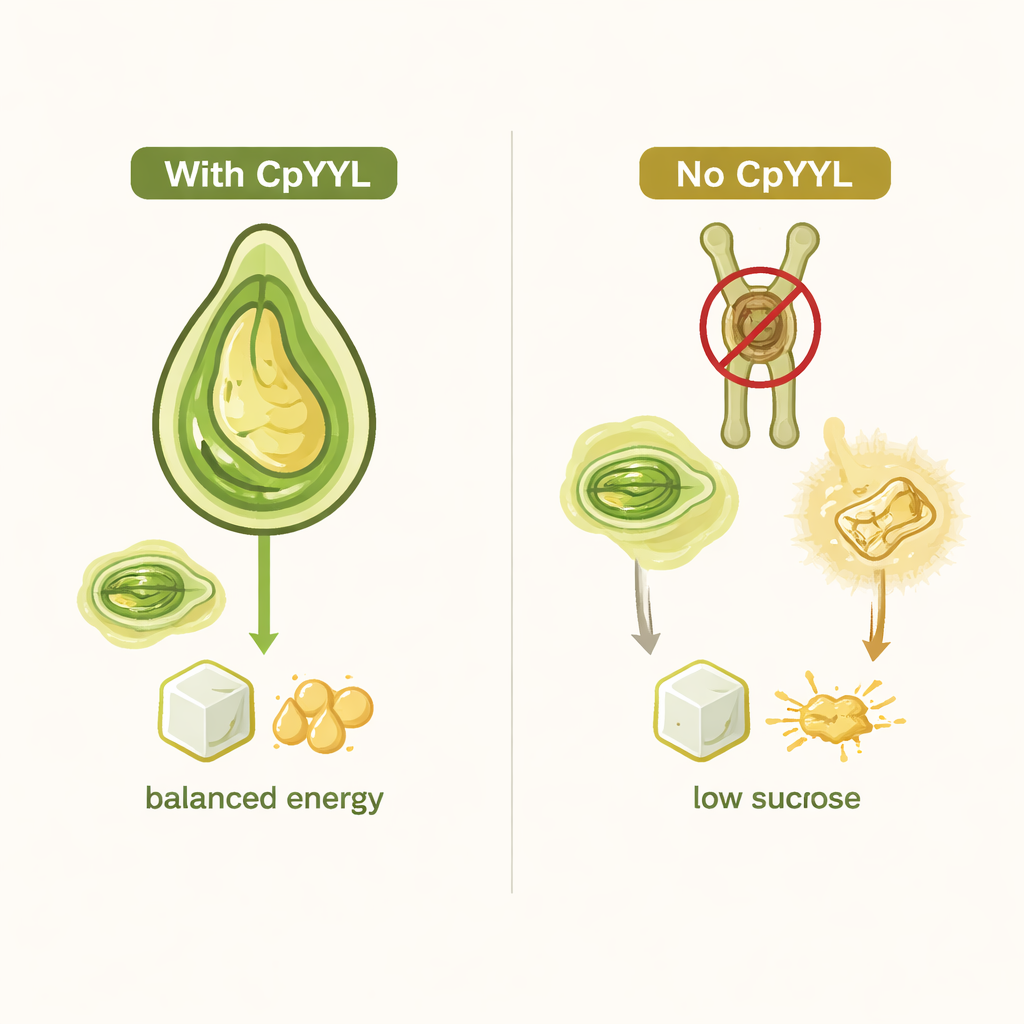
The researchers began by scanning genes present only on the X chromosome, reasoning that the lethal combination must lack a working copy of some essential function. They homed in on a gene they named CpYYL, related to a known embryo‑development gene in the model plant Arabidopsis. In healthy papaya, CpYYL is active in ovules and early embryos and its protein is sent into chloroplasts—tiny green compartments that manage energy and carbon building blocks. On the Yh chromosome, however, the first exon of CpYYL is missing, turning it into a non‑functional pseudogene. That means YY or YhYh embryos inherit only broken copies and cannot complete normal development.
Bringing "impossible" papayas to life
To prove CpYYL was truly the key, the team reintroduced a working copy driven by its natural promoter into female papaya plants, then crossed these with hermaphrodites. In the next generation, seeds that would normally abort instead developed black, fully formed embryos, showing that the added CpYYL could rescue the lethal combination. Using careful genetic markers and DNA sequencing, the scientists were able to recover rare YhYh hermaphrodite plants and YYh males, genotypes that do not exist in nature. These engineered seedlings still suffered high mortality after germination—especially YhYh plants—but many YYh individuals grew into normal‑looking, fully fertile male trees, with flowers, pollen, and growth comparable to ordinary XY males.
How disrupted energy use dooms embryos
Looking inside developing ovules, the team compared gene activity and sugar levels between normal and at‑risk seeds. When CpYYL was missing, embryos initially appeared normal but later showed degenerating tissues. At the molecular level, genes that drive glycolysis—the breakdown of sugars for quick energy—were switched on, while pathways tied to carbon storage and sucrose handling were dialed down. Hermaphrodite ovules lacking a good CpYYL copy had significantly less sucrose, suggesting that embryos were burning through their fuel too fast while their plastids failed to mature properly. In Arabidopsis, overexpressing papaya CpYYL and a partner protein, CpAKRP, could partially rescue similar embryo‑lethal mutants, reinforcing the idea that this protein pair safeguards plastid development and balanced energy use during the earliest stages of life.
What this means for evolution and farming
By pinpointing CpYYL, the study reveals how the papaya Y chromosome has degenerated to the point that individuals with two Y‑type chromosomes cannot survive. This genetic dead end locks papaya into a system where males and hermaphrodites must carry at least one X chromosome, stabilizing sex ratios in wild populations. For breeders, experimentally reviving YYh and YhYh plants provides powerful new tools to map other sex‑related genes and, ultimately, to design true‑breeding hermaphrodite lines that yield uniform, high‑value fruit with far less guesswork in the field. In everyday terms, understanding and fixing a single broken gene could help turn the papaya’s complicated love life into more reliable harvests on your table.
Citation: Yue, J., Liu, J., Zeng, Q. et al. Recreating viable YYh genotype uncovers the role of CpYYL underlying YY lethality in papaya. Nat Commun 17, 1999 (2026). https://doi.org/10.1038/s41467-026-68627-6
Keywords: papaya sex chromosomes, embryo development, plant genetics, chloroplast energy metabolism, dioecious crops