Clear Sky Science · en
Ablation provides key macronutrients (nitrogen and phosphorous) to glacier ice algae in NW Greenland
Why dark ice on Greenland matters
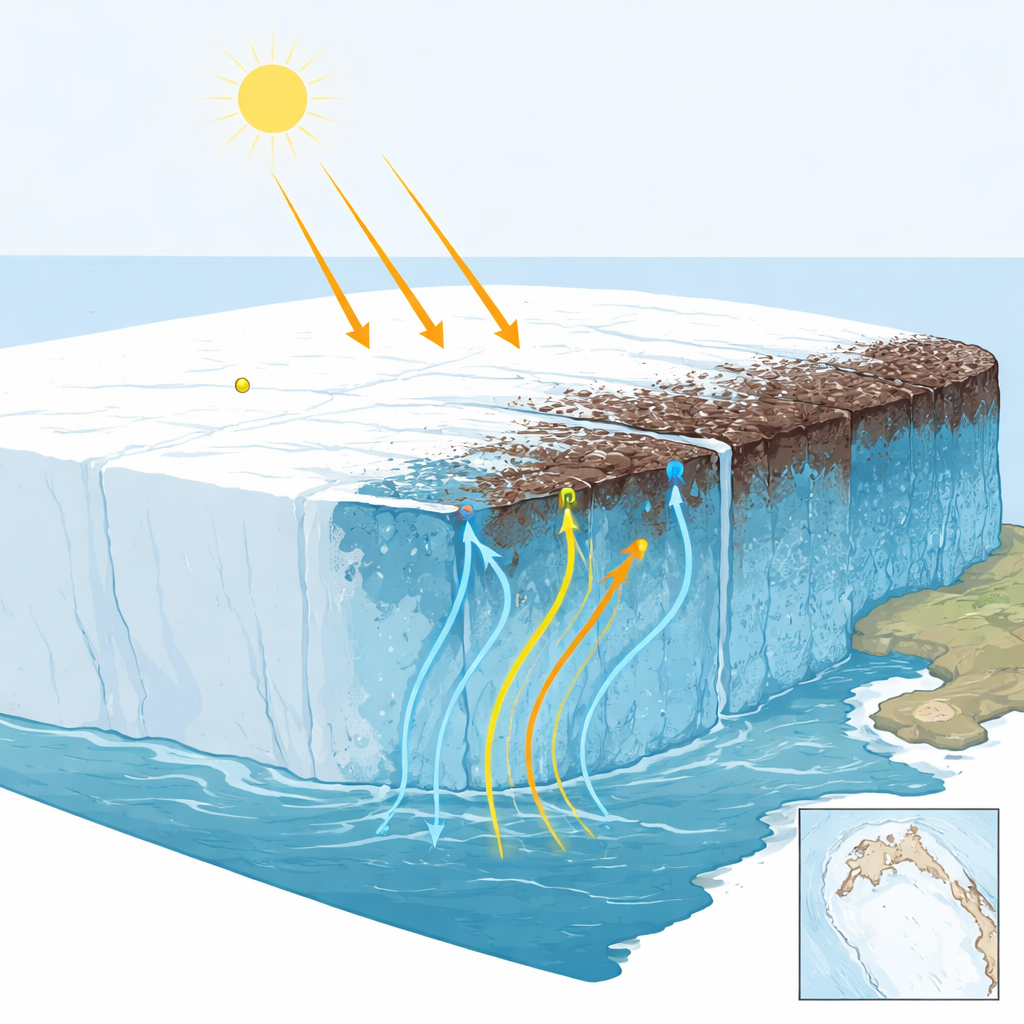
On summer days in Greenland, some parts of the ice sheet turn noticeably darker. This is not soot or industrial grime but thriving communities of tiny algae that stain the ice surface and make it absorb more sunlight. Darker ice melts faster, helping to raise sea levels. Scientists have long suspected that a shortage of key nutrients, especially phosphorus and nitrogen, might hold these algae in check. This study asks a deceptively simple question: does the melting ice itself already supply enough of these nutrients to fuel algal growth?
Hidden plant life on the ice
The algae living on Greenland’s bare ice are microscopic cousins of land plants, colored deep purple by protective pigments. Where they bloom in great numbers they can significantly lower the ice’s reflectivity, speeding up melting over large areas. But like crops in a field, their growth depends on basic ingredients such as carbon, nitrogen, and phosphorus. Carbon is easy to come by from the air, yet nitrogen and phosphorus were thought to be scarce on the ice surface, perhaps arriving only in tiny doses from windblown dust or snowfall. Earlier measurements often failed to detect these nutrients at all, leading to the idea that especially phosphorus was limiting algal growth.
Digging deeper into the ice
To test this idea, the researchers sampled ice at two locations in northwestern Greenland: the Qaanaaq Ice Cap and a nearby part of the main Greenland Ice Sheet. At each site they collected the loose, porous top layer known as the weathering crust, the thin zone just beneath it, and solid, unweathered ice from about a meter down. They then melted and filtered the samples and used a highly sensitive custom-built analyzer to measure nitrogen and phosphorus at billionths-of-a-mole levels, far below the detection limits of most standard methods. They also counted how many algal cells were present in the surface ice and examined mineral particles in the samples to see what kinds of rock fragments were mixed into the ice.
What the meltwater really contains
The results showed that both dissolved nitrogen and dissolved phosphorus are present throughout the ice column, not only at the surface. Concentrations are low, but real and measurable, and surface layers in particular hold enough phosphorus to support the abundant algae found there. Nitrogen at the surface appears partly depleted, consistent with active uptake by microbes, while deeper ice holds somewhat higher levels. The composition of mineral dust differed between sites and included feldspars that can contain traces of nitrogen and phosphorus, but the study found that the ice itself already stores these nutrients, even without invoking a major fertilizing role for special phosphorus-rich minerals. Organic forms of nitrogen and phosphorus were also present, though some of these may come from dead or damaged cells during sample handling.
How much melting is enough
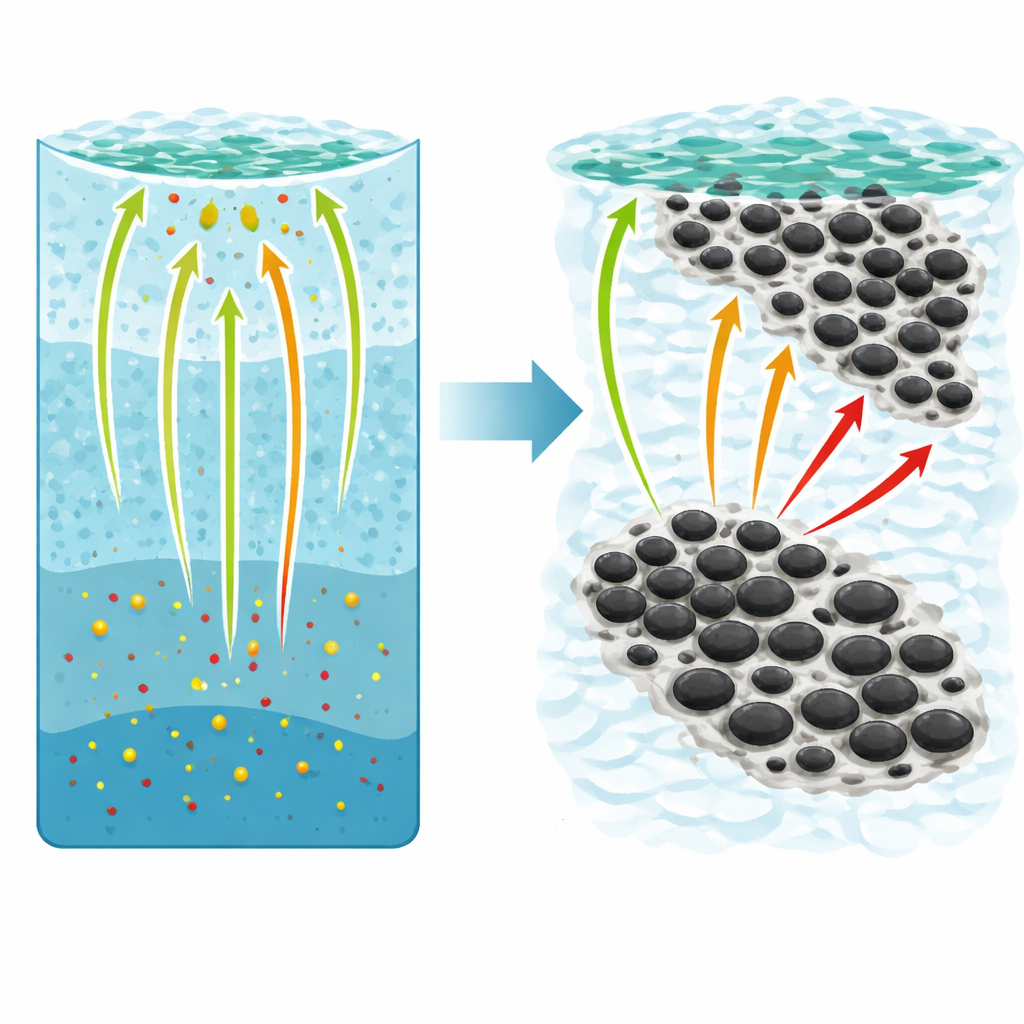
The team then asked whether seasonal melting of the ice—known as ablation—could, by itself, deliver enough nutrients from depth to feed the algae living at the top. Using typical cell numbers, the known carbon content of individual algal cells, and measured ratios of carbon to nitrogen and phosphorus, they estimated how much nitrogen and phosphorus are stored in the living algal biomass per milliliter of surface ice. Comparing these values with nutrient concentrations in deeper, unweathered ice, they calculated the thickness of ice that must melt each year to supply an equivalent amount of nitrogen and phosphorus. For both study sites, the required melt was lower than or comparable to the actual annual melt measured in recent years. When they included organic nutrient forms that could be recycled by other microbes, the apparent surplus of available nitrogen and phosphorus became even larger.
What this means for Greenland’s future
Put simply, the study concludes that the slow but steady lowering of the ice surface each summer naturally delivers more nitrogen and phosphorus than the glacier ice algae can store in their cells. On seasonal time scales, these basic nutrients are unlikely to be the main brake on algal growth at the sites studied. Instead, factors such as how long the ice stays bare, how much sunlight it receives, and short-lived local depletions of nutrients are more likely to govern when and where algae flourish. Because thriving algal communities darken the ice and accelerate melt, understanding that ablation itself is a major nutrient source helps scientists better predict how biological processes will interact with climate warming to shape the future of the Greenland Ice Sheet.
Citation: Gill-Olivas, B., Forjanes, P., Turpin-Jelfs, T.C. et al. Ablation provides key macronutrients (nitrogen and phosphorous) to glacier ice algae in NW Greenland. Nat Commun 17, 2129 (2026). https://doi.org/10.1038/s41467-026-68625-8
Keywords: Greenland ice algae, nutrient limitation, phosphorus and nitrogen, glacier melt, ice sheet darkening