Clear Sky Science · en
Multiomics insights into eating time patterns and cardiovascular risk among Chinese children
Why When Kids Eat Matters
Most parents worry about what their children eat, but this study from China asks a different question: when do they eat? Researchers followed thousands of schoolchildren to see whether the timing and length of their daily eating window—the hours between the first bite in the morning and the last bite at night—were linked to early signs of heart and blood vessel problems. Their findings suggest that simply finishing food earlier in the evening, without changing how much kids eat, may help protect their hearts.
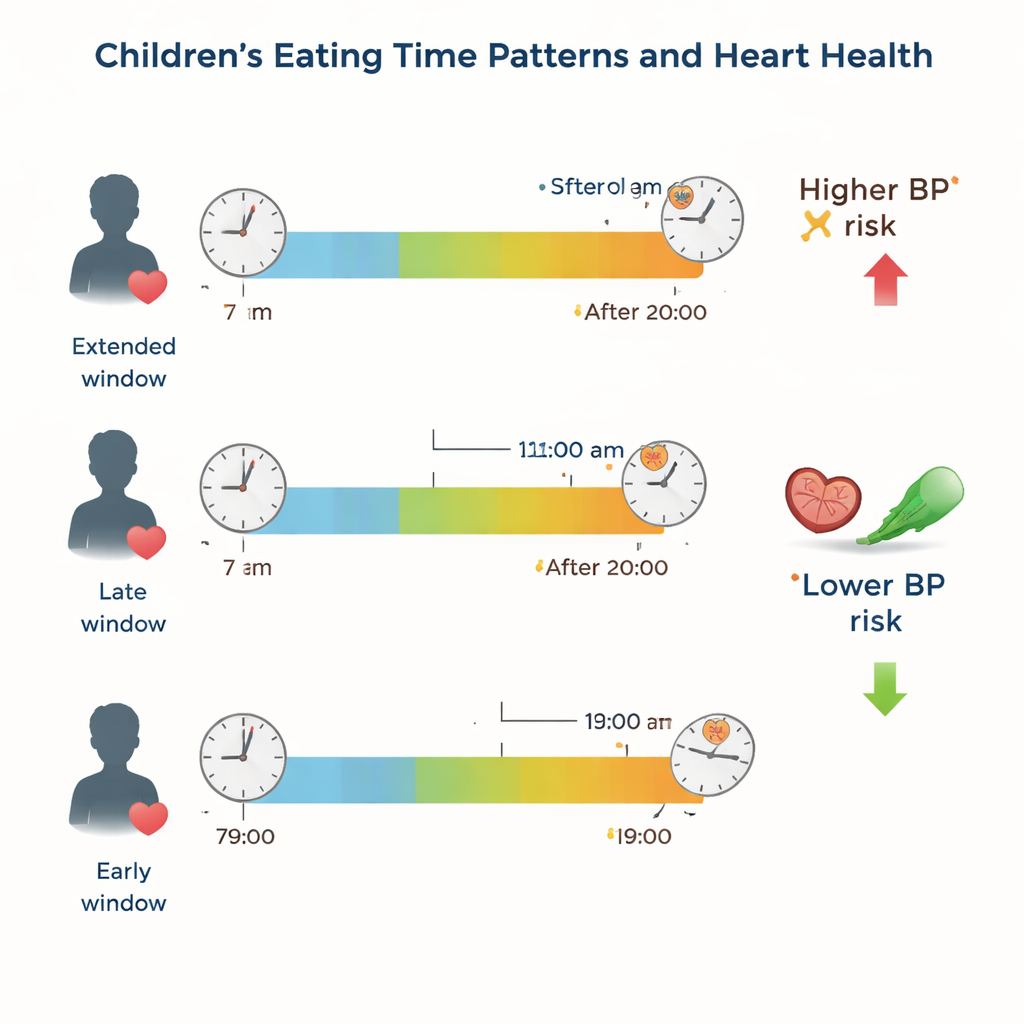
Three Daily Eating Patterns
The study included 7,459 children aged 6 to 17 from three provinces in southwest China. Using detailed questionnaires about first and last eating times, researchers sorted children into three groups. One group had an “extended eating window,” stretching over more than 12.5 hours a day, often from early morning to late evening. A second group ate within 12.5 hours but still had their last meal after 8:00 p.m., called the “late window.” The third group also ate within 12.5 hours but finished at or before 8:00 p.m.—the “early window.” All children also had careful measurements of blood pressure, heart structure, artery health, activity levels, diet quality, and family background.
Blood Pressure and Growing Arteries
Even after accounting for weight, exercise, calories, and family factors, the patterns were striking. Each extra hour that children spent eating during the day was linked to slightly higher systolic and diastolic blood pressure. Kids whose eating stretched beyond 12.5 hours had a 32% higher chance of having elevated blood pressure than those with shorter windows. Eating the last meal after 8:00 p.m. was linked to a 53% higher risk compared with eating earlier. Children in the early window group had the lowest risk overall—about 26% lower than those in the extended window group. Subtle thickening of the neck arteries and small changes in heart size, still within normal ranges, were also more common among children with longer and later eating windows, hinting at early changes that could matter over decades.
Peeking Inside Blood and Cells
To understand how meal timing might influence young hearts, the team carried out an in-depth “multiomics” analysis—a combined look at hundreds of blood fats (lipids) and nearly 2,000 blood proteins—in a smaller group of 51 children. They found 83 proteins whose levels differed among eating patterns, especially those involved in how heart muscle contracts and how the body handles fats and cholesterol. Children with early eating windows showed protein patterns consistent with healthier heart muscle and calmer cellular stress responses, while those with extended windows showed patterns associated with heart strain and metabolic stress.
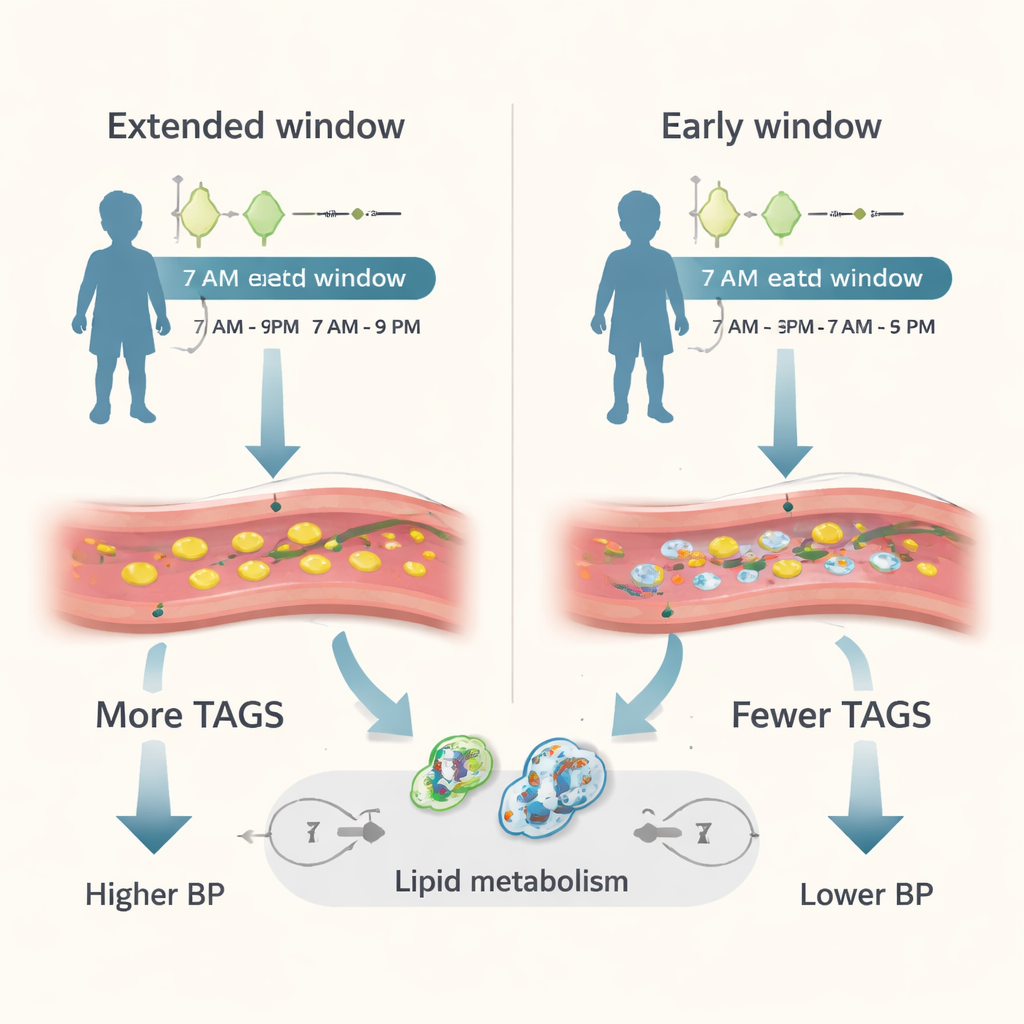
Fat Droplets That Talk to Blood Pressure
The blood fat profiles told an equally important story. Children with long eating windows had higher levels of certain triacylglycerols (TAGs)—a form of fat in the bloodstream—especially larger, more highly unsaturated versions that have been tied to stiff arteries and high blood pressure in adults. Using several machine-learning methods, the researchers identified a small set of TAGs and related lipids that clearly separated children with normal and elevated blood pressure. A statistical analysis suggested that changes in these TAGs explained nearly two-thirds (about 65%) of the link between eating pattern and blood pressure, meaning that late and long eating may push blood pressure upward largely by disturbing fat metabolism.
What This Means for Families
Although this study cannot prove cause and effect, it strongly suggests that when children eat—as much as what they eat—may shape their heart health from an early age. Long days of grazing and late-night snacks were tied to higher blood pressure and early signs of artery and heart changes, while a more compact day of eating that ends by about 8:00 p.m. was linked to healthier readings and more favorable blood fats and proteins. For families, this points to a simple, practical guideline: aim for a 12-hour-or-shorter eating day, with dinner finished earlier in the evening, as part of a heart-friendly lifestyle for growing children.
Citation: Liu, Q., Chen, J., An, X. et al. Multiomics insights into eating time patterns and cardiovascular risk among Chinese children. Nat Commun 17, 1891 (2026). https://doi.org/10.1038/s41467-026-68617-8
Keywords: meal timing, children, blood pressure, heart health, time-restricted eating