Clear Sky Science · en
Ice sublimation transfer of vertically aligned carbon nanotubes for residue-free and structure-preserving integration
Cooling Hot Gadgets with Tiny Forests
Modern electronics like smartphones and infrared cameras pack huge power into tiny spaces, creating hot spots that are hard to cool without damaging delicate parts. This research shows how “forests” of ultra-thin carbon nanotubes can be gently lifted from the fiery environment where they must be grown and cleanly attached to almost any device—using nothing more exotic than a carefully controlled layer of ice. The result is a new way to build cooler phones and more sensitive infrared sensors without harsh chemicals, sticky glues, or high temperatures.
Why Carbon Nanotube Forests Matter
Carbon nanotubes are hollow cylinders thousands of times thinner than a human hair. When they grow straight up from a surface in dense, vertical “forests,” they behave like a super-material: they carry heat extremely well along their length, conduct electricity, flex without breaking, and absorb almost all incoming light. These properties make vertically aligned carbon nanotube (VACNT) forests attractive for applications ranging from flexible electronics to thermal interface materials and infrared detectors. The catch is that these forests can only be grown at very high temperatures, often above 700 °C, which would ruin common device components, especially plastics and standard semiconductor circuitry.
The Challenge of Moving Delicate Nano-Forests
One way around the temperature problem is to grow VACNTs on a heat-tolerant “donor” wafer, then move them onto a cooler, more fragile “acceptor” device. But existing transfer methods come with serious trade-offs. Chemical etching can weaken or collapse the nano-forest as liquids dry and surface tension pulls the tiny strands together. Filling the forest with liquid polymers makes transfer easier but clogs the spaces between tubes and destroys the open, upright structure that gives VACNTs their special behavior. Other approaches use high-pressure or laser “welding,” which again bring heat and potential damage. Earlier attempts to use ice as a temporary glue left behind liquid water during melting and evaporation, which created the same destructive capillary forces the authors wanted to avoid.
Using Ice as a Gentle, Vanishing Glue
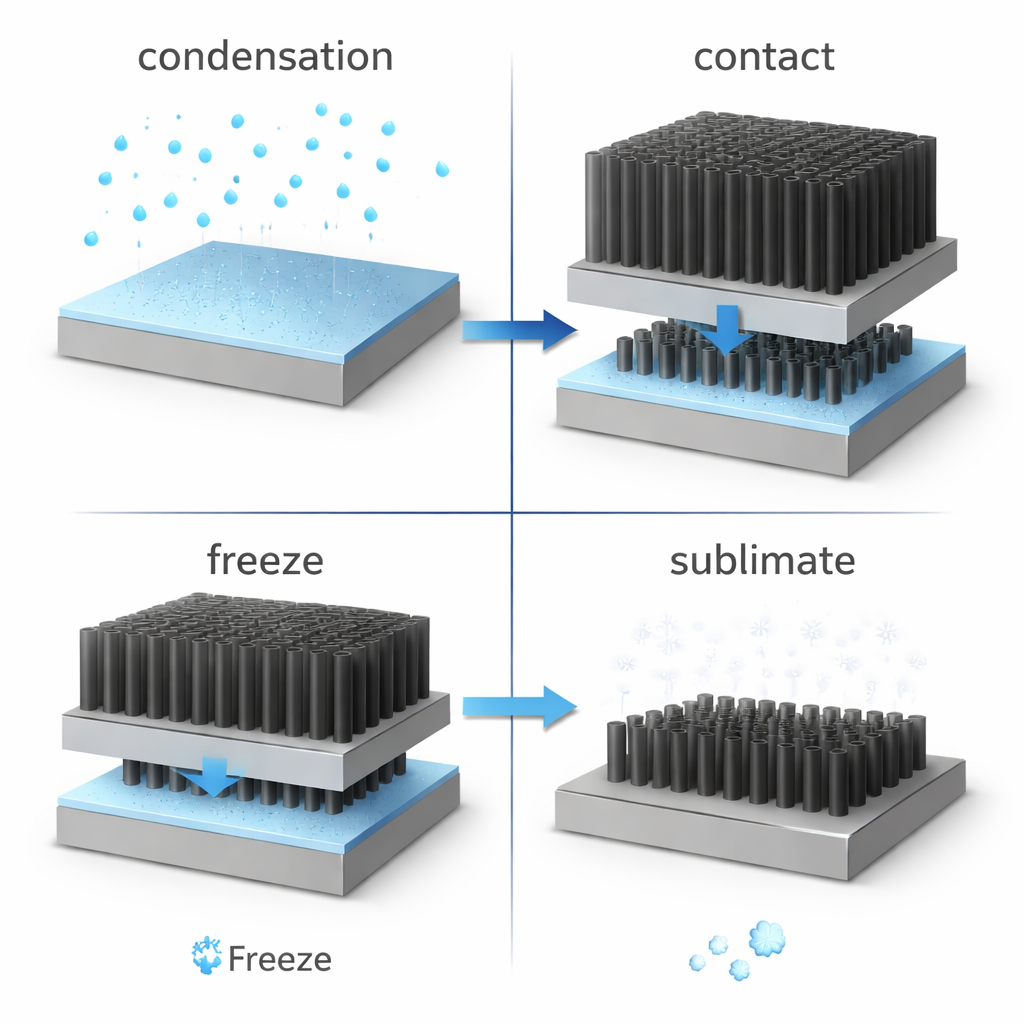
The team’s key advance is an ice-sublimation-based transfer process that lets the ice act as a strong but temporary adhesive without ever leaving a troublesome liquid film at the end. First, they cool the acceptor substrate to around −10 °C so that moisture from the surrounding air condenses and freezes into a thin, uniform ice sheet. The donor with its VACNT forest is pressed onto this icy surface so that the nanotube tips meet a brief, controlled layer of water, then the system is cooled again so the water refreezes around the tube ends. This ice mechanically locks and adheres to the nanotubes more strongly than they are anchored to their original growth layer. After lifting away the donor wafer, the remaining ice on the acceptor is removed in a vacuum at pressures below the triple point of water, so it skips the liquid phase and goes directly from solid to vapor. This avoids the capillary forces that would normally bend or bundle the tubes, preserving their tall, straight architecture with transfer yields above 95% even for patterns as small as 10 micrometers.
From Rigid Chips to Stretchable Films
Because the process works at or below room temperature and uses no harsh chemicals, it is compatible with a wide range of materials. The researchers successfully transferred VACNT patterns onto rigid wafers, metals, flexible plastic films, and even highly stretchable silicone. Microscopy showed that the forests stand upright and remain in intimate contact with their new surfaces. Measurements confirmed that the transferred forests keep most of their original properties: adhesion strong enough to survive bending and stretching, high electrical conductivity, effective heat flow along the tubes, and strong infrared light absorption. The authors also fine-tuned ice thickness, showing that a layer around a few tens of micrometers is thick enough to embed the tube tips and create strong adhesion, but not so thick that it accidentally bonds back to the original wafer.
Turning Nano-Forests into Practical Parts
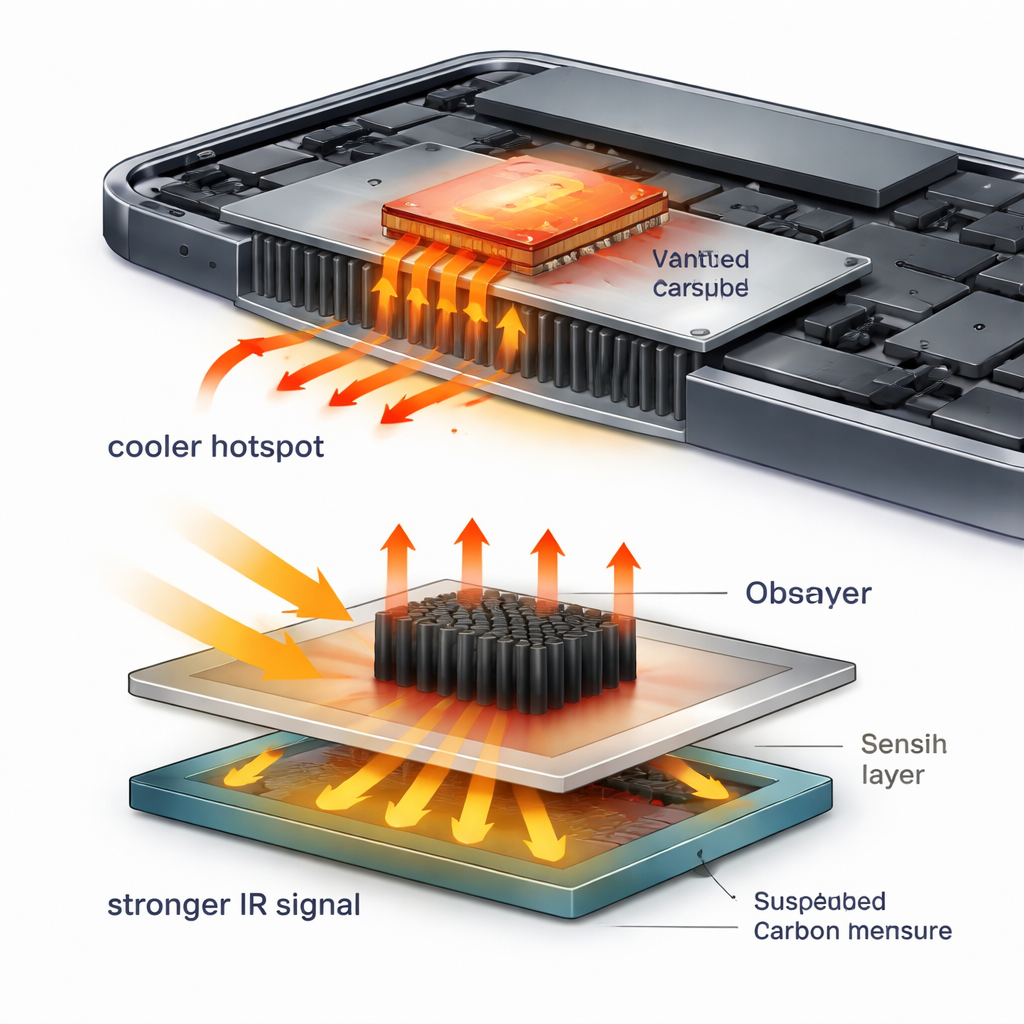
To show what this transfer method enables, the team built two proof-of-concept devices. In one, a VACNT forest became an ultra-thin thermal interface material sandwiched between a heat source and a metal heat sink. Compared with common thermal paste or pads, the nanotube layer carried heat more efficiently and reduced the temperature of a smartphone hot spot by about 4 °C during intensive use. In the second demonstration, they transferred VACNTs onto a delicate, suspended membrane inside a tiny infrared sensor. Here the forests acted as almost perfect black absorbers of long-wave infrared light, funneling absorbed energy into a sensing layer. The modified sensors showed up to 3.43 times stronger response than identical sensors without nanotubes, thanks to the combination of near-total light absorption and excellent heat conduction.
What This Means for Everyday Technology
By using a vanishing layer of ice as a clean, reversible glue, this work solves a long-standing problem: how to harvest the remarkable capabilities of carbon nanotube forests without exposing real-world devices to extreme heat or messy processing. The method keeps the nano-forests tall, open, and uncontaminated while placing them onto almost any surface, from stiff silicon chips to bendable plastics. That opens the door to cooler, more efficient electronics and sharper, more sensitive infrared cameras, and it suggests a general strategy for integrating other fragile nanostructures into future gadgets in a gentle, residue-free way.
Citation: Han, H., Hwang, K., Jo, E. et al. Ice sublimation transfer of vertically aligned carbon nanotubes for residue-free and structure-preserving integration. Nat Commun 17, 1912 (2026). https://doi.org/10.1038/s41467-026-68614-x
Keywords: carbon nanotubes, thermal interface materials, infrared sensors, nanomaterials transfer, ice sublimation