Clear Sky Science · en
Phonon-driven wavefunction localization enhances room-temperature single-photon purity in large hybrid lead halide perovskite quantum dots
Why this tiny light source matters
Imagine a light bulb that never emits more than one photon at a time—like a perfectly timed stream of single raindrops instead of a splash. Such single-photon sources are a cornerstone for future quantum computers, ultra-secure communications, and ultra-sensitive imaging. The challenge is to build versions that work reliably at room temperature, are easy to make, and can shine in different colors. This paper shows that by cleverly using the natural vibrations of atoms inside a special class of nanocrystals, researchers can create bright, stable, color‑tunable single-photon emitters without resorting to extreme cooling or shrinking the crystals to their very limits.
From tiny crystals to single particles of light
The study focuses on colloidal perovskite quantum dots—nanometer-sized crystals made from lead halide compounds. These tiny cubes can be synthesized from solution, much like making a pigment, and are already used in bright TV and display technologies. When excited with a laser, a quantum dot usually emits light in small packets called excitons. For quantum technologies, we want each excitation pulse to give at most one photon, not two or more. Conventional strategies improve this “single-photon purity” by making the dots very small, which tightly confines the excitons. But shrinking the dots introduces serious drawbacks: they become more sensitive to surface defects, blink and fade faster, and absorb light less efficiently. The authors therefore searched for a different way to confine excitons, one that does not depend solely on size.
Shaking atoms that trap light
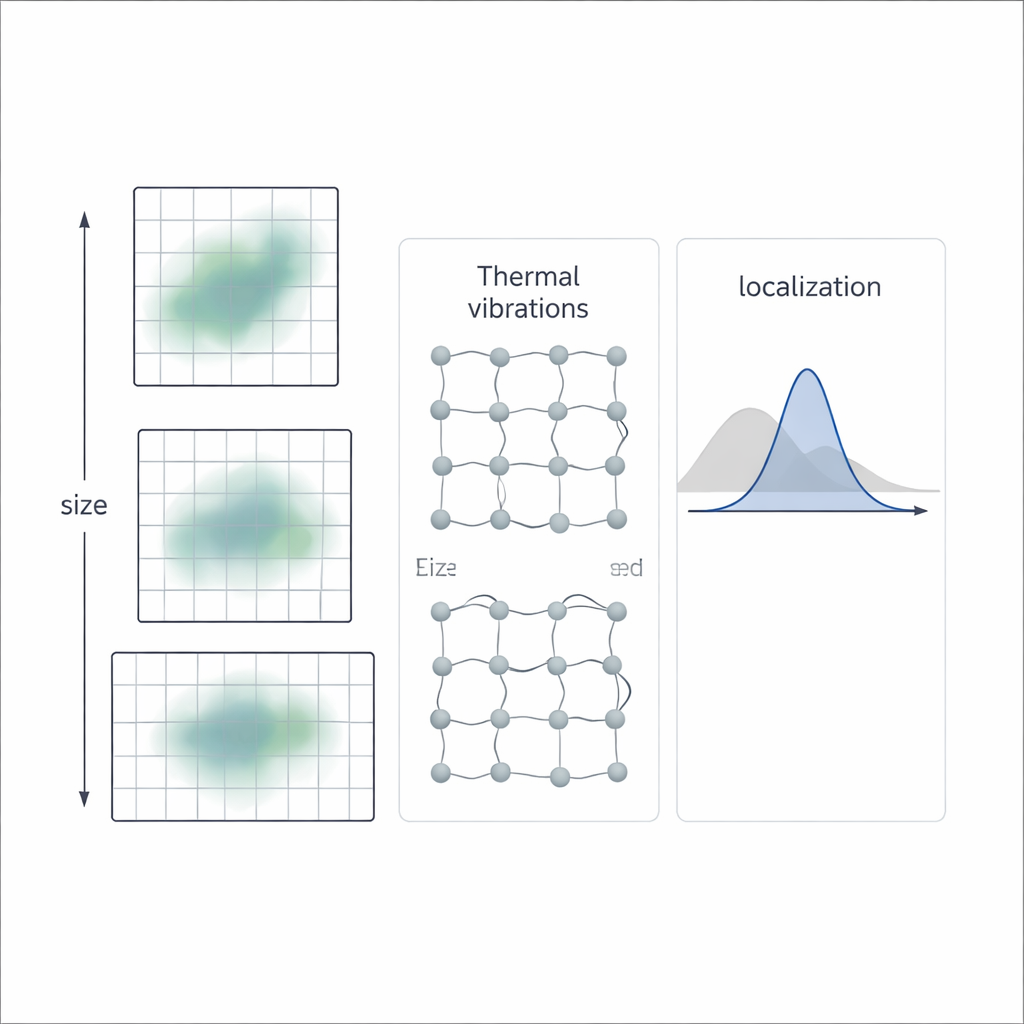
Inside any crystal at room temperature, atoms vibrate around their average positions. In the perovskite quantum dots studied here, these vibrations can be unusually large and irregular, especially when an organic molecule called formamidinium (FA) sits in the central “A-site” of the crystal lattice. Using advanced computer simulations and single-particle spectroscopy, the researchers show that these anharmonic vibrations create a constantly changing, disordered landscape for the electronic wavefunction. Instead of spreading across the whole dot, the exciton’s wavefunction becomes dynamically localized into a smaller region—effectively adding an extra, vibration-driven confinement on top of the geometric confinement set by the dot’s size. This localization is stronger in FA-based perovskite dots than in cesium-based ones, because the FA-containing lattice is softer and more prone to local symmetry-breaking and octahedral tilting.
Turning disorder into cleaner single photons
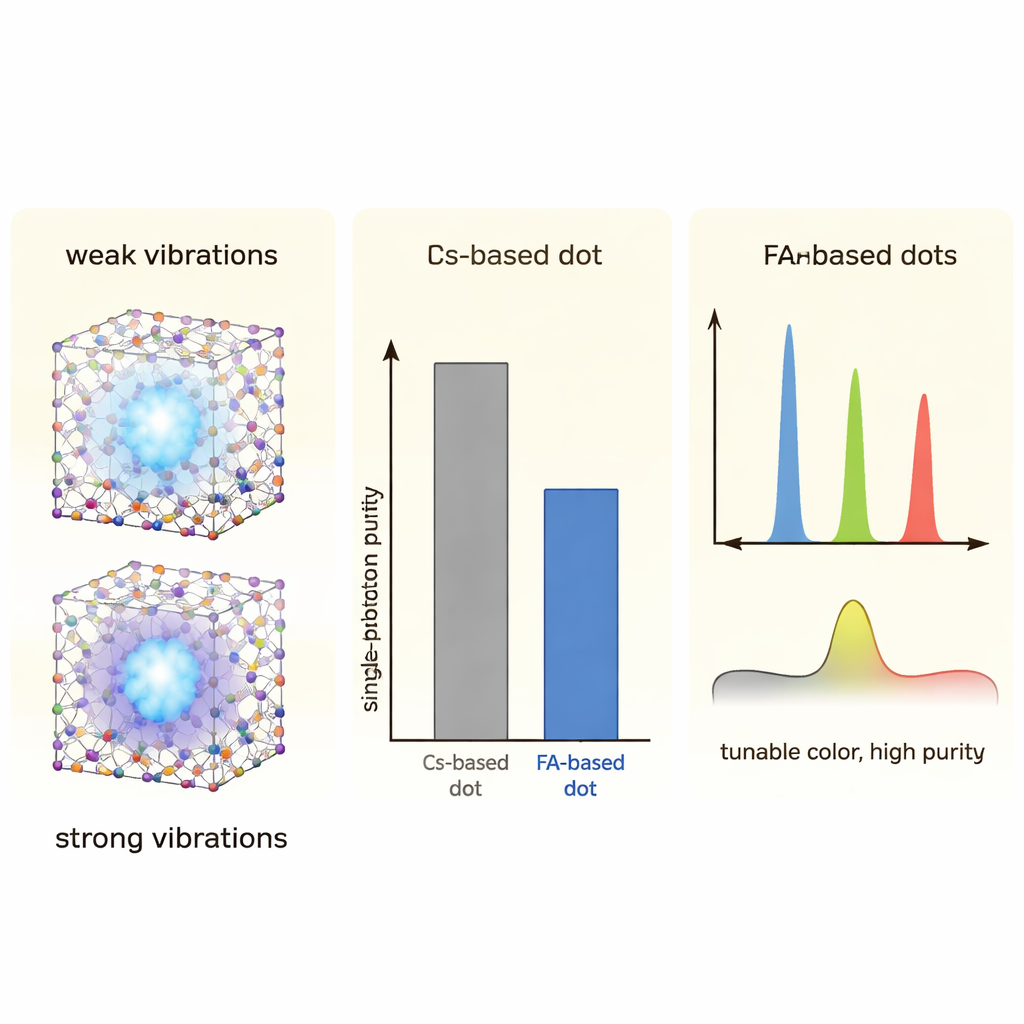
Why does this matter for single photons? When more than one exciton is created at the same time, they can recombine in ways that lead to unwanted two-photon bursts. The experiments reveal that in FA perovskite dots, the vibration-induced localization strengthens the interactions that rapidly drain away these multi-exciton states via non-radiative Auger-Meitner processes. As a result, the probability of emitting two photons from a single excitation pulse drops dramatically. Large FA-based dots, whose physical size would normally allow multi-photon emission, still show very strong “antibunching,” corresponding to single-photon purities above 95% at room temperature. This purification effect becomes more pronounced at higher temperatures, where atomic vibrations are stronger, turning what is usually seen as harmful lattice disorder into a useful design tool.
Bright, stable, and tunable quantum light
Because this confinement comes from atomic motion rather than extreme downsizing, the quantum dots can remain relatively large. That brings major practical benefits: larger dots are more photostable, blink less, and absorb light more efficiently, all of which are crucial for real devices. The team demonstrates individual FA-based perovskite dots that emit around a million photons per second, remain stable for over an hour under continuous illumination, and keep their high single-photon purity even near saturation of their brightness. By adjusting both the dot size and the halide composition (chloride, bromide, or iodide), they tune the emission color smoothly across the visible spectrum—from blue to green to deep red—while maintaining purities above 90%. This makes the same material platform suitable for applications ranging from underwater communication with blue photons to low-loss fiber transmission and bioimaging with red and near-infrared light.
A new handle for quantum light design
In everyday terms, the authors have found a way to use the natural “jiggle” of atoms inside soft perovskite crystals to trap light more tightly, clean up the output to nearly perfect single photons, and still keep the emitters bright, robust, and color‑flexible at room temperature. Instead of fighting lattice vibrations, they deliberately harness them as an invisible, reconfigurable cage for excitons. This idea—engineering quantum behavior by tuning how electrons couple to vibrations—could be applied well beyond this particular material, offering a fresh route to designing practical quantum light sources for future communication, computing, and sensing technologies.
Citation: Feld, L.G., Boehme, S.C., Sabisch, S. et al. Phonon-driven wavefunction localization enhances room-temperature single-photon purity in large hybrid lead halide perovskite quantum dots. Nat Commun 17, 1974 (2026). https://doi.org/10.1038/s41467-026-68607-w
Keywords: single-photon sources, perovskite quantum dots, wavefunction localization, electron-phonon coupling, room-temperature quantum optics