Clear Sky Science · en
Enhancing soil citrulline degrading function to mitigate soil-borne Fusarium wilt
Why soil chemistry matters for healthy crops
Farmers who grow the same crop year after year often see their fields slowly “tire out” as soil‑borne diseases build up. This study uncovers a surprising chemical accomplice in that process: a natural amino acid called citrulline that plants and microbes release around roots. The authors show how excess citrulline in the root zone can supercharge a devastating fungus that causes Fusarium wilt in cucumbers, watermelons, and related crops—and how boosting specific helpful microbes that eat citrulline can break this harmful cycle.
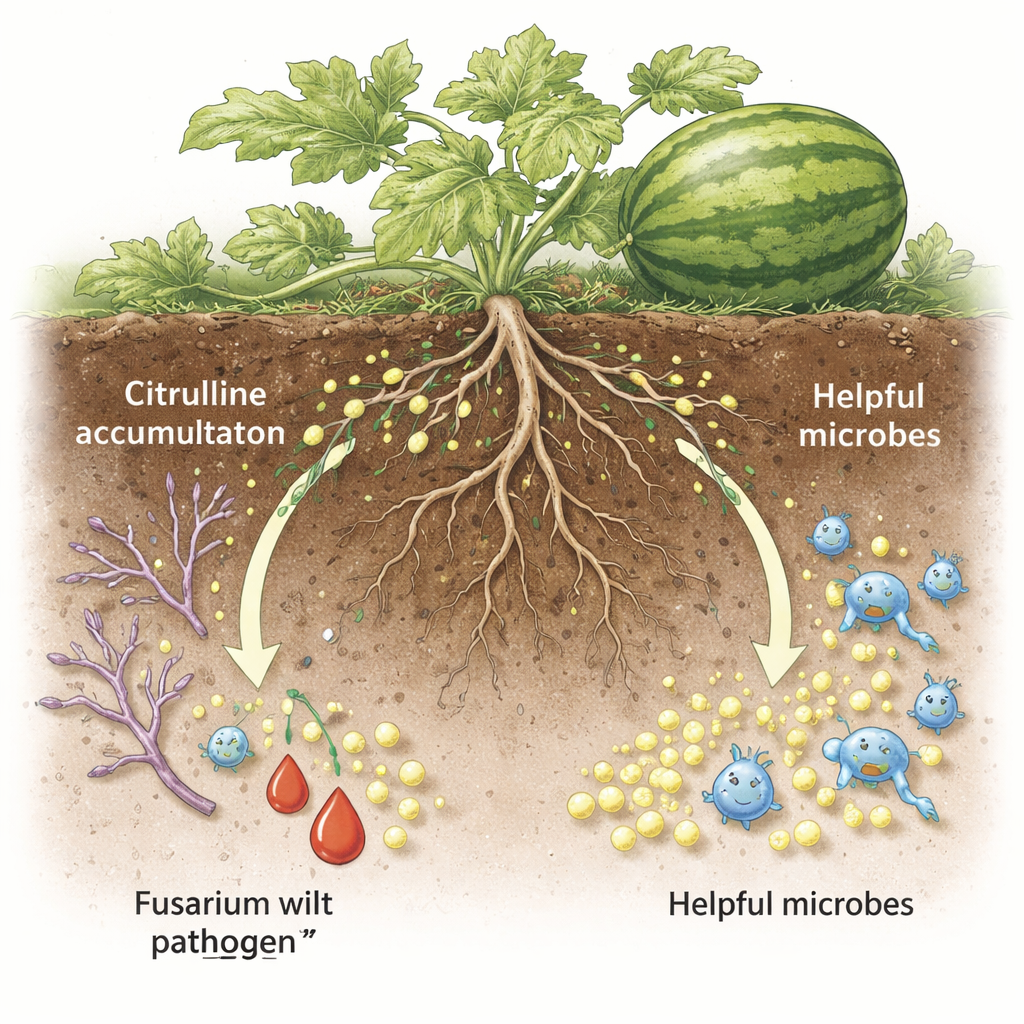
A hidden troublemaker in the root zone
The thin layer of soil that clings to roots, known as the rhizosphere, is rich in plant exudates and microbial by‑products. These compounds quietly shape which microbes thrive and how they behave. The researchers focused on citrulline, a nitrogen‑rich molecule that cucurbit plants naturally produce in large amounts. By sampling soils from many watermelon fields, they found that citrulline levels were consistently higher in soils where Fusarium wilt was already present or easily triggered, compared with healthy or disease‑suppressive soils. When they experimentally added citrulline to pots, wilt became more frequent and more severe, and disease risk climbed in step with citrulline concentration.
How citrulline feeds a plant‑killing fungus
To understand why citrulline was so tightly linked to disease, the team grew the watermelon wilt fungus, Fusarium oxysporum f. sp. niveum, with and without added citrulline. They discovered that even modest amounts of citrulline caused the fungus to make much more fusaric acid, a potent toxin known to damage plant tissues. Gene activity measurements showed that the fungus sharply switched on its fusaric acid production genes whenever citrulline was available and turned them back down once citrulline was used up. This confirmed that citrulline is not just present in diseased soils—it actively fuels toxin production and makes the pathogen more aggressive.
What keeps healthy soils in balance
Healthy fields, however, showed a different pattern. Using metagenomic sequencing—a way to read the collective DNA of all microbes in soil—the authors found that healthy rhizospheres were enriched in gene modules involved in breaking down citrulline and related amino acids. One key module, known as the ornithine–ammonia cycle, was significantly more abundant in healthy soils than in disease‑prone ones. Network analyses pointed to specific reactions and genes, especially a gene called arcB, as central hubs in these citrulline‑processing pathways. In other words, healthy soils tend to host microbial communities that can quickly “clear away” excess citrulline before the pathogen can exploit it.
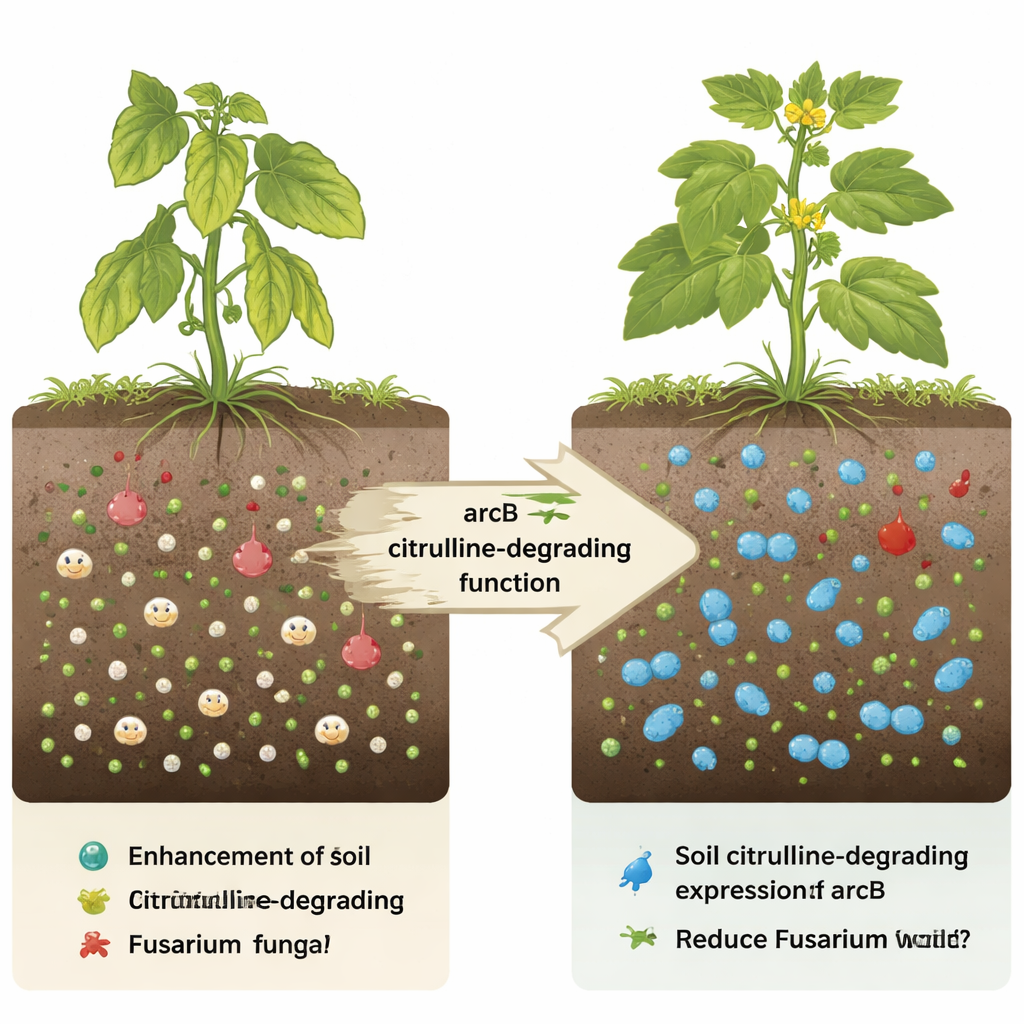
Recruiting helpful microbes to eat the excess
Guided by these genetic clues, the researchers isolated a soil bacterium, Pseudomonas putida YDTA3, that was exceptionally good at degrading citrulline using two key genes, arcB and argH. When they knocked out these genes, the mutants lost much of their ability to consume citrulline, confirming their importance. Adding the wild‑type strain to soil pots reduced Fusarium wilt at first, but its protective effect faded over several planting cycles as the bacterium failed to maintain stable populations around roots. To create a more durable solution, the team transferred the arcB gene into a consortium of native Escherichia bacteria that already persisted well in the rhizosphere. This engineered community, called EO‑arcB, rapidly stripped citrulline from soil in laboratory tests and, in long‑term pot experiments with watermelon, pumpkin, and cucumber, consistently kept disease levels far lower than either untreated soil or soil treated with the original Pseudomonas strain.
From mechanism to future field practice
The findings highlight a simple but powerful principle: in continuous cropping systems, it is not only the buildup of pathogens that matters, but also the accumulation of specific root‑derived chemicals that feed those pathogens. By enhancing the soil’s ability to degrade citrulline—whether through targeted microbial inoculants, stimulating native citrulline‑degrading microbes, or tailored bio‑fertilizers—farmers may be able to reduce Fusarium wilt without relying solely on pesticides or crop rotation. While the engineered EO‑arcB consortium used here is mainly a proof of concept and raises regulatory questions about genetically modified microbes, the broader lesson is clear: carefully managing the chemical dialogue between roots and microbes can turn soil from a disease amplifier into a natural line of defense.
Citation: Ding, Z., Wen, T., Teng, X. et al. Enhancing soil citrulline degrading function to mitigate soil-borne Fusarium wilt. Nat Commun 17, 1868 (2026). https://doi.org/10.1038/s41467-026-68606-x
Keywords: Fusarium wilt, soil microbiome, citrulline, biological control, continuous cropping