Clear Sky Science · en
The frequency response of networks as open systems
Why signals travel differently through networks
From ecosystems and brains to power grids and gene circuits, many systems in nature and technology can be seen as webs of interacting parts. These webs are constantly poked by the outside world: light hits our eyes, power plants ramp up and down, nutrients enter food webs. Yet the same nudge can be passed along, damped out, or reshaped depending on how the connections are wired. This paper asks a simple question with far‑reaching impact: given a network and a choice of where signals enter and leave, is the system built to let signals flow or to keep them in check?
Seeing networks as open to their surroundings
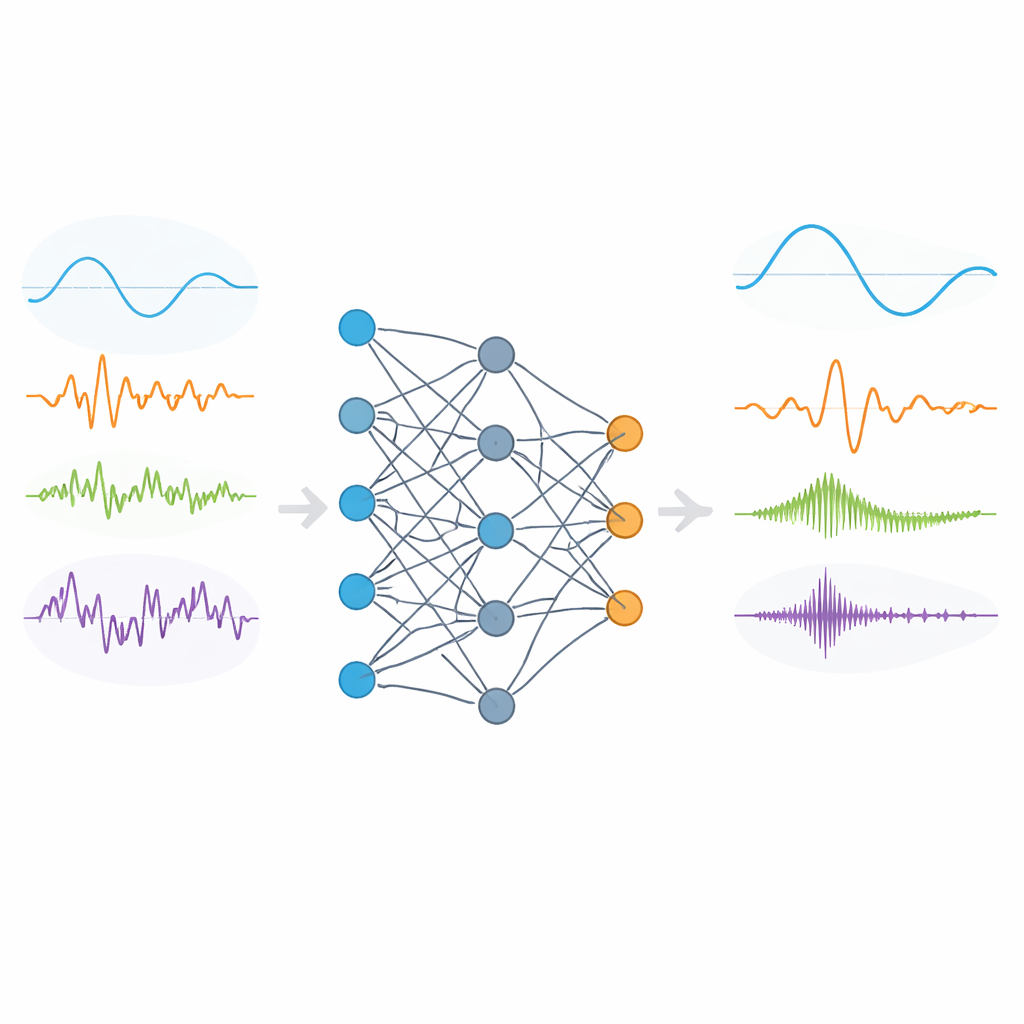
The authors treat each network as an open system with designated input nodes, where outside signals arrive, and output nodes, where responses are read out. In between lies a web of connections that can redirect, delay, or distort what comes in. Instead of focusing only on deliberate control actions, they look at all kinds of inputs the environment might provide: steady pushes, smooth rhythms, rapid wiggles, or random noise. By analyzing how different frequencies pass from input to output, they view each network as a kind of filter that can amplify, attenuate, or reshape signals depending on their tempo.
Measuring how strongly a network reacts
To compare very different systems on equal footing, the study uses a single yardstick called the H2 norm. In plain terms, this quantity summarizes how much the network tends to boost or suppress inputs overall, taking into account both time and frequency. Mathematically, it is tied to a construction known as the controllability Gramian, which encodes how easy it is for signals injected at the inputs to influence states throughout the network. Large values of this measure indicate strong amplification of disturbances or environmental cues; small values indicate that signals are quickly absorbed or muted.
Simple chains and path structure as a guiding example
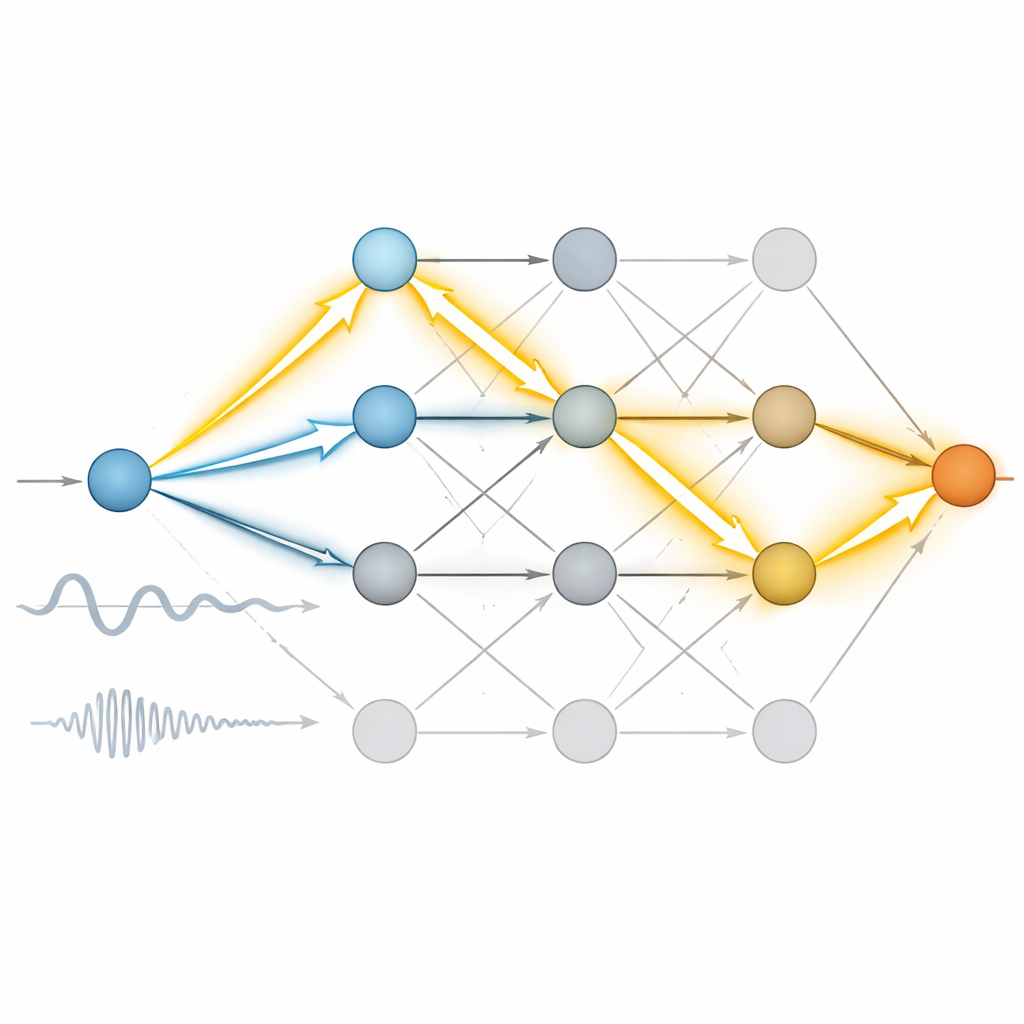
Before turning to messy real data, the authors analyze a simple model: a one‑way chain of nodes where a signal enters at one end and exits at the other. In this setting they can compute exactly how amplification depends on link strengths along the chain and on local damping at each node. When connections between nodes are stronger than the local tendency to resist change, signals are passed along and can even grow as they move downstream. When local damping dominates, the chain effectively blocks the signal. This clear pass‑versus‑block transition in a simple feed‑forward structure provides intuition for what happens in more complex directed networks with multiple paths.
Real networks: nature passes signals, engineers often block them
Armed with this framework, the authors examine a rich collection of empirical networks, including food webs, cell‑signaling pathways, gene regulatory circuits, brain connectomes, and electric power grids. For each one, they use realistic models of the underlying dynamics to derive a linear approximation around a stable operating state, then compute how the choice of real input nodes compares with many random alternatives. Biological networks such as food webs, signaling pathways, and gene networks typically show “passing” behavior: their actual input locations yield much stronger amplification than would be expected by chance. In contrast, many power grids are “blocking”: their layouts and generator placements tend to damp out disturbances, an intentional feature that helps keep voltages and frequencies stable.
Directionality and hierarchy shape signal flow
The study finds that a key structural ingredient behind strong passing behavior is directionality. Many biological networks are close to directed acyclic graphs, where influences flow mostly one way from sources to sinks with few feedback loops. Such networks are strongly “non‑normal,” meaning that their directed structure cannot be simplified to a symmetric pattern. The authors show that, in these cases, signal amplification can be traced back to the number, length, and strength of directed paths from input to output. Longer chains of strong forward links and weak local damping favor amplification, while symmetric or weakly directed structures, as seen in many power grids and brain networks, tend to limit it.
What this means for understanding and designing networks
Overall, the paper reveals that networks are not neutral channels: their wiring and the placement of inputs and outputs strongly bias whether environmental signals are passed on or suppressed. Natural systems that must sense and respond—like cells and ecosystems—often adopt highly directed, layered architectures that favor one‑way transmission toward “sink” nodes. Engineered systems that must stay stable—like power grids—lean toward more symmetric structures that block amplification. By linking these broad patterns to a common mathematical measure, the work offers both an explanatory lens for how living networks evolved and a practical guide for tuning future technological networks to be either more responsive or more robust.
Citation: Nazerian, A., Asllani, M., Tyloo, M. et al. The frequency response of networks as open systems. Nat Commun 17, 2088 (2026). https://doi.org/10.1038/s41467-026-68602-1
Keywords: signal propagation, complex networks, directed acyclic graphs, network robustness, frequency response