Clear Sky Science · en
Emergent universal long-range structure in random-organizing systems
Order Born from Randomness
At first glance, randomness and noise seem like enemies of order. We expect shaking a box of particles, stirring a fluid, or training a neural network with noisy updates to produce mess, not structure. This paper shows the opposite can happen: random "kicks" between many interacting elements can spontaneously organize them into unusually even, large-scale patterns. The authors uncover a simple rule behind this hidden order that links soft matter physics, statistical mechanics, and modern machine learning.
Different Worlds, Same Hidden Behavior
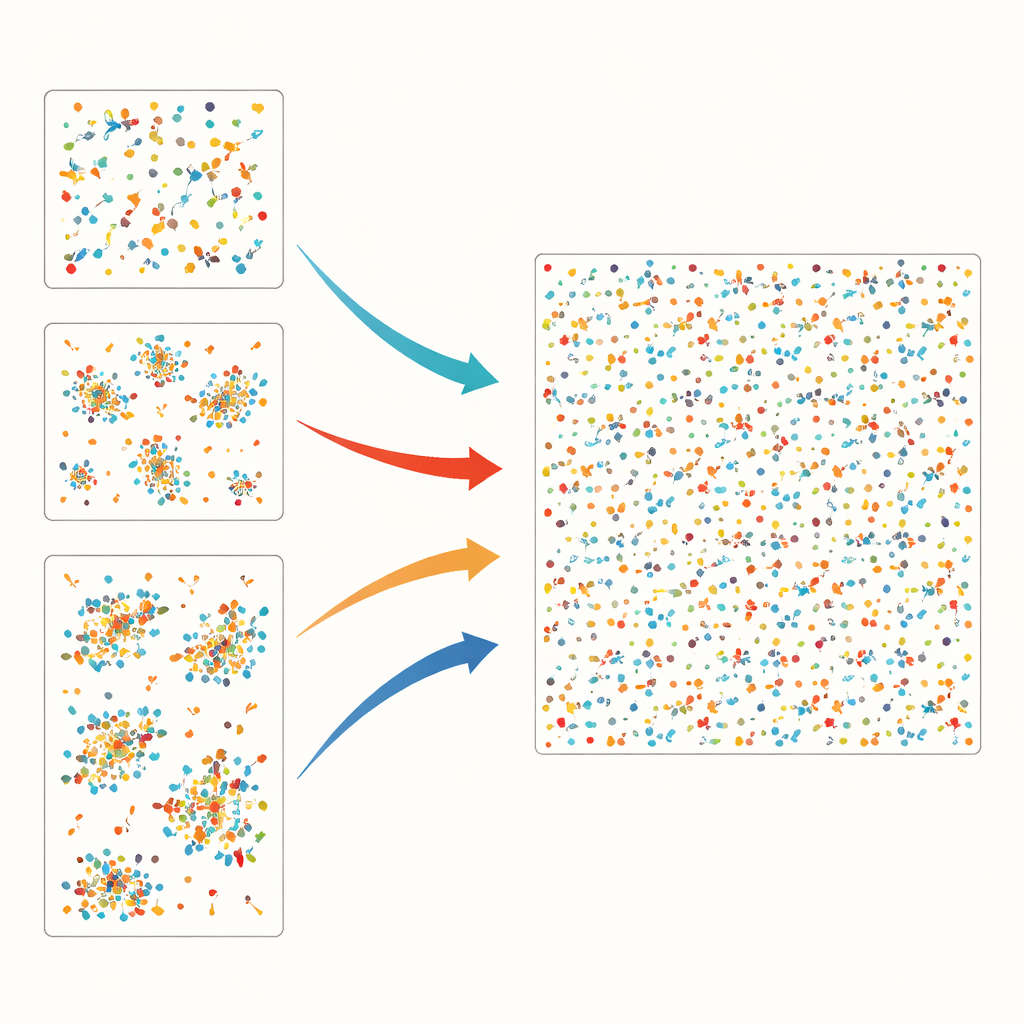
The researchers study three very different systems that all evolve step by step as particles interact locally. In random organization, particles that overlap get nudged in random directions, mimicking shaken colloids. In biased random organization, the nudges are aligned along the line joining each overlapping pair, a setting related to dense packings of spheres. In stochastic gradient descent, the workhorse of deep learning, the "particles" feel forces derived from an energy landscape, but only a randomly chosen subset is updated at each step. Despite these contrasts—different sources of randomness, different rules of motion, and different physical meanings—all three systems move from a quiet state to a forever-moving state as particle density increases, and it is in this active regime that surprising large-scale order appears.
A Universal Pattern in Density Fluctuations
To probe the emerging structure, the authors measure how particle density fluctuates across different length scales. If you draw windows of various sizes and count how many particles fall inside, a typical disordered system shows increasingly wild variations at larger scales. In the systems studied here, those long-range fluctuations are strongly suppressed: large regions contain almost the same number of particles as one another, even though the arrangement still looks disordered up close. This property, called hyperuniformity, usually requires fine tuning or long-range forces. Here, however, it arises far from any critical point and with only short-range interactions. The team shows that a single quantity—the correlation of the noise between each pair of interacting particles—governs how strongly long-range fluctuations are reduced. As the random kicks of each pair become more perfectly opposed, the range over which fluctuations are suppressed grows without bound.
A Bridge from Particles to Smooth Fields
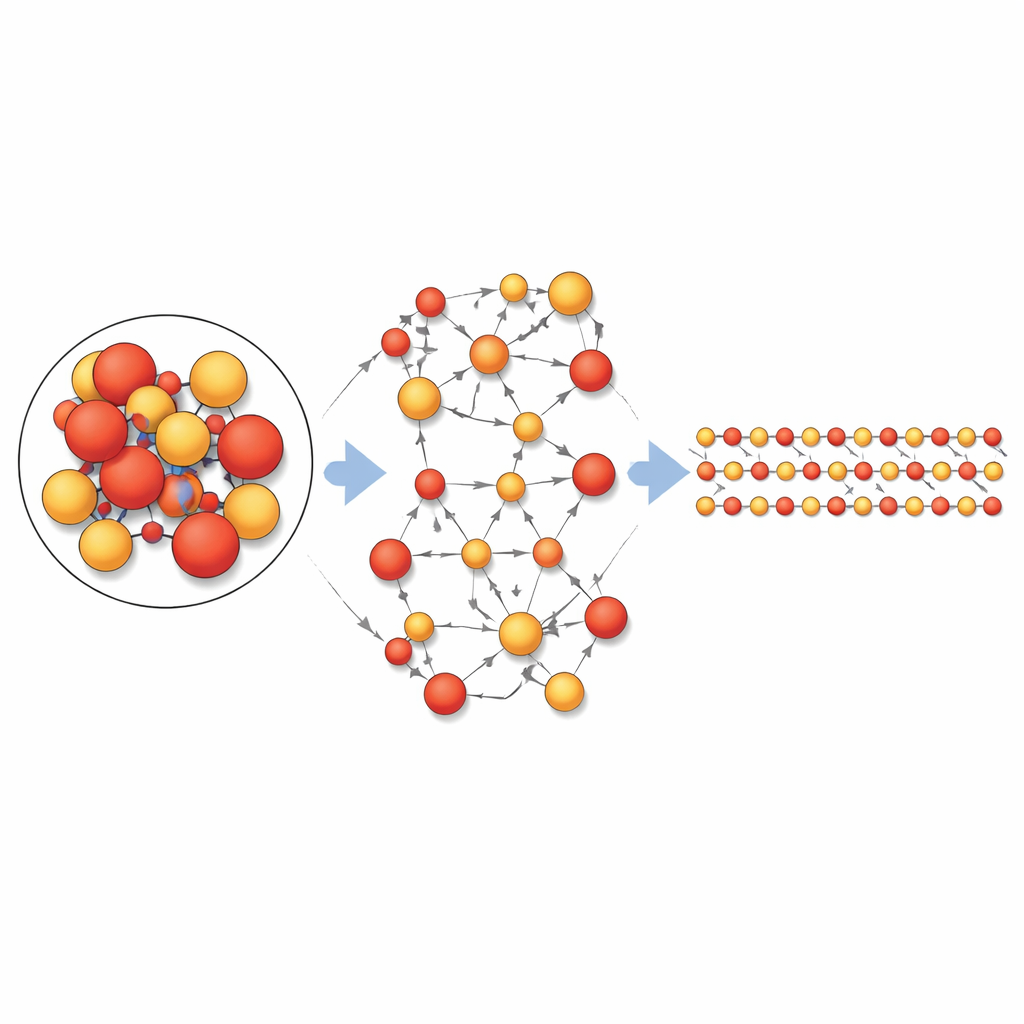
To explain these findings, the authors create a continuous description that averages over many particles. Starting from the microscopic update rules, they derive a fluctuating hydrodynamic equation for the smooth density field. This equation combines drift, diffusion, and a carefully constructed random flux that retains the essential pairwise noise correlations. Solving this continuum theory—both analytically and with numerical simulations—they obtain a compact expression for the structure of density fluctuations. Without introducing any adjustable parameters, this formula quantitatively matches the particle simulations for all three systems, different spatial dimensions, and a wide range of control parameters. Crucially, keeping the structure of the noise in the theory is what allows it to reproduce the observed large-scale order.
Noisy Learning and Flat Landscapes
The study also sheds light on a long-standing puzzle in machine learning: why noisy algorithms like stochastic gradient descent tend to settle in broad, "flat" valleys of the loss landscape, which are known to generalize better to new data. By viewing stochastic gradient descent as a random-organizing particle system on an energy landscape, the authors measure how easily the system’s energy increases under small perturbations around its steady states. They find that stronger noise correlations, smaller update batches, and larger learning rates push the dynamics toward flatter regions, just as in deep neural networks. Their continuum theory connects this flatness directly to the same noise-controlled suppression of density fluctuations, suggesting that the tendency of stochastic gradient descent to favor flat minima is a universal feature of high-dimensional landscapes, not a peculiarity of specific models.
Why This Matters and What Comes Next
For a lay reader, the main message is that noise need not be a nuisance: when structured in the right way, it can reliably create highly uniform arrangements in systems ranging from shaken particles to learning algorithms. The work pinpoints pairwise noise correlation as the key knob that tunes how smoothly matter, or information, is spread across space or configuration space. This insight offers practical routes to designing hyperuniform materials with desirable optical or mechanical properties using only short-range interactions and controlled driving. It also provides a unifying language to think about pattern formation in contexts as diverse as ecology, neuroscience, and artificial intelligence, and suggests new avenues where adding just the "right" kind of randomness could be a powerful design principle.
Citation: Anand, S., Zhang, G. & Martiniani, S. Emergent universal long-range structure in random-organizing systems. Nat Commun 17, 2346 (2026). https://doi.org/10.1038/s41467-026-68601-2
Keywords: self-organization, hyperuniformity, stochastic gradient descent, noise-driven dynamics, random-organizing systems