Clear Sky Science · en
Entanglement-inspired frequency-agile rangefinding
Measuring Distance with Gentle Light
From self-driving cars to satellite mapping, modern life depends on devices that measure distance by bouncing light off faraway objects. But bright sunlight and long distances add a lot of unwanted "glare" to these measurements, forcing sensors to use more power or accept fuzzy results. This paper presents a new way to measure distance that borrows ideas from quantum physics but works with an ordinary laser, achieving extremely precise, low-power range measurements even in bright daylight.
A Quantum Trick, Without the Fragile Quantum Gear
Quantum physicists have shown that pairs of linked photons can cut through noise and improve sensing. Unfortunately, producing and detecting such entangled photons is technically demanding and too dim for many real-world uses, especially over hundreds of meters. The researchers asked a simple question: can they keep most of the noise-fighting advantages of quantum entanglement, but with a bright, robust, classical laser? Their answer is yes. By carefully shaping the color and timing of laser pulses, they build strong correlations in ordinary light that mimic the useful parts of quantum behaviour, without the complexity and fragility of genuine entanglement.
Color-Coded Pulses That Remember When They Left
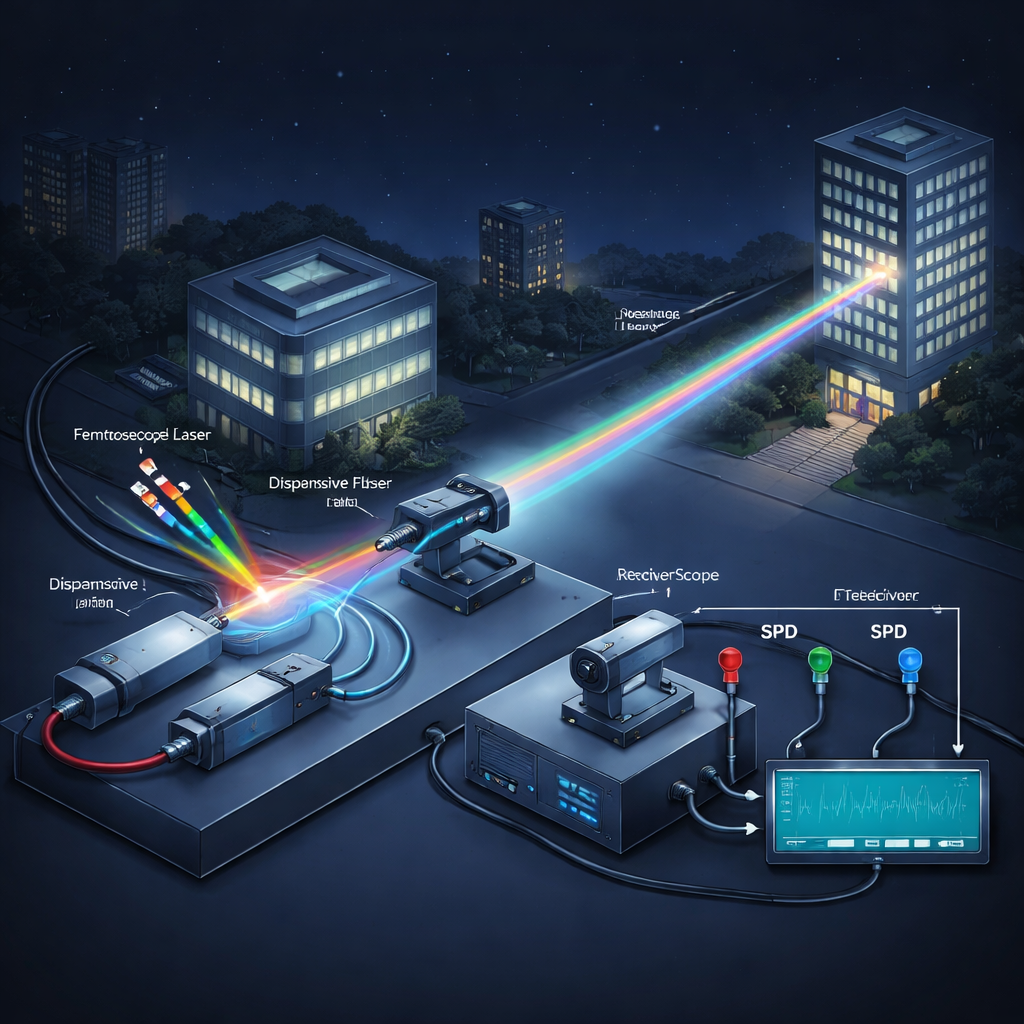
At the heart of the system is a femtosecond laser—one that emits extremely short flashes of infrared light. These flashes are stretched in a long optical fiber so that different colors within each pulse are spread out over a billionth of a second. An electronic modulator then carves out three distinct time slices, each tied to a different color channel. A pseudo-random pattern decides, every few microseconds, which color goes out when, creating a constantly changing, secret-like code in both time and frequency. Later, a grating-based optical device reshapes the pulses so that, to an outsider, the beam looks like an ordinary faint laser, hiding the encoded structure that will be used for measurement.
Pinpoint Distances Across a City Street
To test their design outside the lab, the team aimed the laser from one building at the rough stone wall of another, about 155 meters away, using just 48 microwatts of transmitted power—far less than many consumer devices. Light scattered back from the wall was collected by a telescope and split into the three color channels, each monitored by a single-photon detector. By comparing the known send pattern with the returning photon counts in each channel, they built up a sharp timing peak that reveals the round-trip travel time of the light, and thus the distance. With only 100 milliseconds of data, they measured the building distance as 154.8182 meters with a precision of better than a tenth of a millimeter—thinner than a sheet of paper—despite large losses and very few detected photons.
Beating Sunlight by Spreading into Many Channels
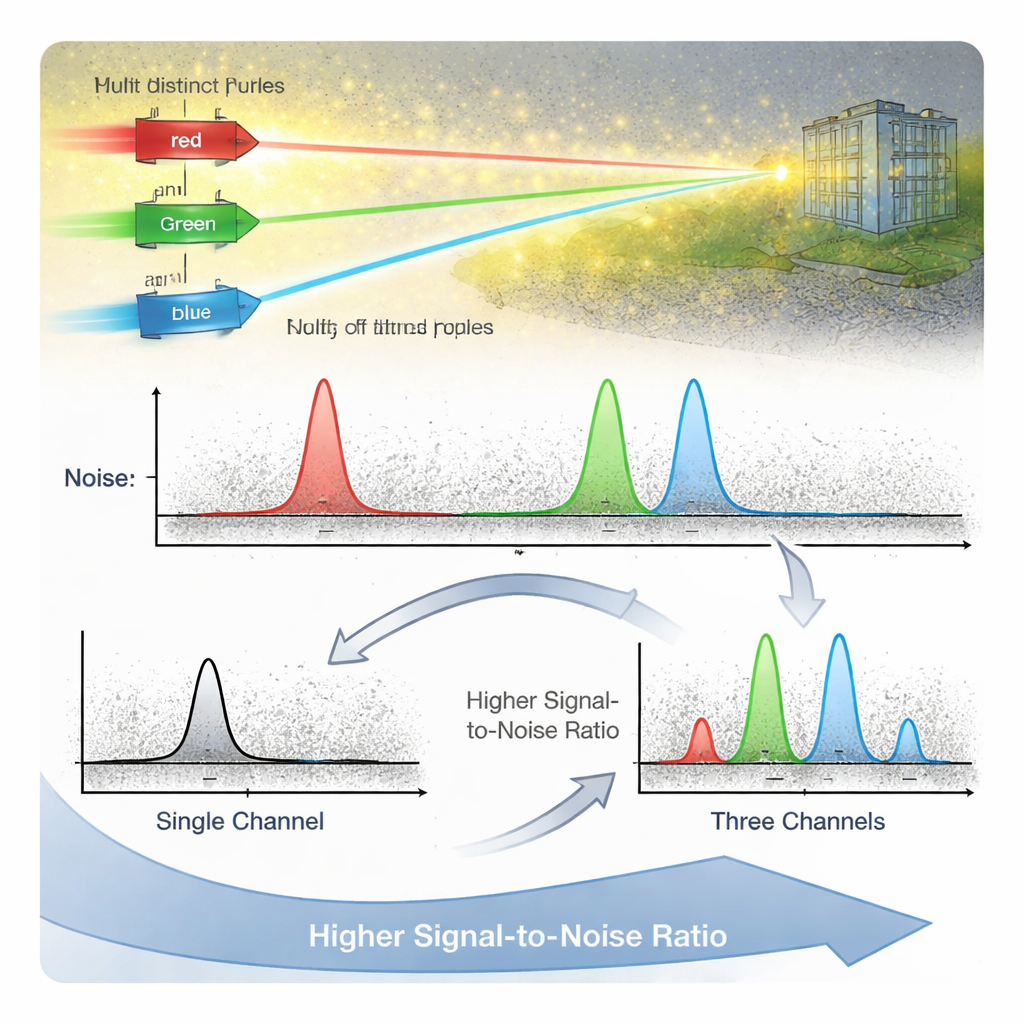
A major benefit of this approach is how it suppresses unwanted background light. Random sunlight does not follow the special color-and-time code of the outgoing pulses. When the researchers analyze the data, they only keep counts that line up with the correct channel at the correct time, effectively discarding most noise. Their theory predicts that spreading the signal over more color channels reduces both detector dark counts and background noise, improving the signal-to-noise ratio. Field tests under night, rain, clouds and direct sun confirmed this: moving from one to three channels made range peaks clearly visible in bright daylight where a single-channel system struggled, and models suggest that tens of channels could push performance even further and beyond a kilometer.
Quiet, Precise, and Hard to Detect
Because the transmitted power is extremely low and the special timing pattern is hidden, the outgoing beam blends into natural background light, making it difficult for others to spot or jam. Yet the intended receiver, holding the secret pattern, can still extract precise distance information from a handful of photons. In everyday terms, the work shows that we can measure long distances with the delicacy of a whisper instead of a shout, by using clever coding in color and time rather than brute-force brightness. This quantum-inspired technique opens the door to more practical, low-power, and even covert rangefinding and imaging systems in the real world.
Citation: Nie, W., Zhang, P., McMillan, A. et al. Entanglement-inspired frequency-agile rangefinding. Nat Commun 17, 2001 (2026). https://doi.org/10.1038/s41467-026-68589-9
Keywords: LiDAR, quantum-inspired sensing, remote rangefinding, noise-resistant imaging, single-photon detection