Clear Sky Science · en
Air quality improvement masks global cooling from CO2 reductions under China’s carbon neutrality policies for half a century
Why Cleaner Air Can Still Mean a Warmer World
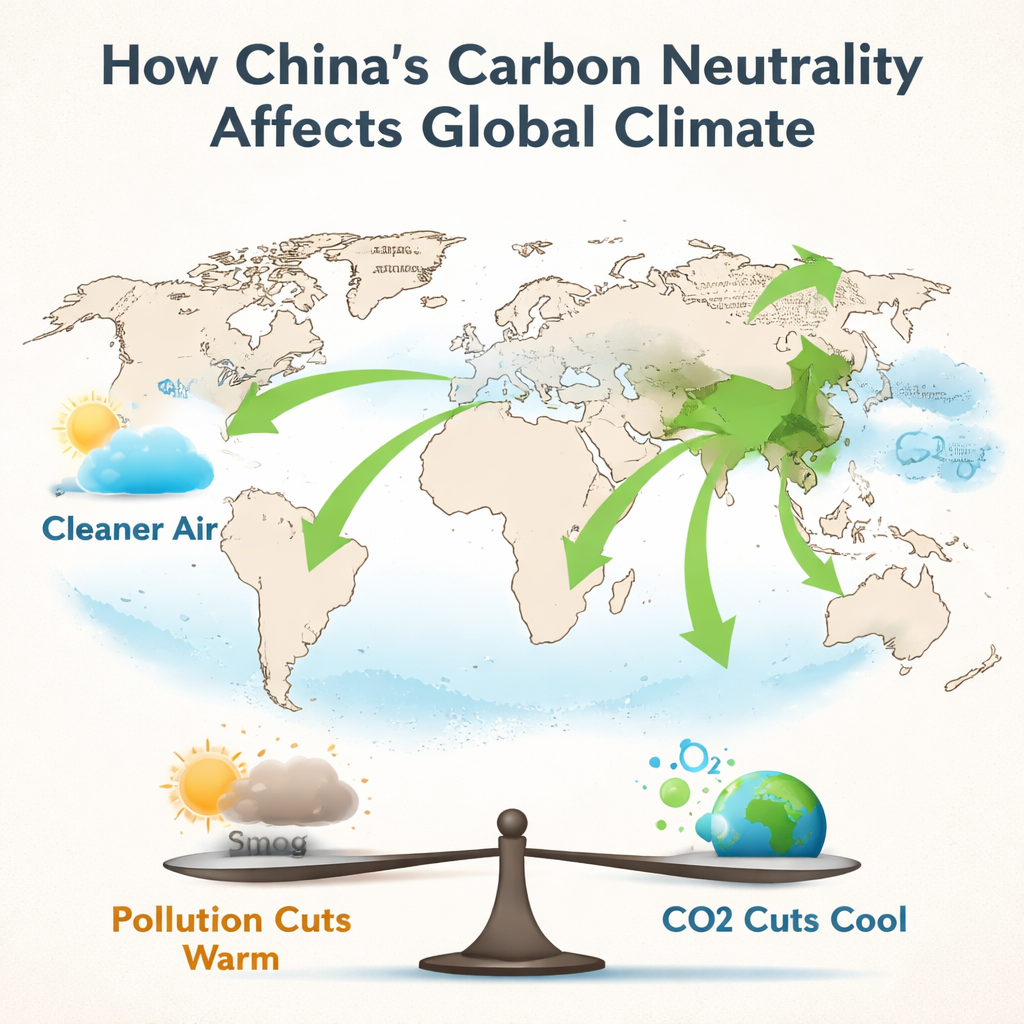
Cutting greenhouse gases and cleaning up dirty air are often seen as a straightforward win–win for the planet. This study shows a more complicated picture: as China pursues ambitious plans to reach carbon neutrality and dramatically improve air quality, the world may experience less cooling from those efforts than many people expect for several decades. Understanding this tradeoff helps explain why global temperatures may keep rising even as skies over major cities turn visibly clearer.
China’s Twin Pledges: Clear Skies and Net-Zero Carbon
China, like many rapidly developing countries, faces a double challenge: it is both a leading emitter of carbon dioxide (CO2) and home to severe air pollution that harms millions of people. The government has pledged to reach carbon neutrality by 2060 and to build a “Beautiful China” with much cleaner air by around 2050. Meeting these goals requires deep cuts in CO2 from power plants, industry, and transport, along with steep reductions in pollutants such as sulfur dioxide and tiny airborne particles known as fine particulate matter, or PM2.5. These pollution cuts are crucial for public health, but they also change how much sunlight and heat the atmosphere absorbs and reflects.
How the Researchers Probed Future Climate Impacts
The authors used a state-of-the-art Earth system model, which simulates the atmosphere, oceans, ice, and living systems together, to test how China’s policies could affect climate worldwide throughout this century. They compared three futures. In a “business-as-usual” pathway, only policies in place by 2020 continue, with emissions peaking and then declining slowly. In a “carbon neutrality and clean air” pathway, China reaches net-zero CO2 by 2060 and enforces strong air quality rules. A third, “sensitivity” pathway keeps CO2 at the cleaner level but air pollutants at business-as-usual levels, allowing the team to tease apart the separate effects of CO2 cuts and pollution controls.
A Surprise Balance: Warming from Cleaner Air vs. Cooling from Less CO2
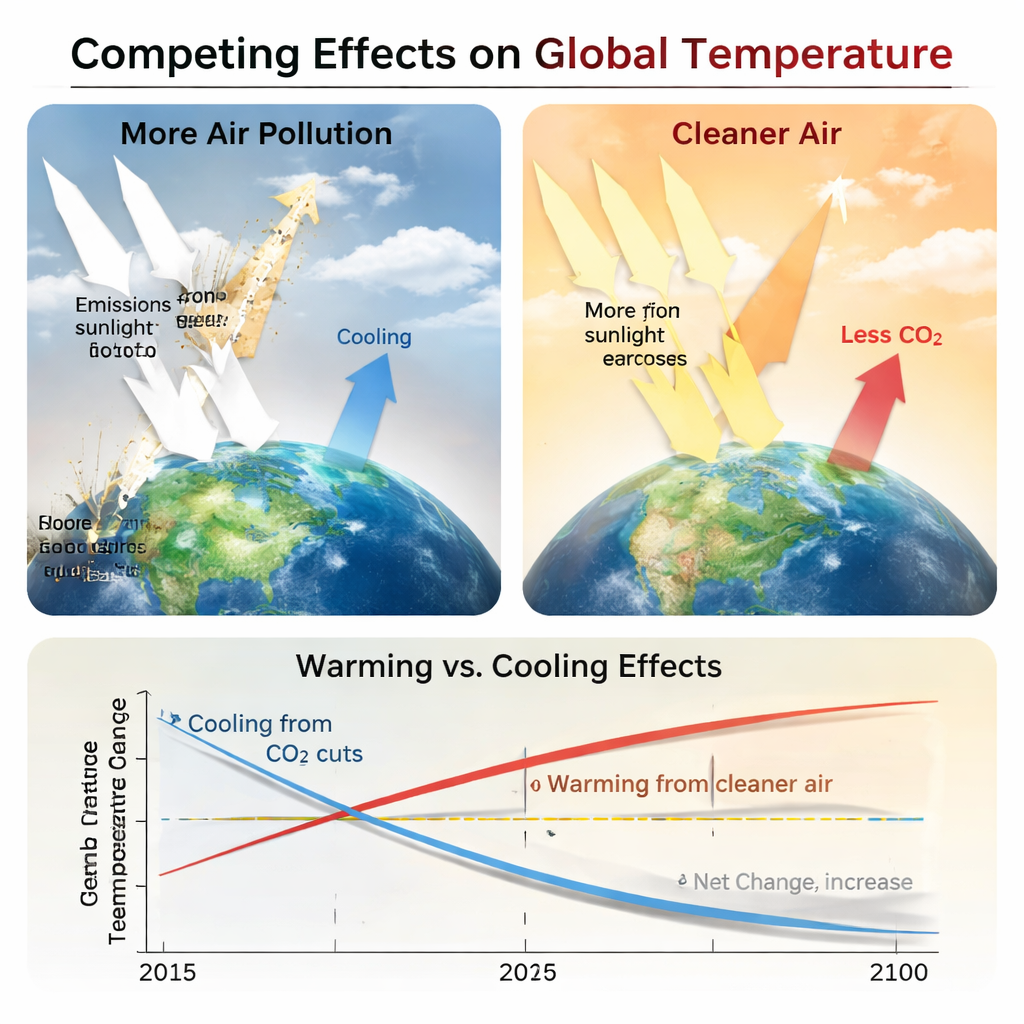
For the mid-century period around 2050–2070, the model shows that cutting CO2 in China cools the planet by about 0.16 °C compared with business as usual. Yet, during the same decades, cleaning up air pollution warms the planet by about 0.12 °C. The net result is a tiny global cooling of only about 0.03 °C—essentially a near tie. The warming mainly comes from reducing sulfur dioxide and organic particles, which today form reflective aerosols that bounce sunlight back to space and brighten clouds. As these cooling particles disappear, more sunlight reaches Earth’s surface, offsetting much of the cooling benefit from lower CO2, even though all the emission changes occur in a single country.
Uneven Changes Across Hemispheres and Over Time
The climate response is not evenly spread around the globe. Because aerosols are short-lived and concentrated near where they are emitted, most of the extra warming from cleaner air appears over the Northern Hemisphere, especially the Arctic and regions downwind of China over the North Pacific. In contrast, the cooling from reduced CO2 is more evenly distributed between hemispheres. Together, these shifts create a pattern with more warming in the north and slight cooling in the south, and push heavy tropical rain bands slightly northward. Over time, the story changes: warming from cleaner air levels off after about 2055, while cooling from accumulating CO2 cuts keeps growing. Only after roughly 2070 does a clear net global cooling from China’s policies emerge, reaching about 0.21 °C by 2100.
What This Means for Climate Choices
For non-specialists, the key message is that cleaning the air is vital for health but temporarily reveals hidden warming that dirty pollution had been masking. China’s plans will save many lives and should not be slowed, yet they will not quickly lower global temperatures on their own. To see earlier and stronger cooling, the authors argue that China and other countries with heavy pollution should move faster toward carbon neutrality, pursue technologies that remove CO2 from the air, and sharply cut other heat-trapping gases such as methane. In short, clearer skies are an essential step—but meeting global temperature goals will demand even more ambitious and earlier action on all forms of climate pollution.
Citation: Zhao, B., Wang, X., Wang, Y. et al. Air quality improvement masks global cooling from CO2 reductions under China’s carbon neutrality policies for half a century. Nat Commun 17, 1914 (2026). https://doi.org/10.1038/s41467-026-68586-y
Keywords: carbon neutrality, air pollution, aerosols, global warming, China climate policy