Clear Sky Science · en
Operationally classical simulation of quantum states
Why this matters for everyday technology
Quantum technologies promise ultra-secure communication and powerful new devices, but they are notoriously hard to build and certify. This article asks a deceptively simple question with big practical consequences: when do we truly need “genuinely quantum” states, and when can clever use of ordinary classical devices mimic them well enough? By drawing this line sharply, the authors show how to tell when superposition — the hallmark of quantum behavior — is really present in an experiment or a future technology.
Classical gadgets trying to fake quantum behavior
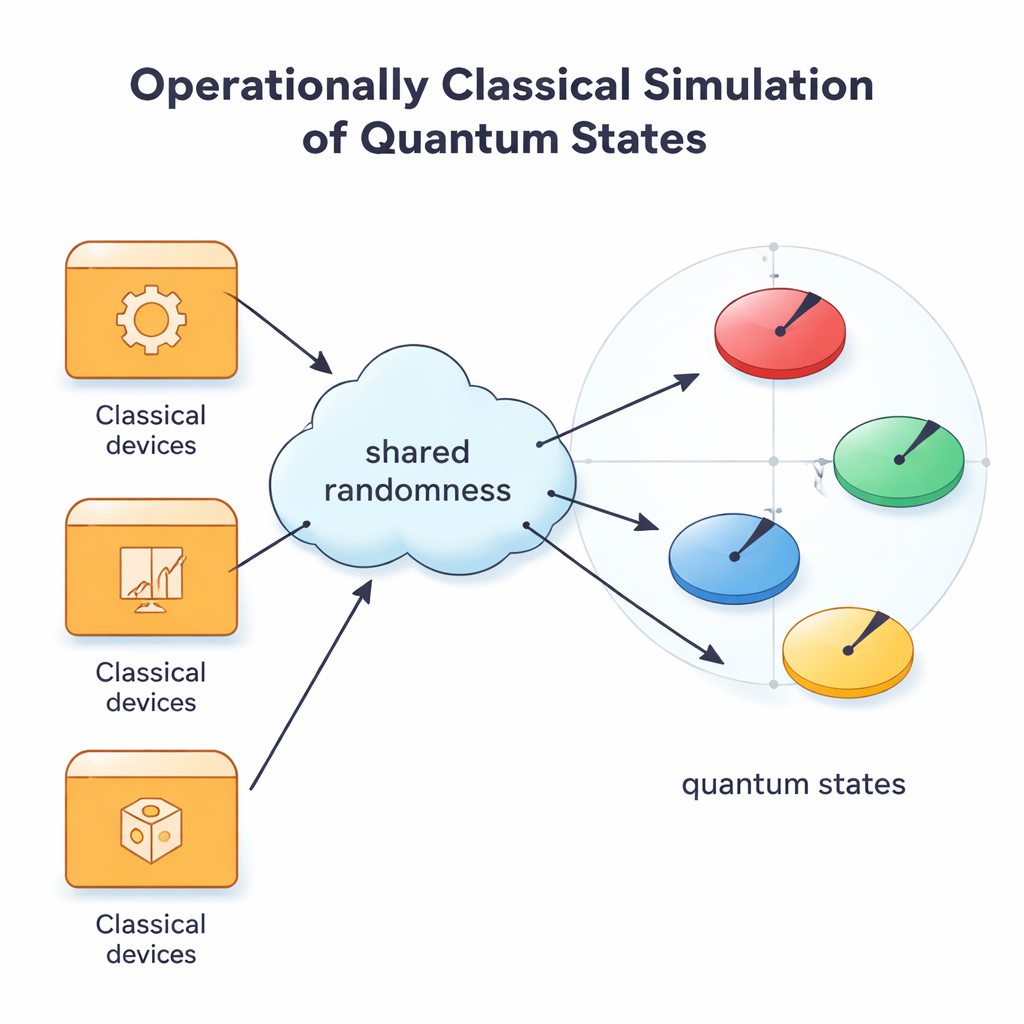
In standard textbook terms, quantum states look classical if they can all be expressed as diagonal in a single basis, meaning they never appear in genuine superposition relative to one another. But this is a very strict requirement: almost any pair of distinct quantum states fails this test, even if they are extremely noisy and practically useless. The authors relax the notion of “classical” to something more operational: imagine many simple state-preparation gadgets, each of which on its own can only output non-superposed states in some basis of its choosing. A random number (a shared classical variable) decides which gadget is used on each run, and its outputs can be randomly post-processed. The question is whether this network of individually simple, non-quantum devices can collectively reproduce the same statistics as a given set of quantum states.
When classical coordination is enough
From this picture, the authors define what it means for a set of quantum states to be “classically simulable”: every state in the set can be written as an average over states produced by these classical gadgets, with each gadget restricted to mutually commuting outputs. They then introduce a measure of complexity: how large a quantum subspace each gadget is allowed to occupy. Simple models live in small subspaces; more powerful ones can span the full Hilbert space. This leads to a nested hierarchy of increasingly capable classical simulations, from trivial cases where all states are identical, up to the broadest class that can mimic many non-commuting quantum sets without ever generating true superposition inside any single device.
How much noise makes quantum theory look classical?
A central technical result concerns noisy quantum states, where each pure state is mixed with featureless background noise. The authors prove exact thresholds for how much noise must be added in a given dimension before all states in that space admit a classical simulation. Below the threshold, some sets of states are irreducibly quantum; above it, even the entire state space can be faked by coordinated classical devices. Strikingly, as the dimension grows, this threshold visibility shrinks roughly like (log d)/d, meaning high-dimensional quantum systems quickly become very hard for any classical scheme to imitate unless they are extremely noisy. The team also develops more tailored analytical and numerical methods for specific, practically important sets of states, such as those used in quantum cryptography and in standard measurement bases.
Certifying genuine quantum coherence in the lab
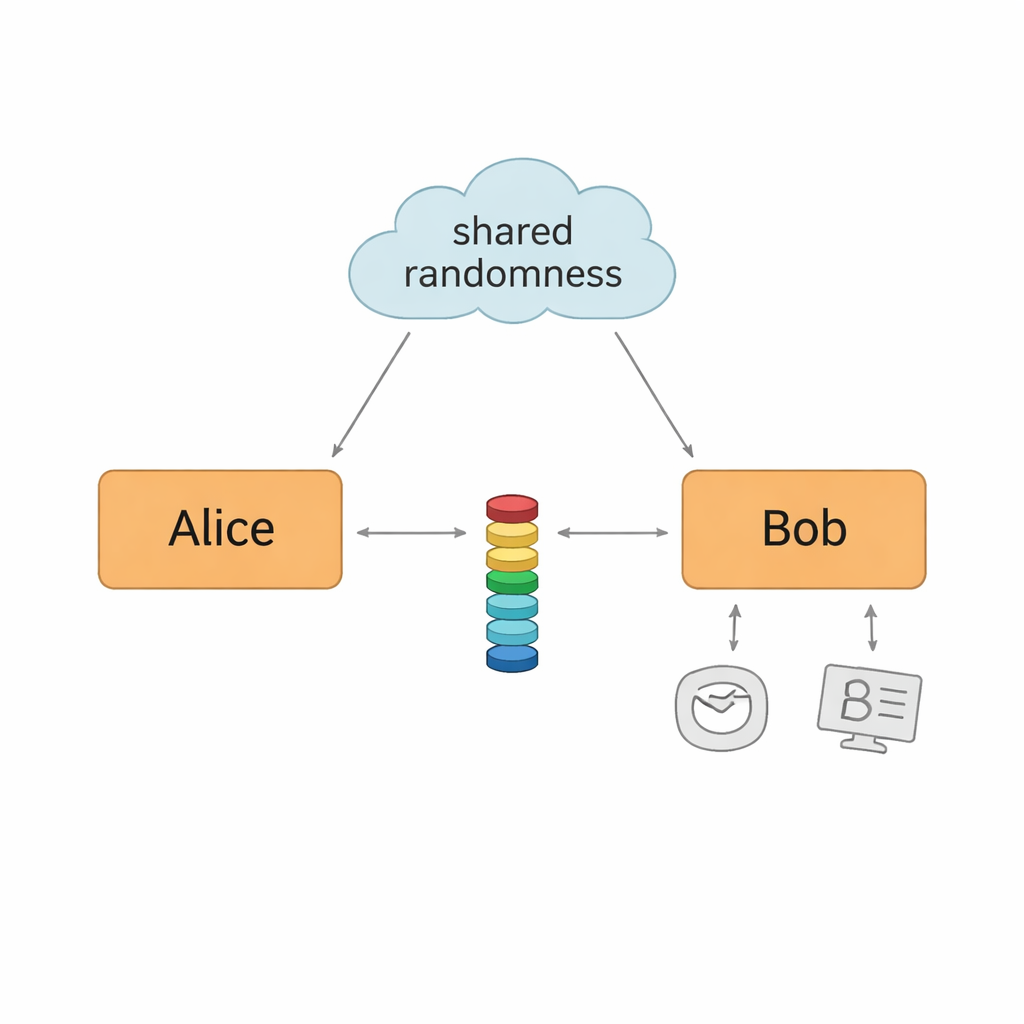
Beyond showing when classical simulation is possible, the article develops ways to prove that it is impossible for a given experimental setup. Instead of fully reconstructing states — a demanding tomographic task — they design witness inequalities that depend on a modest set of well-calibrated measurements in a prepare-and-measure experiment. Violating such an inequality certifies “absolute quantum coherence”: no network of classical devices of the allowed kind can explain the observed statistics. The authors connect these witnesses to well-studied ideas such as Einstein–Podolsky–Rosen steering and joint measurability of measurements, allowing existing mathematical tools to be repurposed for diagnosing quantum state sets.
What this tells us about future quantum devices
In everyday terms, the paper draws a clear operational boundary between what can be done with cleverly coordinated classical hardware and what truly requires quantum superposition. It shows that as we move to higher-dimensional systems, classical impostors become dramatically weaker, justifying the push toward high-dimensional quantum technologies. At the same time, for practical protocols that use only a limited number of states, the authors provide both recipes for optimal classical attacks and robust tests that can reveal when a device has crossed into genuinely quantum territory. This dual perspective — how to fake and how to certify — makes their framework a powerful tool for designing, benchmarking, and securing next-generation quantum information technologies.
Citation: Cobucci, G., Bernal, A., Renner, M.J. et al. Operationally classical simulation of quantum states. Nat Commun 17, 1104 (2026). https://doi.org/10.1038/s41467-026-68581-3
Keywords: quantum coherence, classical simulation, prepare-and-measure, quantum information, EPR steering