Clear Sky Science · en
Climate policy portfolios that accelerate emission reductions
Why the Shape of Climate Policy Matters
Most countries now have climate laws and clean‑energy programs on the books, but their emissions are still far from where they need to be to keep global warming in check. This study asks a deceptively simple question with big real‑world consequences: not just whether climate policies work, but which kinds of policy packages work best at cutting carbon pollution from burning fossil fuels while economies keep growing. The answers help citizens, campaigners, and decision‑makers understand how to redesign today’s patchwork of climate efforts into smarter portfolios that deliver faster emission cuts.
Looking at Thousands of Climate Rules Worldwide
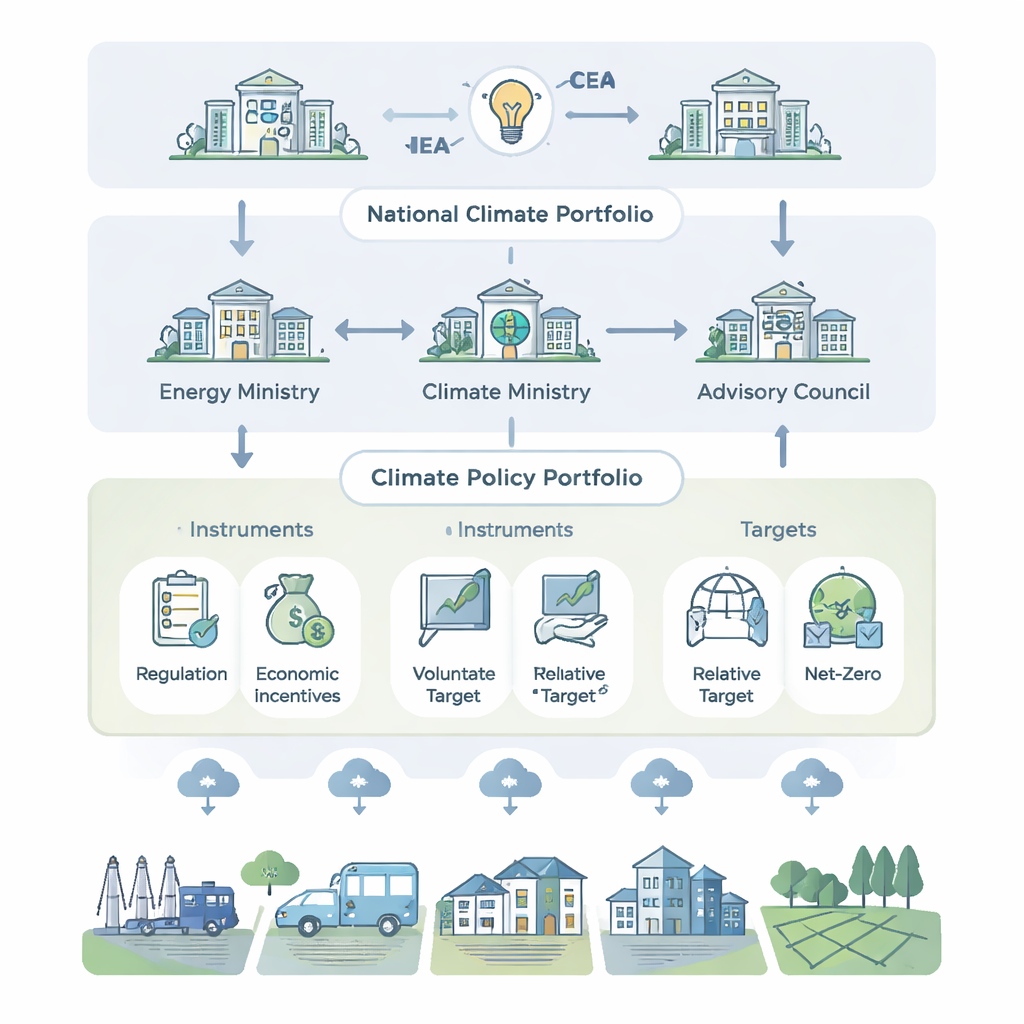
The researchers assembled a large dataset of 3,917 climate‑related policy instruments adopted between 2000 and 2022 across 43 countries, including members of the OECD and major emerging economies such as China, India, and Brazil. Together these countries account for about four‑fifths of global fossil CO2 emissions. For each policy, they recorded what type of tool it used (for example, regulations, taxes and subsidies, or voluntary programs) and which parts of the economy it targeted (such as power plants, transport, buildings, or industry). They also tracked whether countries had long‑term emission‑reduction targets and dedicated government bodies, like energy or climate ministries and participation in international energy organizations.
From Policy Lists to Pollution Numbers
To link these policy portfolios to real‑world outcomes, the team used statistical models that follow each country over time. Instead of looking at total emissions alone, they focused on emission intensity: how much CO2 is released for each unit of economic output. This allows fair comparisons between large and small economies and separates climate progress from simple changes in economic size. After accounting for factors such as income levels, trade patterns, and climate conditions, they examined how the build‑up of climate policies and their design features related to changes in emission intensity from 2000 to 2022.
More and Tougher Policies Do Cut Emissions
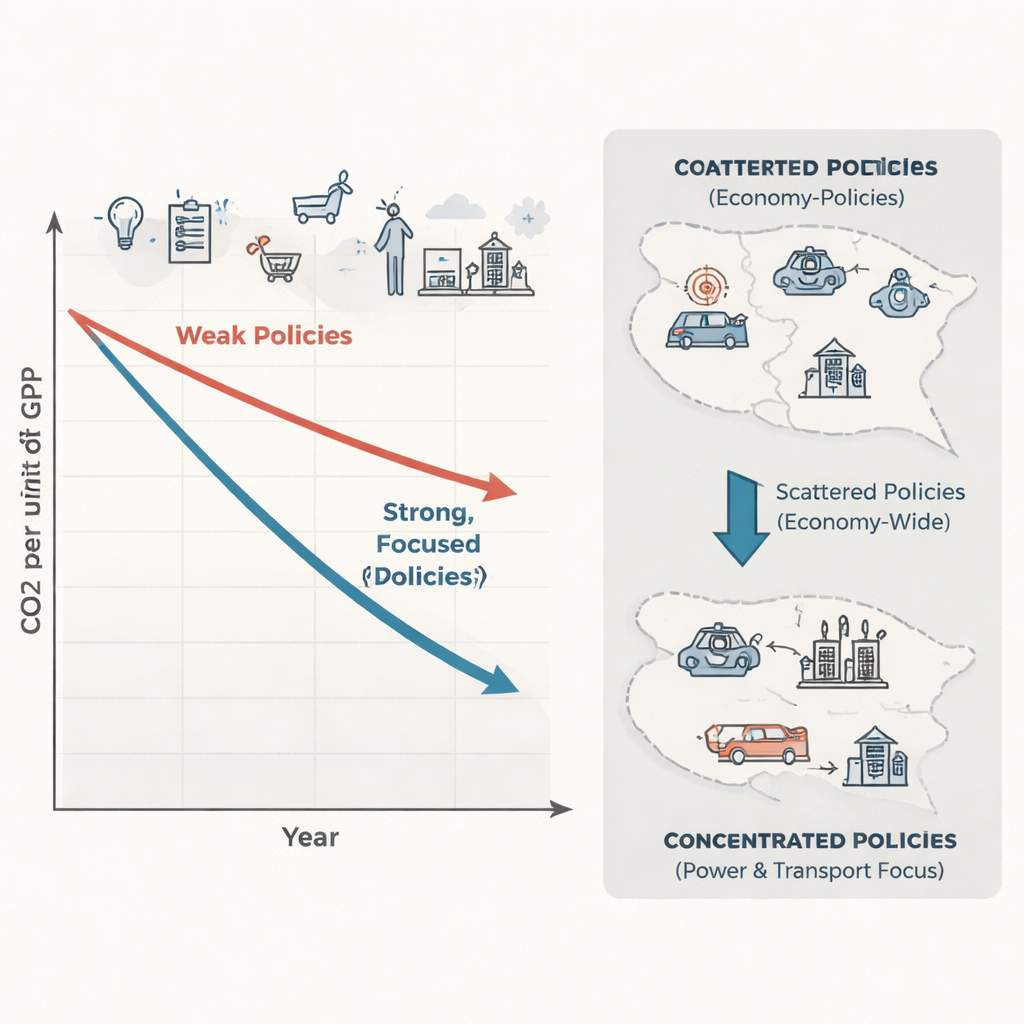
The analysis confirms that countries with a larger and more stringent stock of climate policies saw faster declines in CO2 per unit of GDP. Adding roughly twenty climate policies, on average, was associated with a drop in emission intensity of a little over one percent, even after controlling for other influences. Case studies of the United States and China show how a steady accumulation and tightening of measures—such as laws promoting clean energy, efficiency standards, and investment programs—coincided with shifts from coal to cleaner energy sources and slower growth, or even declines, in emissions. Countries that added fewer and weaker measures, such as Brazil over this period, tended to see slower progress.
Focused Portfolios Beat Scattergun Approaches
Beyond sheer numbers, the composition of a country’s climate toolbox also matters. The study finds that portfolios concentrating on a few types of policy instrument are linked to quicker emission cuts than those that spread effort evenly across many instruments. Economic tools such as carbon pricing, subsidies for clean technologies, and public investment generally outperformed purely regulatory or voluntary approaches. Likewise, concentrating policies on the most polluting sectors—typically power generation and transport—was more effective than thinly covering the whole economy. Countries like China and Israel, which focused strongly on the energy supply sector, reduced their emission intensity more quickly than peers with more diffuse efforts.
Targets and Institutions Multiply the Impact
Climate policies worked best when embedded in a supportive institutional framework. The presence of long‑term emission‑reduction targets, especially “absolute” goals that specify how much national emissions should fall relative to a past year (often 1990), amplified the impact of underlying policies. Countries with only “relative” targets—such as reducing emissions per unit of economic growth—saw weaker effects. Dedicated energy and climate ministries, independent advisory bodies, and membership in intergovernmental forums like the International Energy Agency and the Clean Energy Ministerial were also associated with stronger links between policy portfolios and falling emission intensity. These institutions help design, coordinate, and sustain policies across political cycles.
Big Gains, But Still Far from the Finish Line
By comparing actual emission paths with a scenario in which no climate policies had been adopted, the authors estimate that existing climate policy portfolios in the 43 countries together avoided about 27.5 billion tonnes of CO2 between 2000 and 2022—roughly 3.1 billion tonnes in 2022 alone. Yet this is still far below what is needed to keep the world on track for the temperature goals of the Paris Agreement. For a lay reader, the takeaway is clear: climate policies do work, and certain designs work significantly better. To protect the climate, countries must rapidly scale up not just the ambition of individual measures, but the overall architecture of their climate policy portfolios—concentrating on powerful tools and high‑emitting sectors, backing them with clear long‑term targets and strong institutions, and spreading these successful designs worldwide.
Citation: Arvanitopoulos, T., Bulian, S., Wilson, C. et al. Climate policy portfolios that accelerate emission reductions. Nat Commun 17, 1989 (2026). https://doi.org/10.1038/s41467-026-68577-z
Keywords: climate policy, emission intensity, carbon reduction, energy transition, environmental governance