Clear Sky Science · en
The insect Toll pathway activates antibacterial immunity against the citrus Huanglongbing pathogen
How tiny insects influence a big citrus problem
Citrus Huanglongbing, also called citrus greening, is one of the most destructive diseases threatening orange and other citrus groves worldwide. The culprit is a hard-to-grow bacterium that hides in plant sap and is spread by a sap‑sucking insect known as the Asian citrus psyllid. This study asks a simple but crucial question: how does this tiny insect detect the invading bacterium, and why does the microbe manage to persist inside its body without killing it? The answers reveal a surprisingly sophisticated immune alarm system in the insect—and an equally clever counterattack from the bacterium.
The disease, the insect, and the hidden battle
The bacterium Candidatus Liberibacter asiaticus (CLas) lives in the phloem, the plant tissue that carries sugar‑rich sap. Asian citrus psyllids feed on this sap and carry the bacterium from diseased trees to healthy ones. Young psyllids pick up the pathogen most efficiently, while adults are better at passing it on. Curiously, CLas does not seem to make the insects noticeably sick, suggesting that the psyllid’s immune system controls the infection just enough to keep both host and microbe alive. Until now, scientists did not know how the insect senses this particular bacterium or which internal defenses hold it in check. 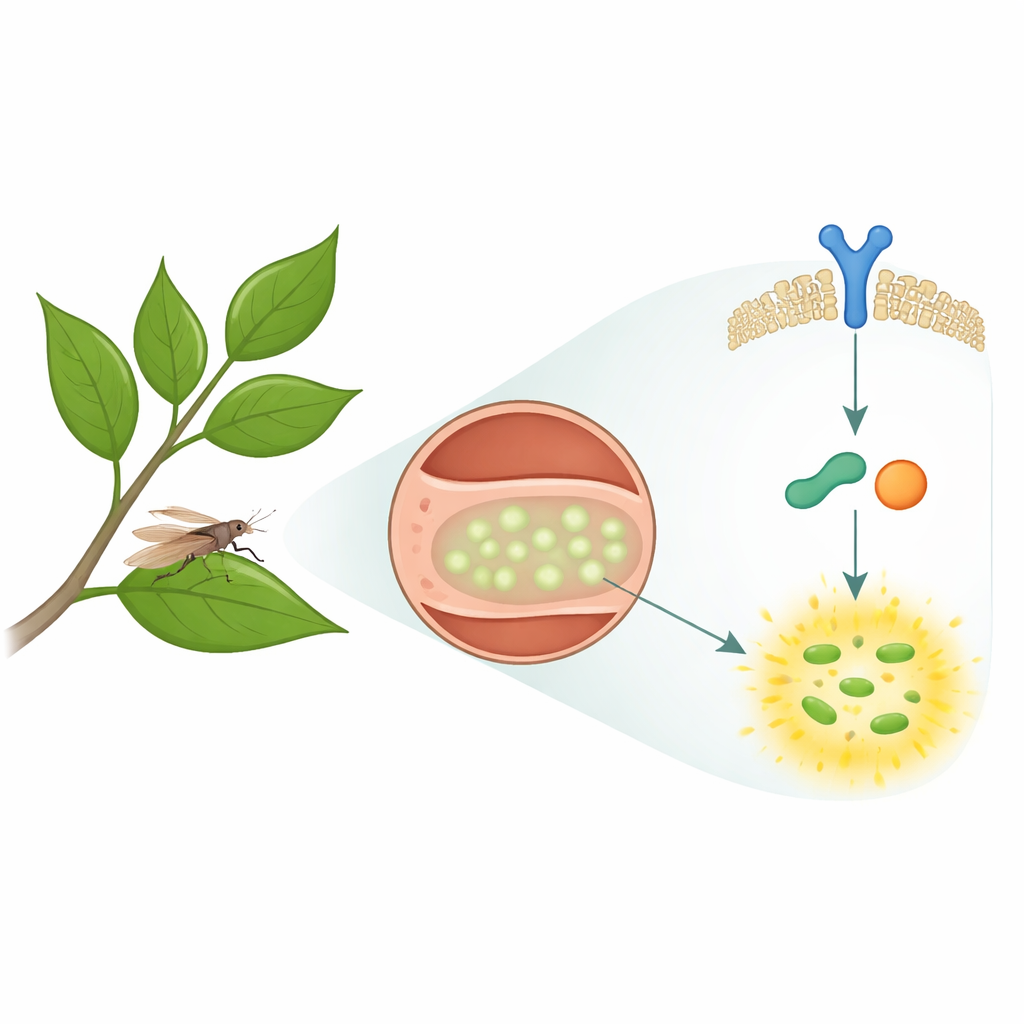
A direct early warning sensor on the insect’s cells
The researchers discovered that a receptor protein on psyllid cells, called Toll8, serves as a front‑line sensor for CLas. In many insects, similar receptors only respond indirectly, relying on other molecules to first detect invading microbes. Here, Toll8 behaves more like well‑known immune sensors in humans and other vertebrates. It binds directly to a small barrel‑shaped protein that sits in the outer membrane of the bacterium. When this barrel protein touches Toll8, the receptor pairs up with itself at the cell surface, forming a dimer that flips on an internal alarm signal. Silencing the Toll8 gene in psyllids led to a sharp rise in bacterial levels, showing that this single sensor is a key part of their antibacterial defense.
From alarm signal to defensive weapons
Once Toll8 is activated, it launches a chain reaction inside the insect cell. First, an adapter protein called MyD88 is drawn to the activated receptor and pairs with another copy of itself. This complex then recruits a kinase—a molecular switch—named IKKE, which becomes chemically activated. IKKE in turn modifies a transcription factor called NFAT, allowing it to enter the cell nucleus, where the genetic material is stored. Inside the nucleus, NFAT binds specific stretches of DNA and boosts the activity of several defense genes. Two of the most important outputs are Reeler, a secreted protein that can directly kill bacteria, and nitric oxide synthase (NOS), which produces nitric oxide, a small, reactive gas that has broad microbe‑killing properties. Disrupting MyD88, IKKE, NFAT, Reeler, or NOS each caused CLas to multiply more and increased the likelihood that psyllids would pass the bacterium to new citrus leaves.
How the bacterium fights back
CLas has not remained a passive target in this arms race. The team found that the bacterium releases another protein, called SDE3230, into psyllid cells. This protein does not attack Toll8 directly. Instead, it latches onto a host enzyme, an E3 ubiquitin ligase named UBR5, whose job is to tag other proteins for destruction. With SDE3230’s help, UBR5 more efficiently labels MyD88 with molecular “flags” that send it to the cell’s protein‑shredding machinery. As MyD88 levels drop, the entire Toll8–IKKE–NFAT pathway is weakened, reducing production of Reeler and nitric oxide and giving CLas more freedom to grow and persist. 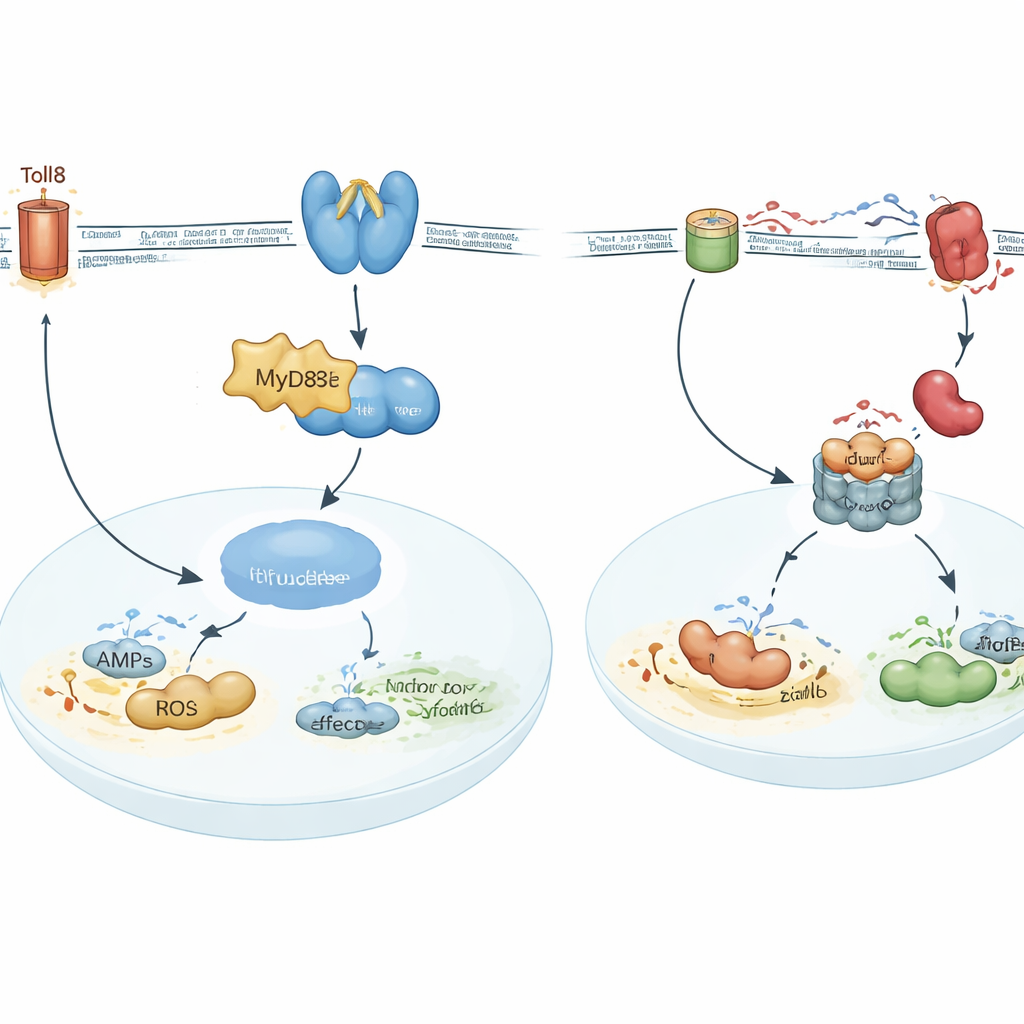
What this means for protecting citrus groves
Taken together, the study reveals an intricate push‑and‑pull between the citrus greening bacterium and its insect carrier. On one side, the psyllid uses Toll8 as a direct sensor to recognize CLas, then relays the signal through MyD88, IKKE, and NFAT to switch on potent antibacterial tools. On the other, CLas deploys SDE3230 to sabotage this pathway by accelerating the breakdown of MyD88, blunting the insect’s defenses just enough to survive and be transmitted. For a lay reader, the key message is that disease spread in citrus groves is governed not only by what happens in the tree, but also by a molecular duel inside the insect vector. Understanding this duel opens up new possibilities: future control strategies might strengthen the psyllid’s Toll8‑based defenses or block the bacterial tricks that disable them, slowing or even stopping the spread of citrus greening.
Citation: Du, Y., Sun, M., Xiao, Y. et al. The insect Toll pathway activates antibacterial immunity against the citrus Huanglongbing pathogen. Nat Commun 17, 2721 (2026). https://doi.org/10.1038/s41467-026-68575-1
Keywords: citrus greening, Asian citrus psyllid, innate immunity, Toll signaling, vector-borne bacteria