Clear Sky Science · en
Presence of primordial Mg can explain the seismic low-velocity layer in the Earth’s outermost outer core
Why Earth’s Deep Heart Matters
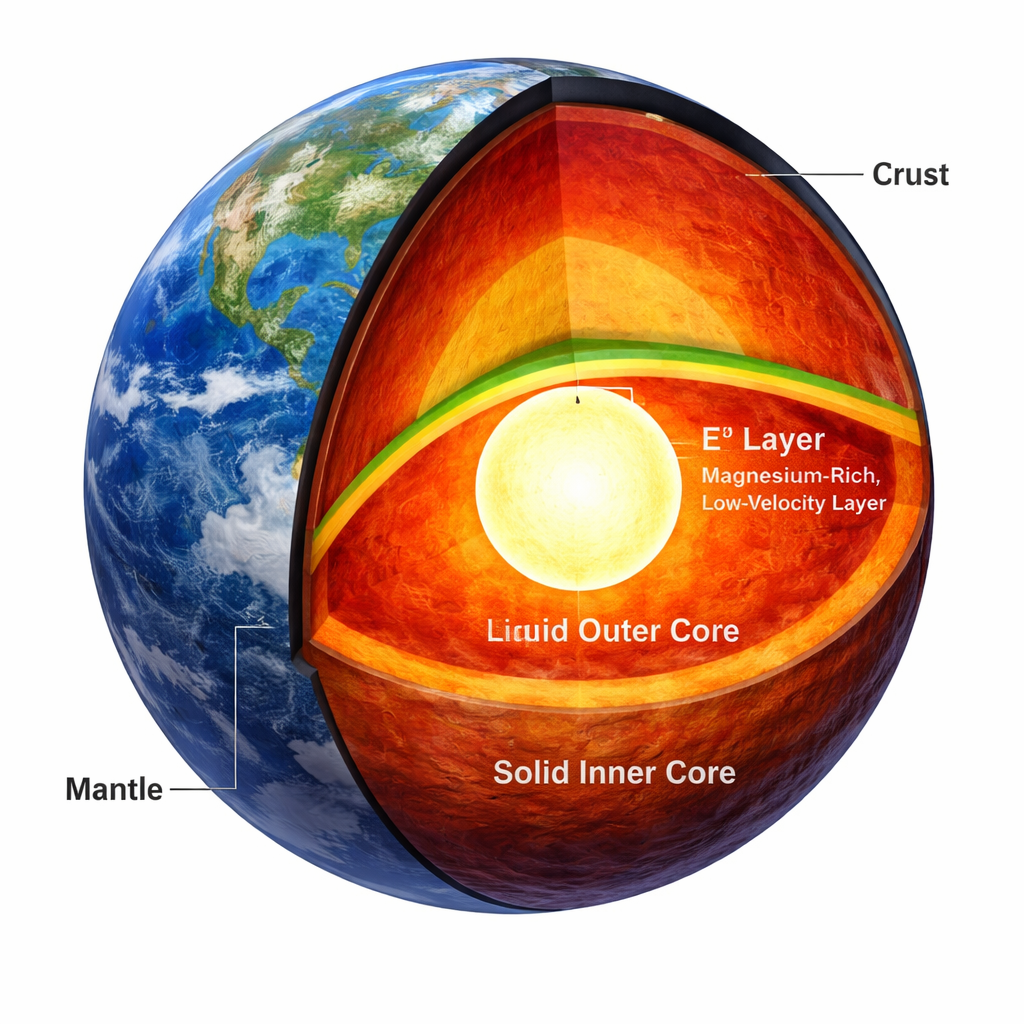
Far beneath our feet, more than 2,800 kilometers down, lies Earth’s liquid metal outer core, the churning region that powers our magnetic field and helps make the planet habitable. Seismic waves from earthquakes reveal that the very top of this outer core is oddly slow at carrying sound, forming a mysterious low-velocity layer known as the E′ layer. This paper explores whether a familiar element—magnesium, common in rocks at Earth’s surface—slipped into the core during our planet’s violent youth and now helps explain this puzzling hidden layer.
A Strange Slow Zone Deep Inside Earth
Seismologists model Earth’s interior by tracking how earthquake waves speed up or slow down as they travel through different layers. Standard models, such as the widely used PREM profile, describe the outer core as a dense, iron-rich liquid slightly “lightened” by small amounts of elements like silicon, oxygen, sulfur, carbon, and hydrogen. But newer seismic models show that in the upper few hundred kilometers of the outer core, sound waves move up to about 1% slower than expected. Existing ideas tried to explain this with a chemically layered outer core, but all the usual “light” elements tend to increase sound speed in iron, not decrease it. This created a paradox: it seemed impossible to make a layer that was both slow enough to match seismic data and light enough to remain stably stratified instead of sinking.
Testing Magnesium in Liquid Iron
The authors focus on magnesium, an element abundant in the mantle but thought to be scarce in the core. High-pressure experiments have hinted that some magnesium could dissolve into molten iron during the intense conditions of Earth’s formation, especially during the Moon-forming giant impact. However, until now, no one had robust calculations of how magnesium changes the density and sound speed of liquid iron at the extreme pressures and temperatures of the outer core. Using first-principles molecular dynamics, a quantum-based simulation method, the researchers modeled liquid iron mixed with different small amounts of magnesium at pressures up to 340 gigapascals and temperatures up to 7,500 kelvin—conditions matching those deep within Earth.
How Magnesium Changes the Core’s Properties
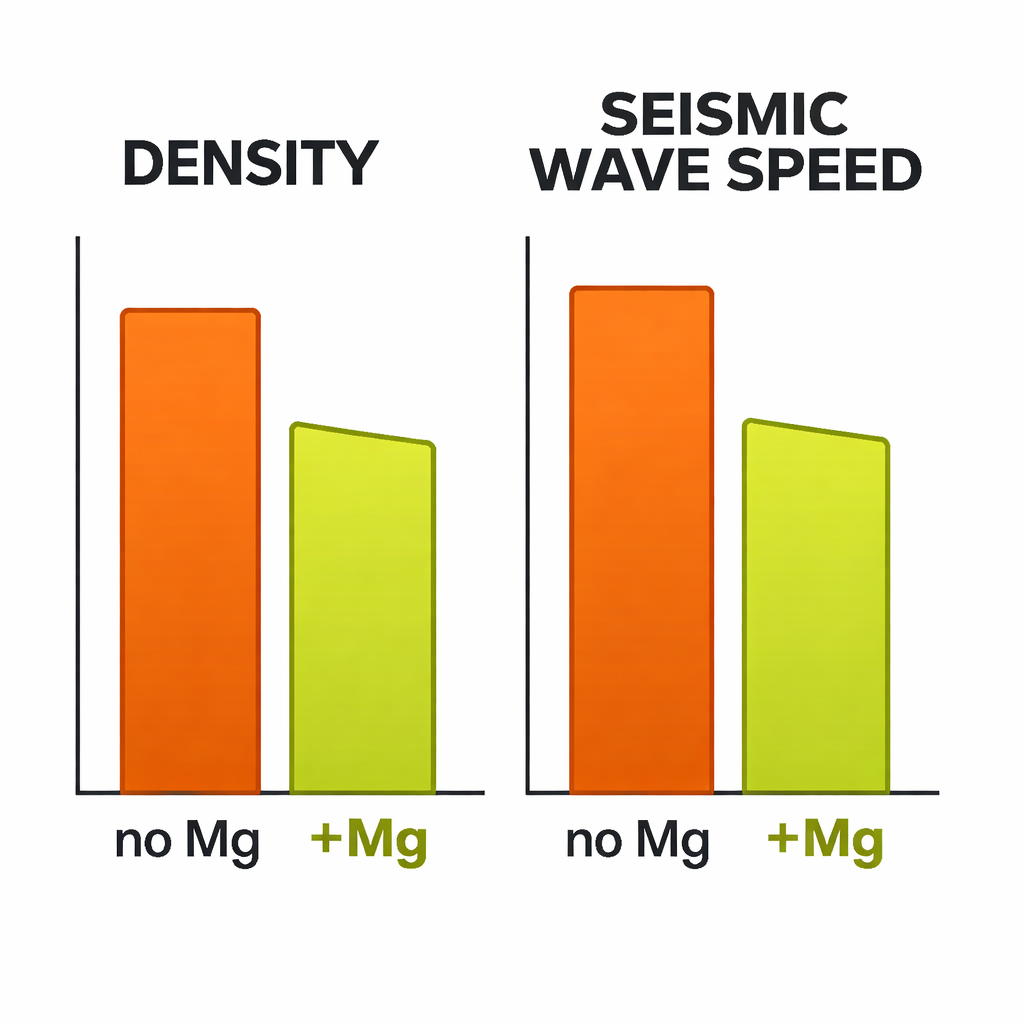
The simulations show that as magnesium is added to liquid iron, both density and the speed of compressional (sound-like) waves decline in a nearly linear way. The effect on sound speed is modest but, crucially, opposite to that of other light elements, which tend to make waves travel faster. By combining their new iron–magnesium results with previous data for other light elements, the authors built models of outer core composition that must simultaneously match seismic densities, seismic velocities, and reasonable chemical limits on how much of each element the core can contain. They tested both a uniformly mixed outer core and a two-layer structure with a distinct upper layer. In all successful models, magnesium is required in the outer core, with typical values between about 0.5 and 1.8 weight percent, and especially concentrated in the outermost several hundred kilometers—precisely where the E′ layer is observed.
Cosmic Collisions and a Magnesium-Rich Shell
These findings suggest a dramatic origin story for the E′ layer. Before the Moon-forming collision, Earth likely already had a liquid iron core containing some silicon and hydrogen but relatively little magnesium. The giant impact would have heated parts of the planet to extreme temperatures, allowing extra magnesium, along with silicon and oxygen, to dissolve into metal that then sank toward the existing core. Because this magnesium-rich metal was relatively buoyant, it pooled to form a stratified shell at the top of the outer core. Over billions of years of cooling, some components, such as silica, water, iron oxide, and perhaps magnesium oxide, may have slowly crystallized or exsolved back into the mantle. What remained was an upper outer core enriched in magnesium and somewhat depleted in oxygen—exactly the sort of composition that would be slightly lighter and carry seismic waves more slowly, matching the E′ layer.
What This Means for Our Planet
To a non-specialist, the core may seem remote, but its composition shapes Earth’s magnetic field, heat flow, and long-term evolution. This study shows that a relatively small amount of primordial magnesium in the outer core can solve a long-standing puzzle about the low-velocity E′ layer without breaking basic chemical or seismic constraints. It also helps explain why Earth’s silicate mantle is a bit poorer in magnesium than some primitive meteorites, implying that a measurable fraction of magnesium is hidden deep in the core. In simple terms, the authors argue that traces of magnesium, delivered and rearranged during the colossal impact that formed the Moon, left behind a thin, magnesium-bearing skin on the outer core—subtle yet powerful enough for earthquake waves to detect across the entire planet.
Citation: Liu, T., Jing, Z. Presence of primordial Mg can explain the seismic low-velocity layer in the Earth’s outermost outer core. Nat Commun 17, 1886 (2026). https://doi.org/10.1038/s41467-026-68572-4
Keywords: Earth core, magnesium, seismic waves, giant impact, outer core composition