Clear Sky Science · en
Controlled hierarchical self-assembly of hyperbolic paraboloid molecules into two-dimensional superstructures with second-harmonic generation characteristic
Why Curved Molecules Matter
Most of the advanced materials inside our phones, lasers, and sensors are built from flat, sheet‑like molecules. This study explores something very different: tiny saddle‑shaped molecules with built‑in curves. The researchers show how to coax these oddly shaped building blocks to line up into ultra‑thin, two‑dimensional layers that not only look like molecular origami, but also convert invisible infrared light into visible green light with remarkable efficiency. Such materials could one day help make faster optical switches, better laser components, and new tools for imaging.
From Saddles to Sheets
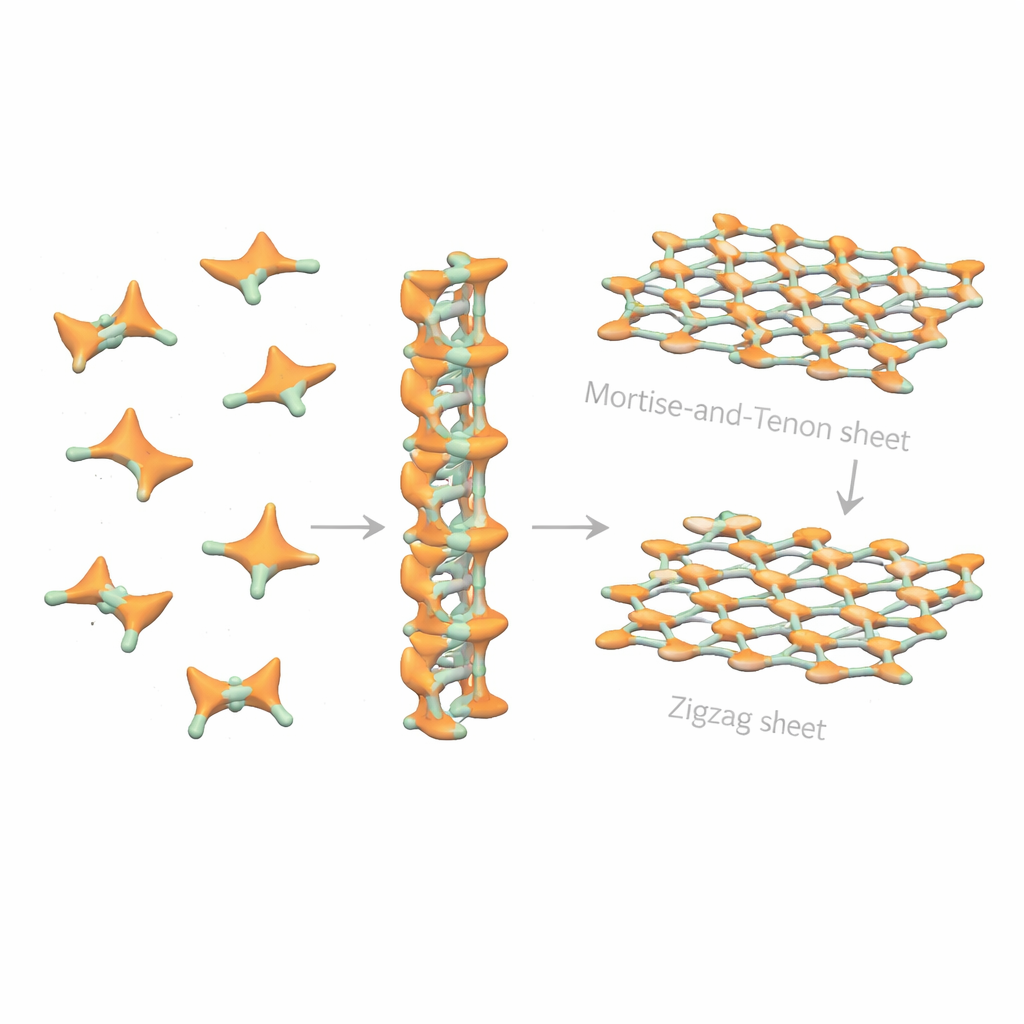
The team started with a specially designed ring‑shaped molecule called Cy‑DBT that naturally bends into a saddle, with rigid "backbone" segments and more flexible linkers. Because of its shape, two of these molecules like to stack face‑to‑face in solution, forming a compact dimer. By carefully choosing the surrounding liquid, the scientists were able to push this dimer to keep organizing itself: first into straight columns, and then into large, flat sheets only a few billionths of a meter thick. This step‑by‑step, or hierarchical, self‑assembly allowed them to build complexity from very simple starting units without any external patterning or templates.
Two Ways to Tile a Molecular Floor
Although the starting molecules are the same, the final sheets can take on two distinct patterns, depending on the solvent conditions. In one, dubbed the Mortise‑and‑Tenon type, neighboring columns lock together like traditional wooden joints in Chinese architecture, forming a tightly interwoven grid. In the other, called the zigzag type, the columns connect in a more slanted, wave‑like fashion to create an array of repeating ridges. X‑ray measurements and high‑resolution microscopy revealed that both versions are highly ordered crystals, but with slightly different thicknesses and internal spacing between the columns.
Watching the Structures Grow
To confirm how these sheets form, the researchers followed the process in real time. Right after adding a small amount of a more polar solvent, they saw tiny clusters whose size matched that of the dimer. Over minutes to hours, these clusters fused into long one‑dimensional strands, then into narrow molecular belts, and finally into broad, plate‑like sheets. Light‑scattering experiments showed the particles steadily growing, while nuclear magnetic resonance and absorption measurements tracked how the interactions between parts of the molecule changed as the material assembled. Together, these data point to a cooperative "nucleation‑and‑growth" mechanism: a small, hard‑to‑form nucleus appears first, and once it exists, additional molecules add on more and more readily.
Turning Infrared into Green Light
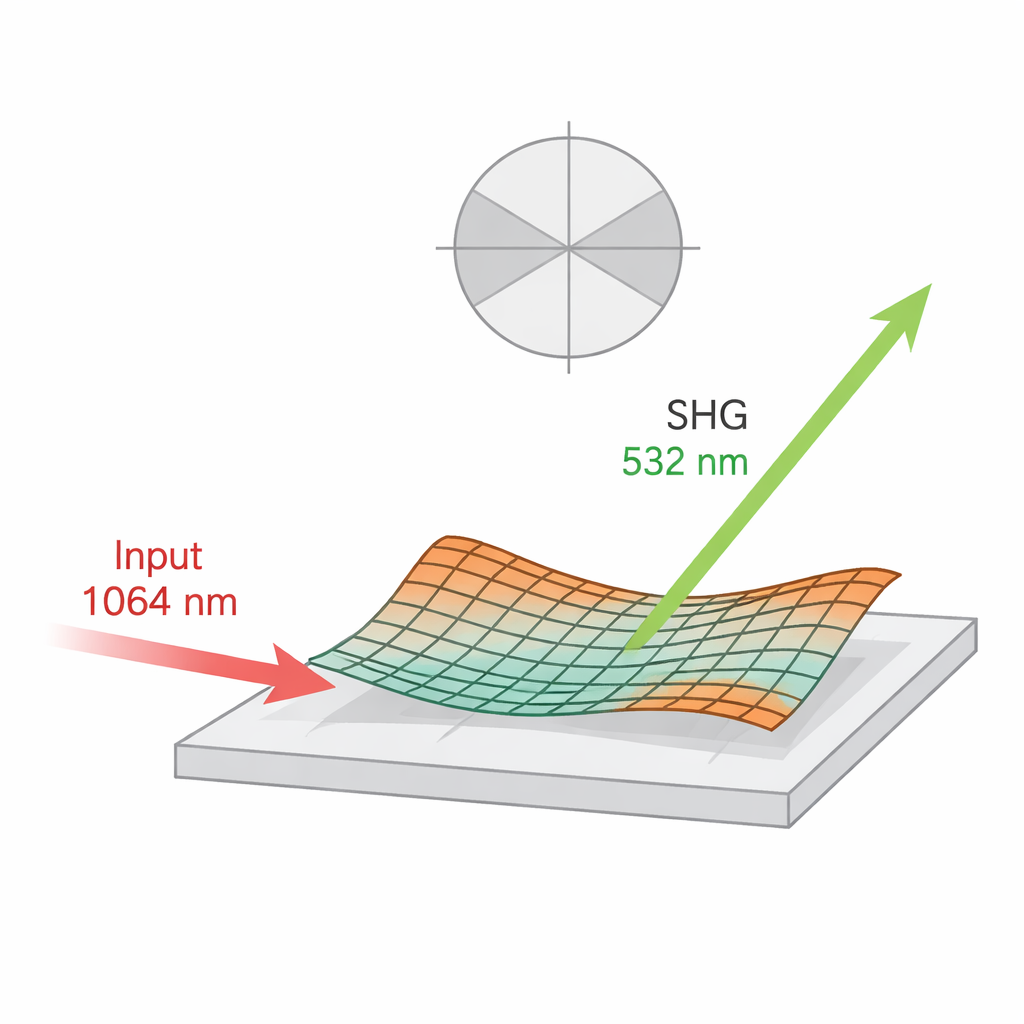
Because the molecules in these sheets line up in a non‑symmetric way, the materials can perform a nonlinear optical trick called second‑harmonic generation: they take in two infrared photons and emit one photon of green light. When the scientists shone a pulsed infrared laser at 1064 nanometers onto the sheets, they detected bright signals at exactly half that wavelength, 532 nanometers. The Mortise‑and‑Tenon sheet produced the stronger response, about one and a half times that of the zigzag version, and both showed a strong dependence on the polarization, or orientation, of the incoming light. This means their internal order is not just neat to look at—it directly enhances how efficiently they reshape light.
What This Means for Future Technologies
By proving that curved, saddle‑shaped molecules can be guided to assemble themselves into large, flat, crystal‑like sheets with powerful light‑converting abilities, this work opens a fresh route to organic optical materials. Instead of carving devices from bulk crystals, chemists can now think about "growing" functional, two‑dimensional layers from the bottom up, tuning their performance simply by adjusting how the building blocks stack. In everyday terms, the study shows how smart molecular design and solvent control can turn tiny, bent rings into thin films that might someday help route light in optical computers, sharpen medical imaging, or stabilize new kinds of lasers.
Citation: Huo, H., Zhang, Y., Xiao, X. et al. Controlled hierarchical self-assembly of hyperbolic paraboloid molecules into two-dimensional superstructures with second-harmonic generation characteristic. Nat Commun 17, 1852 (2026). https://doi.org/10.1038/s41467-026-68567-1
Keywords: self-assembly, nonlinear optics, two-dimensional materials, organic crystals, second-harmonic generation