Clear Sky Science · en
Mobility-driven synthetic contact matrices as a scalable solution for real-time pandemic response modeling
Why everyday movement matters in pandemics
When a new respiratory virus begins to spread, one of the biggest unknowns is how often people of different ages actually come into close contact. Those everyday encounters at school, work, home, or on the bus determine how fast disease moves through a population. Yet measuring these patterns in real time, as people change their behavior in response to rules and fear, is extremely difficult. This study asks a simple but crucial question: can we use routinely collected mobility and behavior data, instead of large recurring surveys, to track these changing contacts fast enough to guide pandemic decisions?
Turning movement data into social encounters
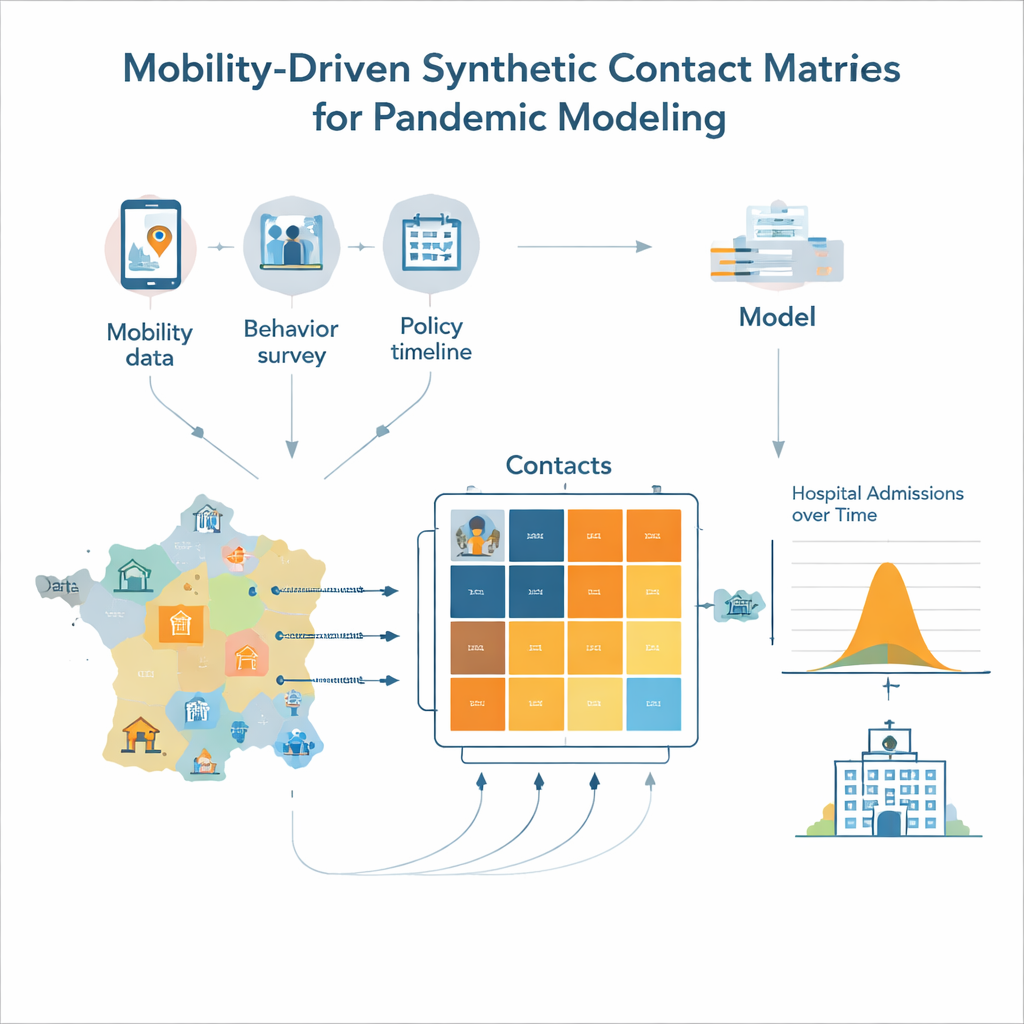
The researchers focused on France during the first two years of COVID-19, a period marked by lockdowns, school closures, curfews, and the arrival of new variants and vaccines. Their central tool is a "contact matrix"—a table that records how many daily contacts people in one age group have with people in another. Before the pandemic, such matrices were built from detailed questionnaires where volunteers listed their contacts. During COVID-19, the team instead generated weekly "synthetic" matrices by starting from pre-pandemic patterns and then shrinking or expanding specific types of contacts based on real-time indicators: Google workplace mobility, school attendance and holiday calendars, and surveys on how often people said they avoided physical contact.
Comparing synthetic contacts with real-world surveys
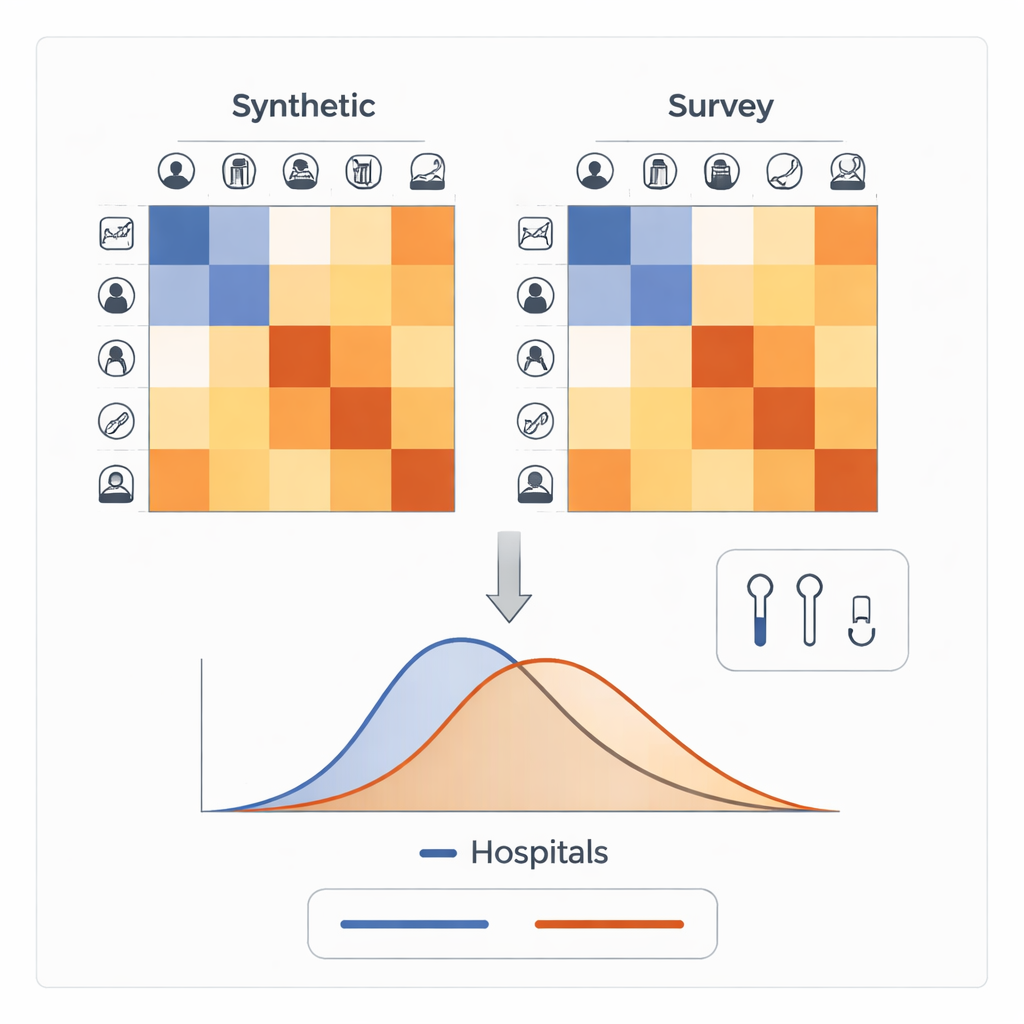
To test whether these synthetic matrices were trustworthy, the authors compared them with seven waves of France’s SocialCov survey, which directly asked people about their contacts at different points in the pandemic. Overall, both approaches showed similar broad trends: during the first lockdown, contacts fell to about a quarter of pre-pandemic levels, and then slowly rose as restrictions eased, without fully returning to normal by mid-2022. But there were key differences. Survey-based matrices reported almost twice as many contacts as the synthetic ones after the first lockdown, a gap largely driven by children and teenagers. In school-open periods, surveys suggested that under‑19s had three to four times more contacts than the synthetic estimates, while adult and senior contact numbers agreed much more closely between the two methods.
Putting both approaches into a disease model
The real test was not just counting contacts but seeing how well each data source could reproduce the actual course of the epidemic. The team fed three different contact assumptions into the same COVID‑19 transmission model for France: weekly synthetic matrices, the sparser survey-based matrices (stretched across time with assumptions between survey waves), and a single fixed pre‑pandemic matrix. They then adjusted one global "correcting factor" over successive phases of the pandemic to capture influences not directly in the matrices, such as masking or seasonality. All three models could follow the overall curve of hospital admissions, but the synthetic-matrix model did so with the smallest errors and the best statistical fit, especially during transitional times like partial school closures or the gradual lifting of curfews.
What the models reveal about age-specific risks
Looking more closely at different age groups, the synthetic matrices gave the most realistic picture for adolescents, adults, and seniors. With these inputs, the model’s predicted hospitalizations and blood-test estimates of past infection closely matched observed data for those ages. The survey-based matrices, by contrast, tended to overstate infections among children and teenagers, likely because they counted more contacts that were less relevant for transmission—for example, masked or brief encounters at school. The synthetic matrices underestimated infection in younger children, showing that both methods still struggle to capture the most meaningful child contacts. Importantly, the authors found that no amount of global rescaling could fix a mismatched contact structure: which ages mix with whom mattered more than just the total number of contacts.
Implications for future pandemic response
For non-specialists, the main message is that it is possible to track changing contact patterns fast enough for real-time decisions without constantly running large, time-consuming surveys. By carefully combining mobility data, simple behavior indicators, and knowledge of where contacts occur (home, school, work, leisure), public health teams can build weekly synthetic contact matrices that are flexible, scalable, and inexpensive. In this study, those matrices outperformed both traditional survey matrices and static pre‑pandemic patterns in explaining who was hospitalized and when. The authors conclude that investing in routine, age‑stratified mobility and behavior data—and in systems that can quickly turn those numbers into contact matrices—will be a powerful ingredient for more agile and effective responses to future epidemics.
Citation: Di Domenico, L., Bosetti, P., Sabbatini, C.E. et al. Mobility-driven synthetic contact matrices as a scalable solution for real-time pandemic response modeling. Nat Commun 17, 1845 (2026). https://doi.org/10.1038/s41467-026-68557-3
Keywords: pandemic modeling, social contacts, mobility data, COVID-19 France, age-structured transmission