Clear Sky Science · en
Resonance fluorescence and indistinguishable photons from a coherently driven B centre in hBN
Turning Tiny Flaws into Quantum Light Sources
Quantum technologies promise ultra-secure communication and powerful new kinds of computation, but they rely on streams of single, perfectly matched particles of light. This study shows how tiny imperfections—"B centres"—inside an ultra-thin crystal called hexagonal boron nitride (hBN) can act as highly reliable, nearly ideal single-photon sources, bringing practical quantum photonic chips a step closer to reality.
A Special Kind of Imperfection
Most materials are engineered to avoid defects, but for quantum optics, the right kind of defect can be a treasure. In hBN, a layered material similar to graphene, certain point defects known as B centres emit individual photons with very well-defined colors. These defects can be created at chosen positions and tend to emit around a specific blue wavelength, making them attractive building blocks for on-chip quantum devices. Until now, however, experiments typically used indirect, non-resonant ways to excite these emitters—good enough to see light, but not good enough to fully harness their quantum coherence, which is essential if photons are to interfere with one another in a predictable way.
Driving the Defects with Laser Precision
The researchers tackled this by exciting the B centres in a fully resonant way: they tuned a laser so that its color matched the internal transition of the defect exactly. This kind of driving, called resonance fluorescence, allows precise control of the quantum state of the defect and greatly improves the timing and uniformity of the emitted photons. To make this work, they placed thin hBN crystals containing B centres on top of a silver mirror in a carefully designed metal–dielectric stack that boosts light collection while remaining flat enough to control polarisation. Using a clever “cross-polarisation” trick—aligning polarizers in the excitation and collection paths at right angles—they were able to strongly suppress the glare from the reflected laser light and isolate the much weaker photons emitted by a single B centre. 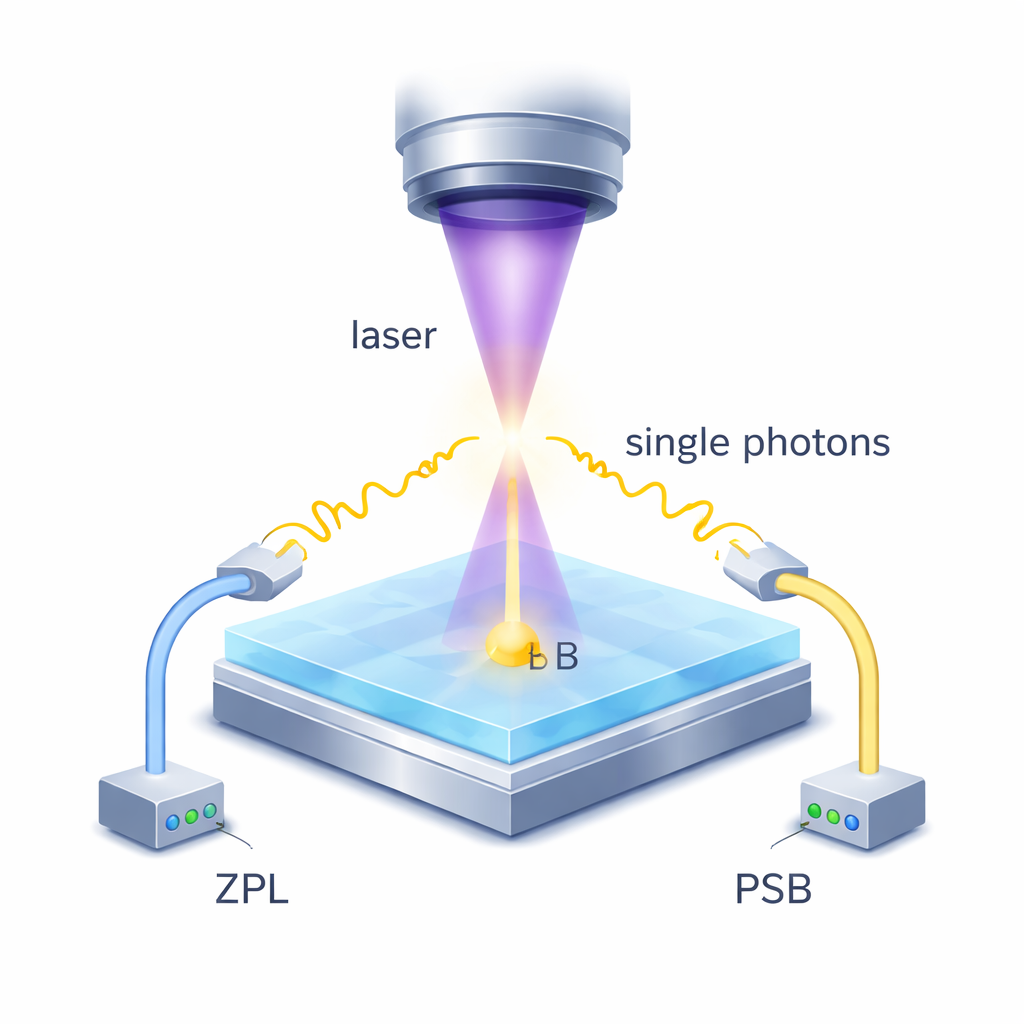
Seeing Clear Quantum Signatures
With this setup, the team could explore how the B centre responds under both continuous and pulsed laser excitation. By first monitoring light in a phonon sideband—photons emitted with slightly lower energy due to vibrations in the crystal—they mapped the linewidth and dynamics of the emitter and demonstrated clean single-photon emission with very high purity. Under stronger resonant driving, they sent the light through a high-resolution Fabry–Perot filter and observed the so-called Mollow triplet: a central emission line flanked by two symmetric sidebands whose separation grows with the square root of the laser power. This hallmark pattern is a textbook signature of coherent light–matter interaction and confirms that the defect behaves much like an ideal two-level quantum system, where the outgoing photons faithfully inherit the coherence imposed by the laser.
Making Photons That Are Truly Indistinguishable
For many quantum information tasks, it is not enough to have single photons—they must also be indistinguishable, so that two photons arriving at a beam splitter merge into a single output path instead of leaving separately. This phenomenon, known as Hong–Ou–Mandel interference, is a sensitive test of photon quality. The researchers used short resonant laser pulses to excite the B centre and then carefully filtered and time-gated the zero-phonon-line photons, which are least disturbed by vibrations. They built an interferometer that brings consecutive photons together on a beam splitter and counted how often detectors clicked in coincidence. A strong dip in coincidences for identical polarisations, compared with an orthogonal-polarisation control measurement, revealed very high interference visibilities—around 0.93 and 0.92 for two different emitters—indicating that the photons are almost perfectly indistinguishable. 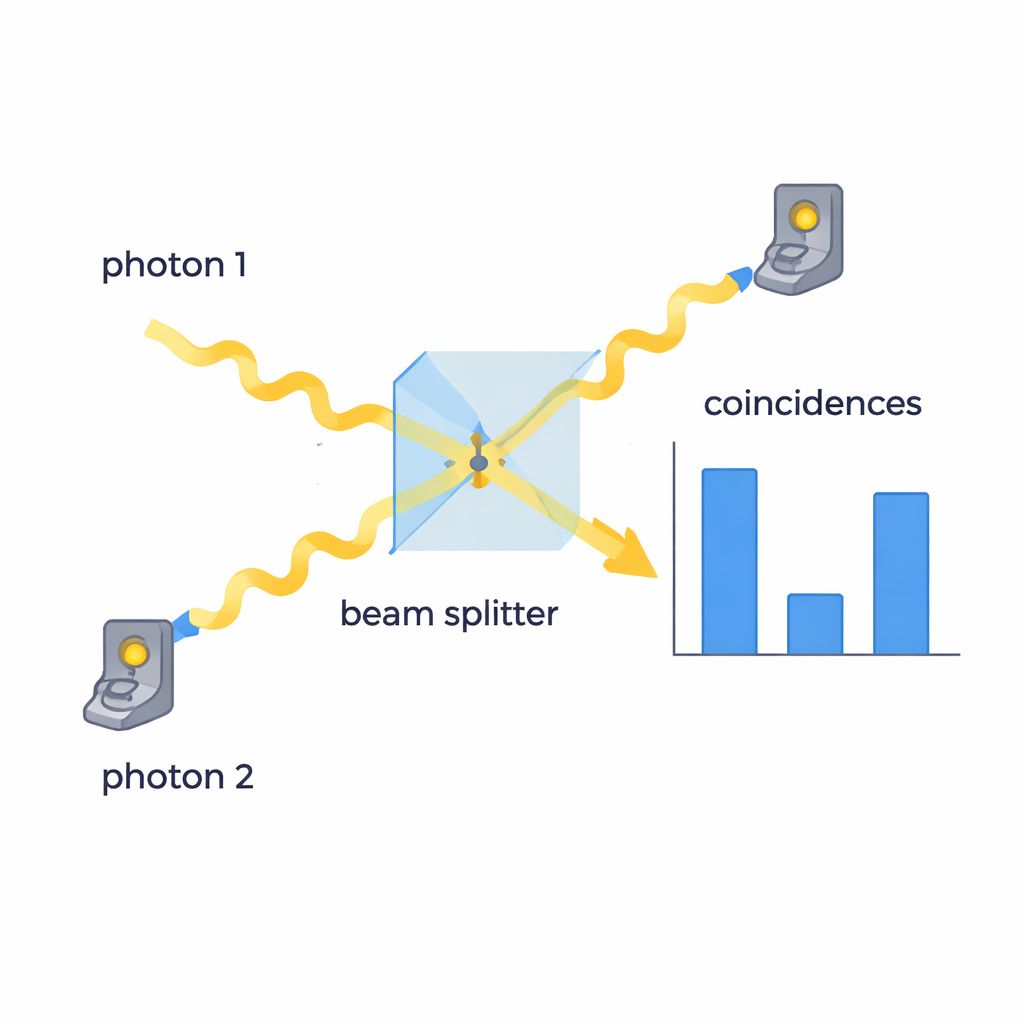
From Lab Demonstration to Quantum Circuits
In everyday terms, this work shows that tiny engineered flaws in a two-dimensional crystal can act like near-ideal, controllable single-photon “light bulbs” that produce photons so similar they effectively behave as one when they meet. Because these B centres can be placed with high precision, have nearly identical colors, and can be tuned electrically, they are promising candidates for building large arrays of identical quantum light sources on a chip. Integrating them into advanced photonic structures, such as microcavities and waveguides, could lead to bright, scalable, and highly coherent photon sources at the heart of future quantum communication networks and optical quantum computers.
Citation: Gérard, D., Buil, S., Watanabe, K. et al. Resonance fluorescence and indistinguishable photons from a coherently driven B centre in hBN. Nat Commun 17, 1843 (2026). https://doi.org/10.1038/s41467-026-68555-5
Keywords: single-photon emitters, hexagonal boron nitride, resonance fluorescence, quantum photonics, indistinguishable photons