Clear Sky Science · en
Self-oscillating synchronematic colloids
When Tiny Beads Start Beating in Unison
Imagine a crowd of metronomes that not only tick together but can also slide and turn across a table, reshaping the crowd as they sync. This study shows how microscopic beads, driven by a steady electric field, can act like such mobile metronomes. Their back-and-forth motion, directions, and positions become linked, creating new, tunable forms of collective motion that could inspire smart materials and tiny robotic swarms.
Little Motors Powered by a Steady Push
The researchers work with plastic microspheres called Quincke colloids, a well-known system in soft-matter physics. When these beads sit in a weakly conducting oil above a flat electrode and a constant electric field is applied, charges build up around each bead and cause it to roll. Under specific conditions, a bead does not simply drift in one direction; instead it rocks back and forth along a preferred line, like a pendulum without hinges. Each bead’s motion can be described by four basic traits: where it is, which way it oscillates, how fast it cycles, and where it is in that cycle (its phase). Because the electric field never changes in time, this periodic motion is “self-oscillating”: the bead itself, not an external rhythm, sets the beat.
From Lone Oscillators to Living-Like Clusters
At low density, the beads behave nearly independently. Each oscillates with roughly the same average frequency, but random fluctuations steadily scramble its phase and orientation. As more beads are added, however, their motion through the fluid creates flows that tug on their neighbors. These hydrodynamic interactions gently steer nearby oscillators toward similar phases and similar oscillation directions. In loosely packed “fluid” clusters, the team observes that neighbors tend to rock in almost the same direction and at nearly the same point in their cycle, a combined order they name “synchronematic.” They quantify this by measuring how strongly phase and direction are correlated as a function of distance: correlations are strong for close neighbors but fade over several bead diameters as random fluctuations compete with fluid-mediated alignment. 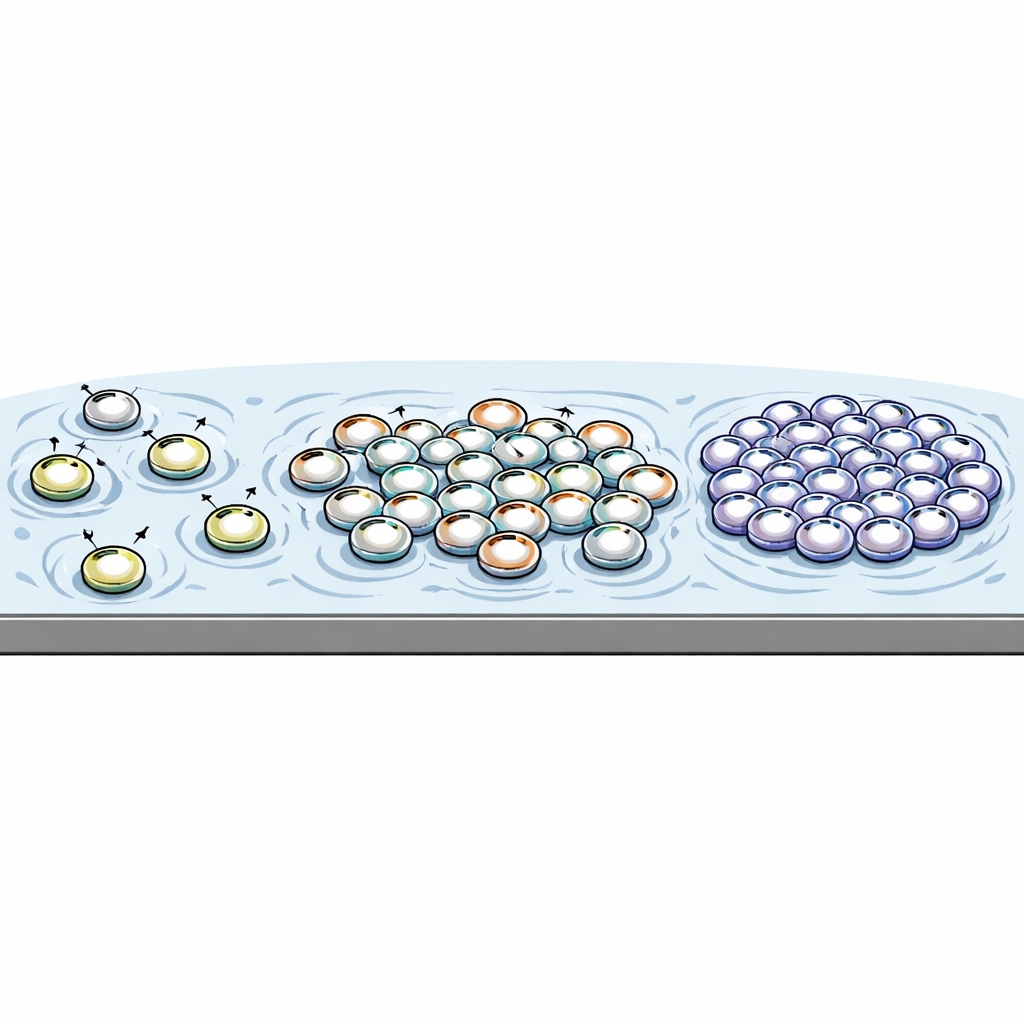
Crystalline Vortices That Spin Faster Together
When the starting distribution of beads is prepared with especially dense patches, the system organizes itself very differently. The beads gather into tight, crystal-like clusters, each with a hexagonal packing similar to a honeycomb. Inside these “synchronematic crystals,” every bead oscillates with almost the same phase and frequency, and their oscillation directions form circular rings around a central defect point. From above, this looks like a tiny pulsating vortex made of rocking beads rather than a steady whirlpool. Remarkably, the collective oscillation frequency of a cluster is higher than that of an isolated bead and increases with the number of beads in the cluster, up to a saturation point. Experiments and detailed computer simulations that include fluid flow, electrostatic forces, and short-range repulsion reproduce these behaviors and show that weak, long-range flows help confine beads into stable, dense clusters.
How Fluid Flows Tie Phase and Direction Together
To understand the rules behind these collective patterns, the authors build a simplified mathematical model that keeps bead positions fixed and focuses on how phases and directions evolve. Using techniques from the theory of weakly coupled oscillators, they derive how the flow created by one oscillating bead nudges the phase and orientation of another. The resulting interaction rules resemble, but go beyond, classic models used to study synchronization and magnetic-like ordering. They contain “reciprocal” terms that make pairs of beads lock in phase, and “non-reciprocal” terms that bias the system so that synchronized beads actually speed each other up. Simulations with this reduced model reproduce both local synchronematic order in disordered clusters and fully synchronized circular order in crystals, while also predicting limits: beyond a certain size, non-reciprocal interactions create phase gradients that can disrupt perfect global order. 
Why This Matters for Future Smart Materials
Overall, the work reveals a new kind of active order in which synchronization of timing and alignment of direction are inseparable. Unlike many active materials that rely on a built-in head–tail polarity or handedness, these beads are effectively symmetric, yet their interactions through the surrounding fluid generate rich spatial and temporal patterns. By tuning particle shape, size, and arrangement, it should be possible to design materials whose mechanical response—how they move, stir fluid, or transport cargo—changes with cluster size and density via shifts in collective frequency. This framework points toward “active oscillatory materials” whose behavior can be programmed not just in space, but also in time.
Citation: Leyva, S.G., Zhang, Z., Olvera de la Cruz, M. et al. Self-oscillating synchronematic colloids. Nat Commun 17, 1841 (2026). https://doi.org/10.1038/s41467-026-68552-8
Keywords: active matter, colloids, synchronization, hydrodynamics, self-oscillators