Clear Sky Science · en
Resolving energy transfer dynamics in Eu²⁺-activated multi-site phosphors via metaheuristic optimization and physics-informed neural networks
Why this glowing crystal matters
LEDs light our homes, phones, and car headlights, and much of their color and efficiency is controlled by special glowing powders called phosphors. Many of the best phosphors are surprisingly complex: the light‑emitting atoms can sit in different “seats” inside the crystal, sharing and shuttling energy in ways that are hard to see directly. This paper shows how modern optimization algorithms and physics‑aware neural networks can finally untangle that invisible energy traffic, revealing which processes really control brightness, color, and efficiency.
Many seats, one glow
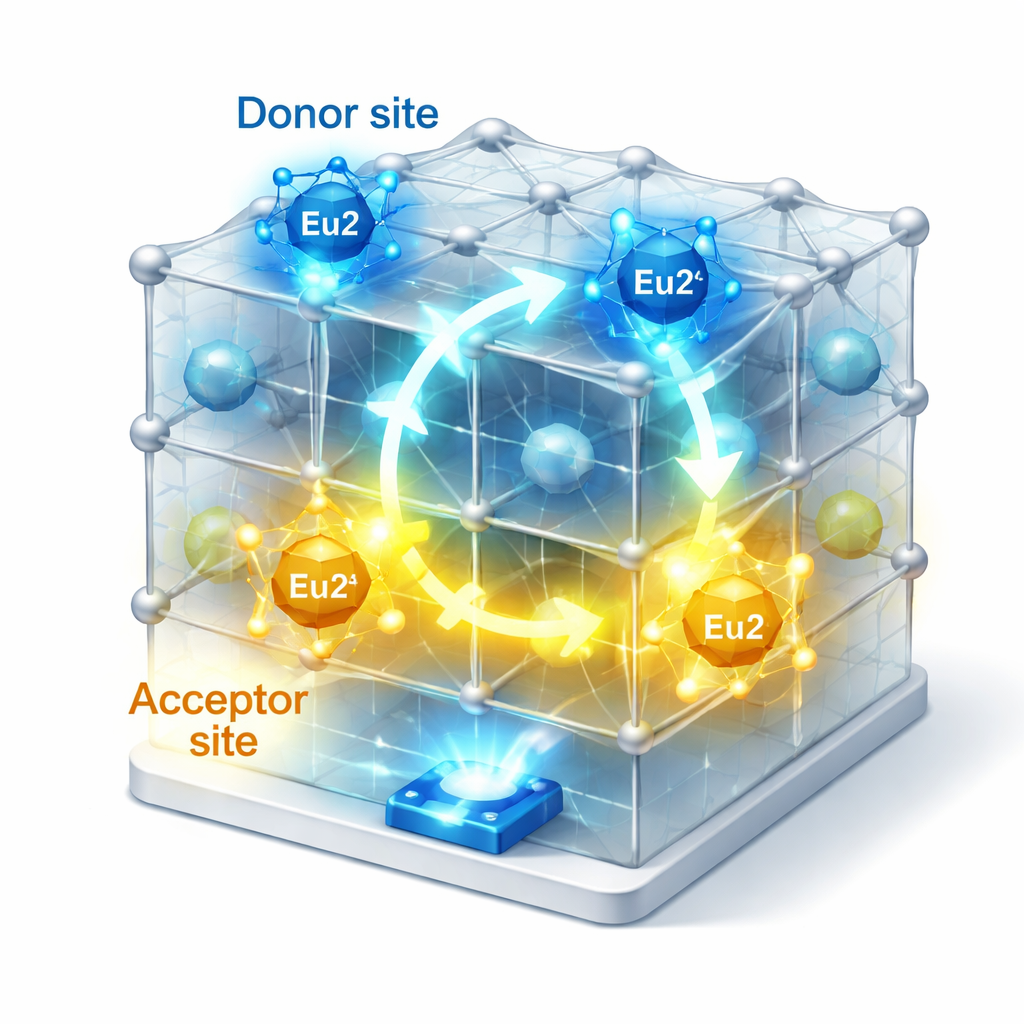
The authors study a yellow‑emitting phosphor based on a lanthanum–calcium oxynitride crystal doped with europium ions (Eu²⁺). In this material, Eu²⁺ can occupy two slightly different atomic neighborhoods, known as donor and acceptor sites. These sites have the same basic geometry but differ in bond lengths and how many nitrogen atoms surround them, which shifts their energy ever so slightly. As a result, donors emit somewhat bluer light while acceptors emit somewhat redder light. When the material is excited with a short laser pulse or a blue LED, its spectrum shows overlapping contributions from both kinds of sites, and the color drifts over time as energy moves from donors to acceptors—a behavior known to experimentalists as “wavelength quenching.”
Why simple curve fitting falls short
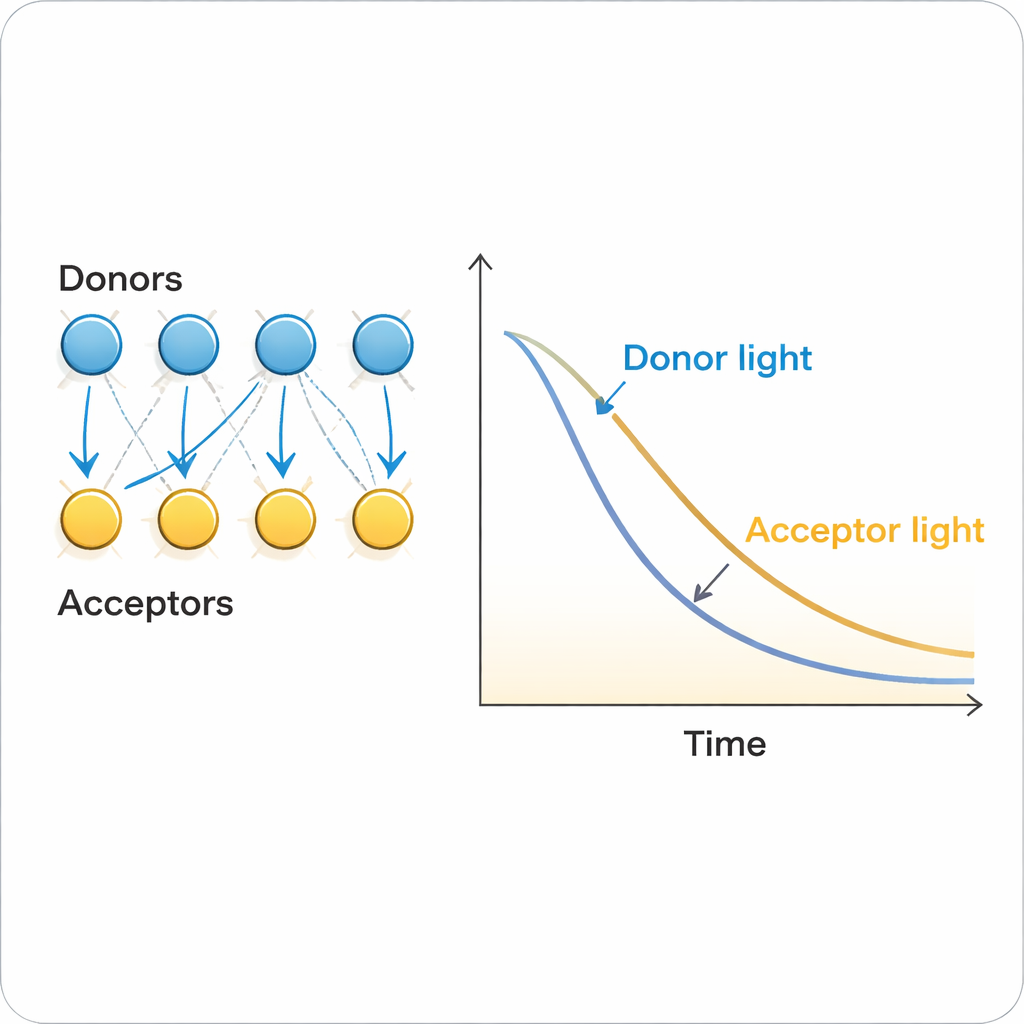
Traditionally, researchers describe how the light fades after a pulse by fitting the decay curve with a sum of exponential functions. This is mathematically convenient but physically misleading: it treats different emitting centers as if they act independently and ignores the fact that excited Eu²⁺ ions can exchange energy with one another. In reality, the populations of donors and acceptors influence each other through non‑radiative energy transfer, leading to nonlinear behavior that a simple sum of exponentials cannot faithfully represent. For multi‑site phosphors like this one, the authors argue that only a full rate‑equation description—with interaction terms that grow with the product of populations—can capture what is actually happening inside the crystal.
Letting algorithms solve the hard physics
Writing down such a rate‑equation model is straightforward; solving it accurately and extracting reliable numbers for all the underlying rates is not. The equations are nonlinear and coupled, with no neat analytical solution. To tackle this, the team combines a standard numerical integrator (the Runge–Kutta method) with powerful “metaheuristic” search strategies—genetic algorithms and particle swarm optimization. These methods explore a large parameter space, hunting for combinations of radiative, non‑radiative, and energy‑transfer rates that make the simulated decay curves match the measured ones at two key wavelengths dominated by donors and acceptors. From this, they recover not only how the total light changes, but also how the populations of regular and slightly defective donors and acceptors evolve in time, something that cannot be measured directly.
Teaching neural networks the rules of the game
In parallel, the authors deploy physics‑informed neural networks (PINNs) as an independent check and as a more scalable route to similar answers. Instead of treating the neural network as a black‑box curve fitter, they embed the actual rate equations into the training process as a “physics loss,” alongside terms that penalize mismatches with experimental decay data and violations of initial conditions. Simple multilayer perceptrons (and, in tests, LSTM networks) learn smooth functions that describe the time evolution of all states while simultaneously adjusting the same physical rate constants. Despite being trained from different starting guesses and even with reduced experimental data, the PINNs converge on rate constants that agree closely with those found by the Runge–Kutta plus metaheuristic approach.
What really controls the light
Both methods paint a consistent physical picture. The key finding is that non‑radiative transfer from donor to acceptor sites is extremely fast—comparable to the rate at which excited ions lose energy to non‑emitting defects, and much faster than the rate at which they emit light as photons. Transfers between donors alone or between acceptors alone are relatively weak. In practical terms, the glow from this phosphor is governed less by simple radiative decay and more by how efficiently energy hops from higher‑energy donors to lower‑energy acceptors and how many defects are present to steal that energy. For LED designers and materials chemists, this means that controlling the distances between Eu²⁺ ions and minimizing defects are just as crucial as choosing the right crystal structure, and that AI‑assisted, physics‑based analysis can provide the quantitative guidance that crude multi‑exponential fits never could.
Citation: Lee, B.D., Seo, Y.H., Cho, M.Y. et al. Resolving energy transfer dynamics in Eu²⁺-activated multi-site phosphors via metaheuristic optimization and physics-informed neural networks. Nat Commun 17, 1837 (2026). https://doi.org/10.1038/s41467-026-68549-3
Keywords: phosphors, energy transfer, Eu2+ luminescence, physics-informed neural networks, LED materials