Clear Sky Science · en
Ultrafast scintillating metal-organic framework films
Seeing Invisible Rays in Real Time
Modern medicine and particle physics both rely on our ability to “see” invisible high‑energy radiation, such as X‑rays and gamma rays, with exquisite timing. This paper reports a new type of thin, solid film that lights up extraordinarily fast when hit by such radiation. These films, built from metal-organic frameworks (MOFs), could help make cancer scans sharper and quicker, and allow physicists to track fleeting particle events with far better precision.
Why Faster Flashes of Light Matter
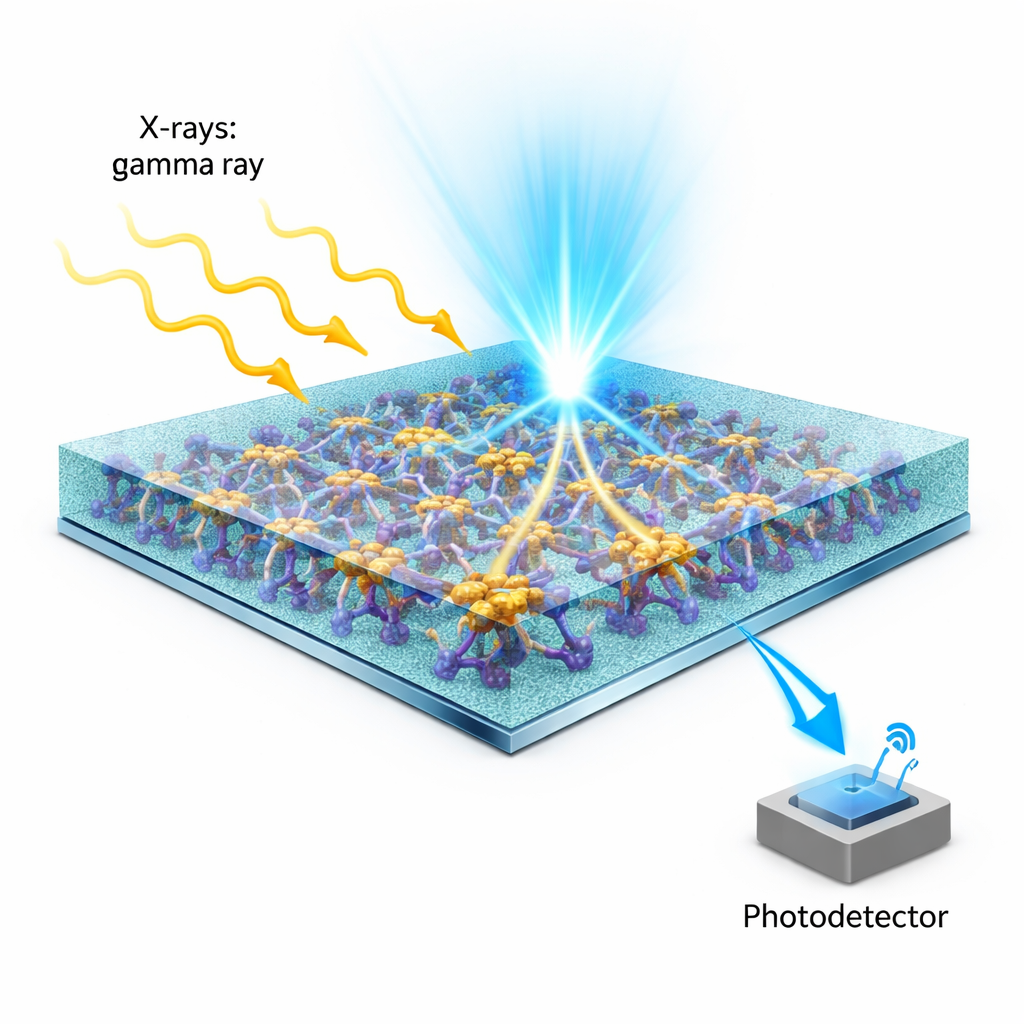
Devices called scintillation counters sit at the heart of many scanners and detectors. They use special materials that convert incoming radiation into a tiny flash of visible or ultraviolet light, which is then read by a photodetector and turned into an electrical signal. The challenge is to have flashes that are both bright and extremely short-lived—lasting only trillionths of a second—so that overlapping events can be separated cleanly. Existing materials either respond fast but emit too few photons, or emit many photons but respond too slowly, especially at room temperature. This trade-off has limited progress toward ultra-precise medical imaging methods like time-of-flight PET, which aims to pinpoint where in the body gamma rays originate with timing accuracy of just a few tens of picoseconds.
Building a New Kind of Scintillating Film
The authors turn to metal-organic frameworks, a family of crystalline, sponge-like materials made from metal clusters connected by organic molecules. In this work, they engineer MOFs whose metal nodes contain hafnium, a heavy element that interacts strongly with high-energy photons. The organic linkers are bright, carefully chosen dyes that either emit ultraviolet light directly or pass energy efficiently to a second dye that glows blue with a large color shift between absorption and emission. This big shift reduces re-absorption of the emitted light and helps more photons escape the film. Using a controlled growth process, the team deposits these MOFs as continuous, roughly 20-micrometer-thick films on glass. Detailed structural and spectroscopic studies show that the films retain a well-ordered crystal framework, short distances between light-emitting molecules, and high internal surface area—all features that promote rapid movement of excited energy within the material.
Turning High-Energy Radiation into Ultrafast Light
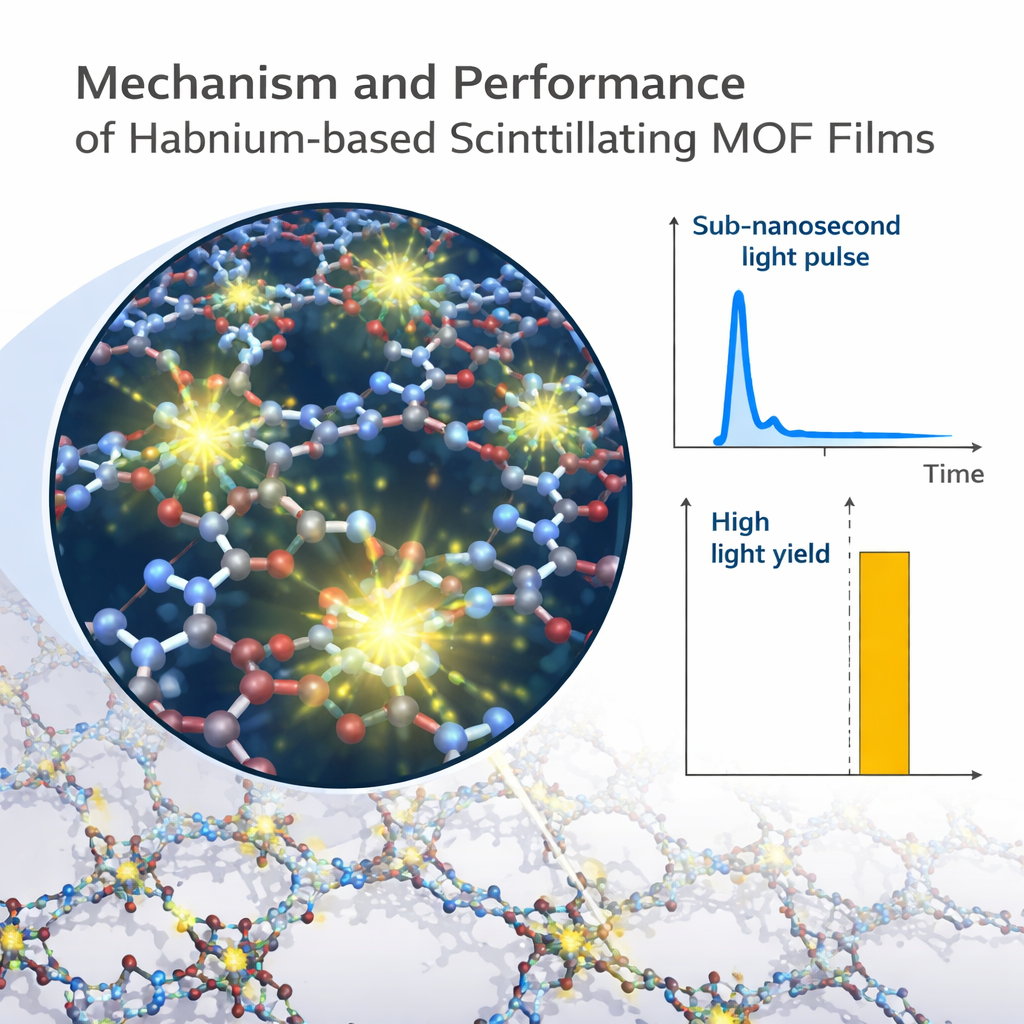
When X‑rays or gamma rays strike the hafnium-based MOF, the heavy hafnium clusters help stop and absorb the radiation, creating charges that recombine on the organic molecules as excited states. These excitations then hop extremely quickly from molecule to molecule. In films that contain two types of ligands, energy is funneled to a small fraction of blue-emitting molecules with very high efficiency, while in single-ligand films the original molecules emit ultraviolet light directly. Time-resolved measurements under pulsed X‑ray excitation reveal that the resulting light pulses are incredibly fast: down to about 150 picoseconds in the ultraviolet-emitting films and under a nanosecond in the blue-emitting ones. At the same time, the films maintain a light yield of around ten thousand photons per mega–electron volt of absorbed energy, a level that surpasses most fast organic scintillators and even many cutting-edge hybrid systems.
A Clever Way to Speed Things Up
The study also uncovers an unusual mechanism that helps shorten the light pulses. Because the excited states move so rapidly and are packed closely, two of them can occasionally collide and annihilate each other, reducing the overall number of excitations but making the remaining population decay faster. This controlled self-quenching, usually considered a drawback, is here turned into an advantage: it trims the scintillation duration without pushing the light yield below useful levels. Simulations and modeling, combined with measurements at different X‑ray energies, show that this effect becomes stronger when more excitations are created, in line with the observed dependence of pulse length on photon energy. Using these measured speeds and brightness, the authors estimate that detectors built from such films could achieve coincidence timing resolutions on the order of 30–50 picoseconds in realistic PET-like geometries—approaching the ambitious 10-picosecond target now being pursued worldwide.
From Lab Films to Future Scanners
To a non-specialist, the take-home message is that the researchers have created thin, solid films that convert high-energy radiation into bright flashes of light that are both very quick and efficient at room temperature. By combining heavy hafnium nodes with carefully chosen light-emitting molecules arranged in an ordered framework, they achieve a rare balance of speed and brightness. These MOF films remain stable under humidity, long-term storage, and repeated irradiation, making them promising candidates for the next generation of medical imaging detectors and high-energy physics instruments that need to see exactly when and where each particle hits.
Citation: Dhamo, L., Perego, J., Villa, I. et al. Ultrafast scintillating metal-organic framework films. Nat Commun 17, 1834 (2026). https://doi.org/10.1038/s41467-026-68546-6
Keywords: scintillation detectors, metal-organic frameworks, time-of-flight PET, X-ray imaging, radiation detection materials