Clear Sky Science · en
Regulating Pb off-centering distortion for white-light emission in 2D halide perovskites
Lighting up homes with smarter crystals
Modern white LEDs often need several different materials mixed together, which can waste energy and limit how natural the light looks. This study explores a special class of layered crystals called 2D halide perovskites that can glow white all by themselves. By learning how the tiny building blocks inside these crystals shift and distort, the authors show how to make them shine more efficiently and more controllably—knowledge that could help create simpler, brighter, and more colorful lighting and display technologies.
Flat crystals built like a club sandwich
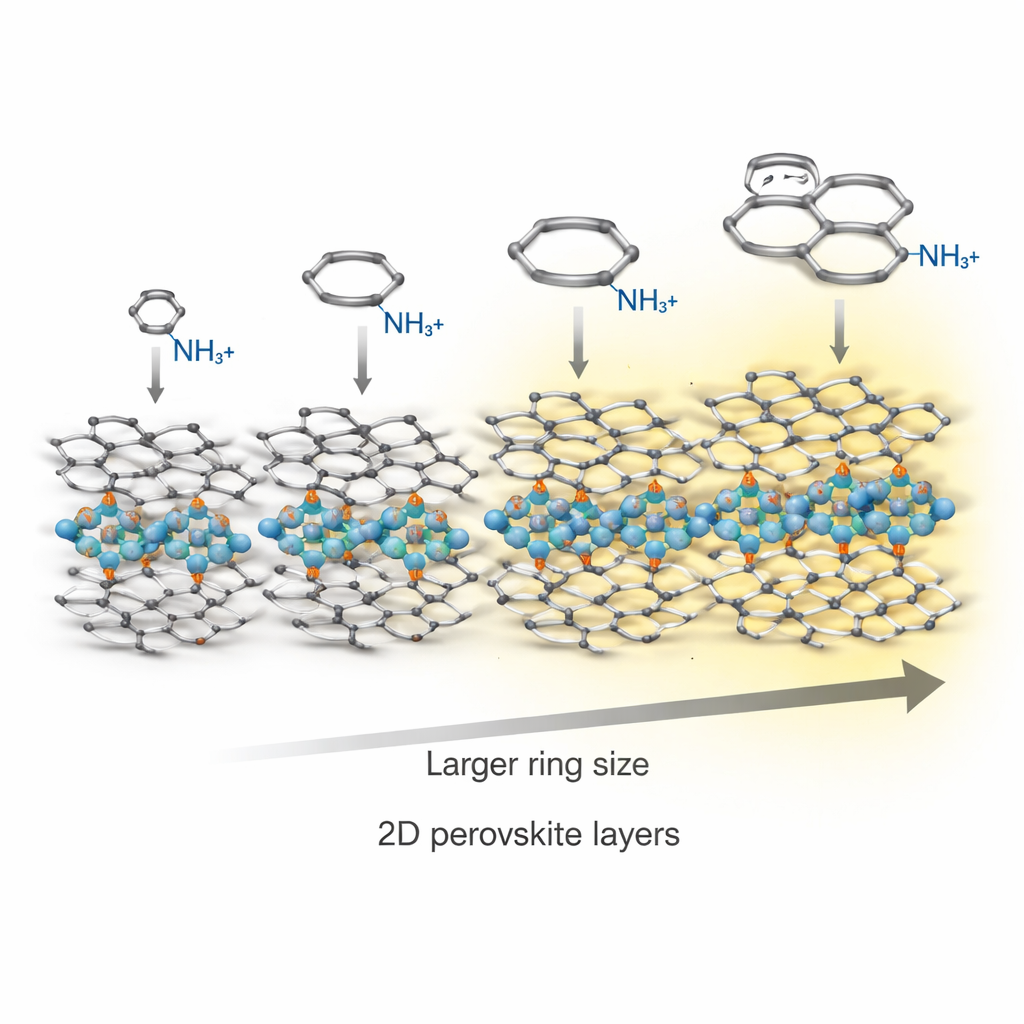
Two-dimensional halide perovskites are crystals made of repeated sheets: an inorganic layer that carries charge, and organic molecules that act like spacers and protection. In this work, the inorganic layer is made of lead and bromine atoms linked into a network of octahedra, while the organic part consists of ring-shaped molecules (small carbon rings with an attached NH3+ group). These sheets stack into a natural “quantum well,” strongly holding on to light-excited electron–hole pairs called excitons. Because the organic layer is water-repelling, these 2D crystals are more stable than their 3D cousins, making them promising for real devices like LEDs and photodetectors. The central question of the paper is how subtle changes in the organic rings reshape the inorganic layer and, in turn, control how the crystal emits light.
How trapped light makes broad white glow
Many of these 2D lead bromide perovskites show broad, white-like emission that does not come from simple band-edge recombination, but from self-trapped excitons. In simple terms, when an exciton forms, it can distort the surrounding lattice, fall into its own local “pothole,” and get stuck there before releasing light. This self-trapping is driven by strong coupling between electrons and vibrations of the crystal (phonons). Until now, scientists disagreed on which kind of structural distortion mattered most: tilting of neighboring octahedra out of the plane or a distortion caused by the lead atom shifting away from the center of its octahedron (a Jahn–Teller–type effect related to lead’s lone electron pair). By preparing a family of crystals that differ only in the size of the cyclic organic ring (from three to six carbons), the authors could tune the structure cleanly and watch how the light emission responds.
Ring size subtly pushes atoms off center
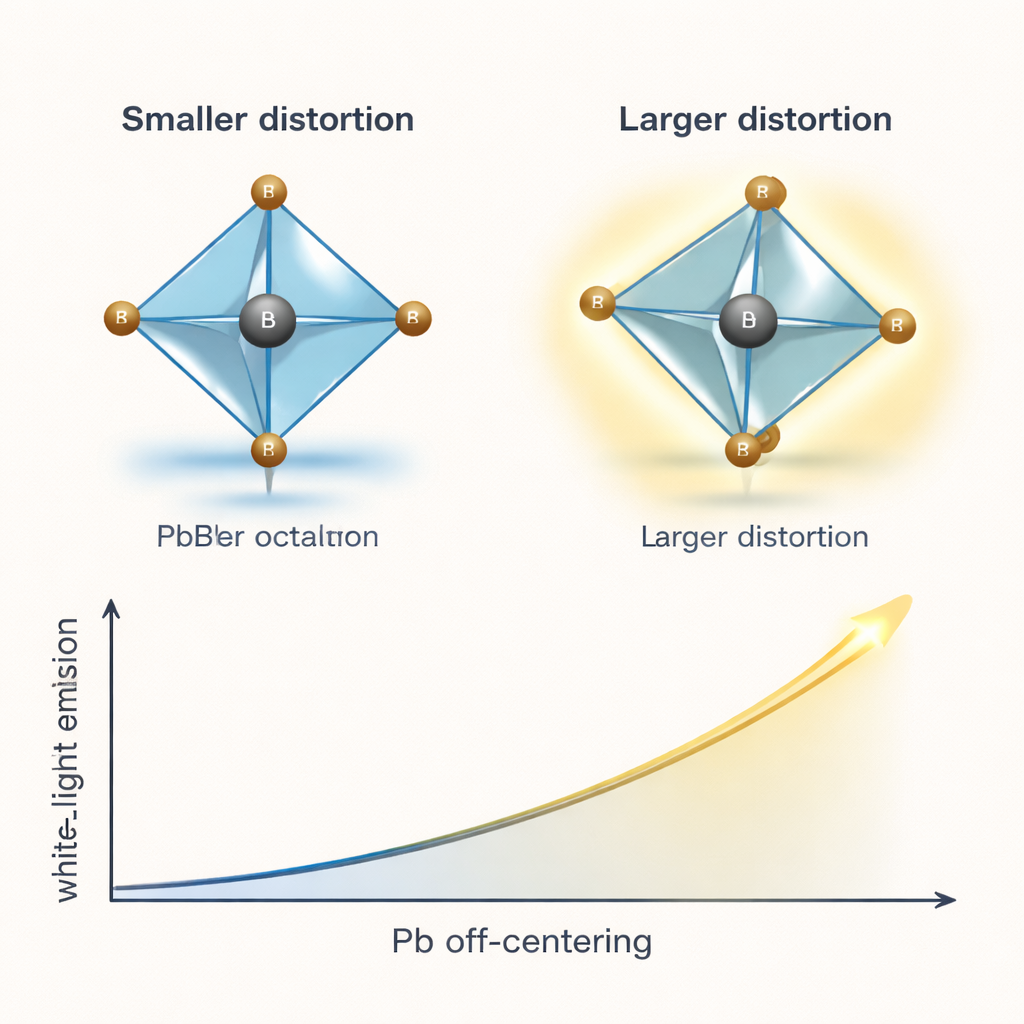
Using X-ray diffraction, the team mapped how the inorganic network bends and stretches as the organic ring grows. Larger rings push the NH3+ group deeper into the pockets between octahedra, changing hydrogen bonds and the way the octahedra fit together. Somewhat counterintuitively, as the ring size increases, the overall out-of-plane tilting of the octahedra goes down, but the lead atom becomes more clearly off-center inside its bromine cage. This off-centering enhances the activity of lead’s lone electron pair and strengthens short-range electron–phonon interactions. Photoluminescence spectra show that crystals with larger rings have stronger broad, low-energy emission attributed to self-trapped excitons and larger shifts between absorption and emission, signaling deeper localization of the excitons.
Watching vibrations and distortions in real time
To connect structure, vibrations, and light emission, the researchers performed temperature-dependent photoluminescence, ultrafast transient absorption, and Raman spectroscopy. They extracted a large Huang–Rhys factor for all samples—a measure of strong electron–phonon coupling—with the largest values in crystals containing the biggest rings. Ultrafast measurements revealed coherent lattice vibrations launched right in the spectral region where self-trapped excitons absorb, indicating that specific phonon modes actively help form these trapped states. Fourier analysis and Raman data showed that the type and energy of the activated phonons shift as the ring grows, and the amplitude of these vibration-driven signals increases, again pointing to stronger coupling. Surprisingly, analysis of phonon dephasing and Raman linewidths showed that the crystals with stronger coupling are not “softer”; in fact, larger rings make the lattice more rigid and less anharmonic, mainly by restricting motion through steric hindrance.
Computational view of deeper traps
First-principles calculations completed the picture. When the lead–bromine octahedra are artificially distorted in a Jahn–Teller-like fashion, the computed electron and hole densities contract around the distorted region, confirming the formation of self-trapped excitons. Configuration-coordinate diagrams show that, as ring size increases, both the energy gained by self-trapping and the lattice deformation energy become larger, while the emission energy shifts lower. This means that excitons fall into deeper local wells and are less likely to escape, making broad white emission more robust. Taken together, experiment and theory show that lead off-centering, not simple octahedral tilting or overall softness, is the key dial that controls self-trapped exciton emission in these 2D perovskites.
What this means for future white LEDs
For a non-specialist, the main message is that the exact way atoms sit and shift inside these layered crystals—especially how far the lead atoms move off center—largely determines how efficiently they can emit white light. By carefully choosing and shaping the surrounding organic molecules, engineers can tune this off-centering distortion and thus turn broad, stable white emission up or down without adding extra phosphors or complex device stacks. This insight provides a practical roadmap for designing simpler, more efficient white-light LEDs and other light-emitting devices based on 2D perovskites, using structural “knobs” at the atomic scale instead of trial-and-error chemistry.
Citation: Zhang, Y., Guo, Y., Feng, M. et al. Regulating Pb off-centering distortion for white-light emission in 2D halide perovskites. Nat Commun 17, 1833 (2026). https://doi.org/10.1038/s41467-026-68545-7
Keywords: 2D halide perovskites, white-light emission, self-trapped excitons, electron-phonon coupling, Jahn-Teller distortion