Clear Sky Science · en
Dimensionality-dependent electronic and vibrational dynamics in low-dimensional organic-inorganic tin halides
Why tiny crystals and vibrations matter
Modern solar cells, LEDs and lasers all rely on how a material handles light energy in the first trillionths of a second after illumination. This paper explores a new family of lead-free tin-based materials where changing the shape of the crystal—from flat sheets to wire-like chains—dramatically alters how light-made particles and atomic vibrations talk to each other. Understanding this hidden conversation could help design safer, more efficient light-harvesting and light-emitting devices.
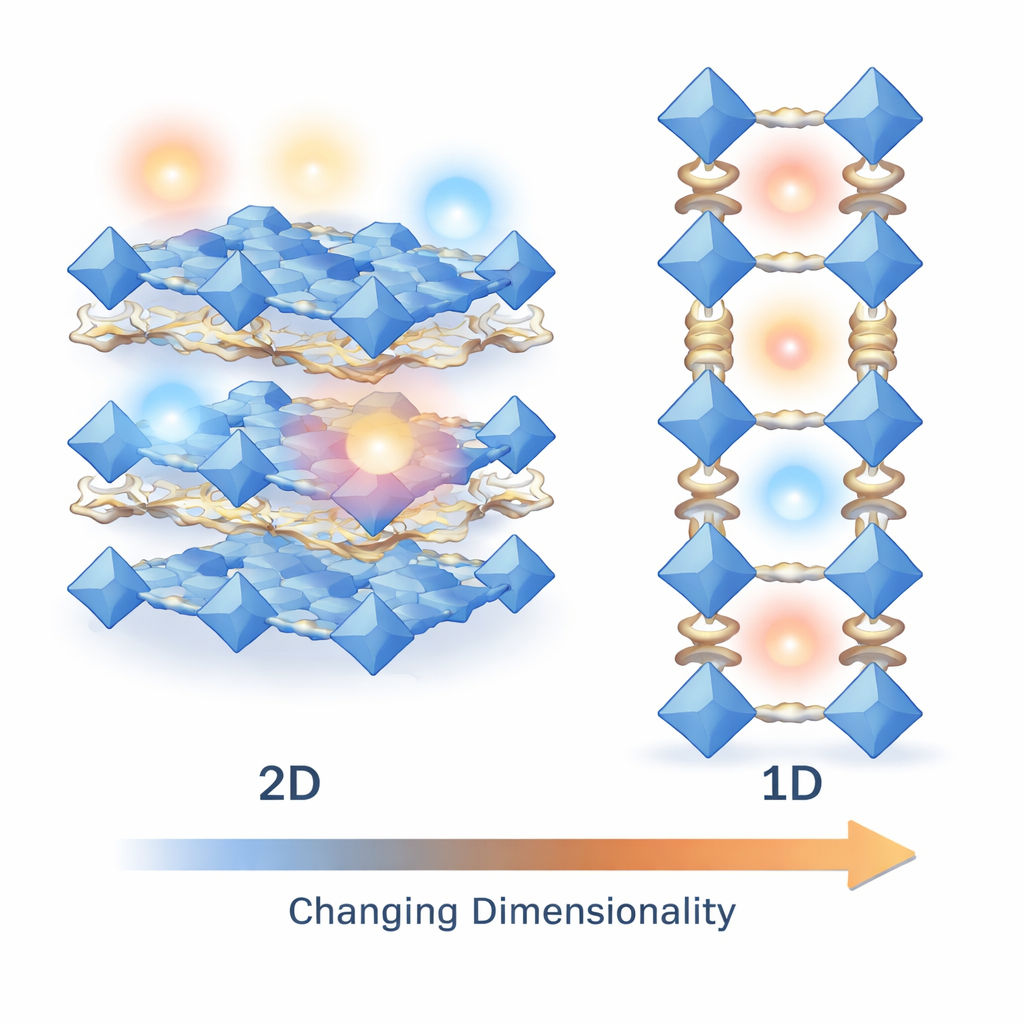
Two ways to build the same material
The researchers studied hybrid materials made from tin and iodine atoms combined with soft organic molecules that act like spacers. By altering how much of the organic component they used, they could steer the crystals into two distinct forms. In the two-dimensional (2D) form, tin–iodine units stack into broad layers, like sheets of paper. In the one-dimensional (1D) form, they line up into chains, like strands of spaghetti, separated by the organic molecules. Although the chemical ingredients are nearly the same, this change in architecture strongly affects how the material absorbs and emits light.
Free gliders versus stuck fireflies
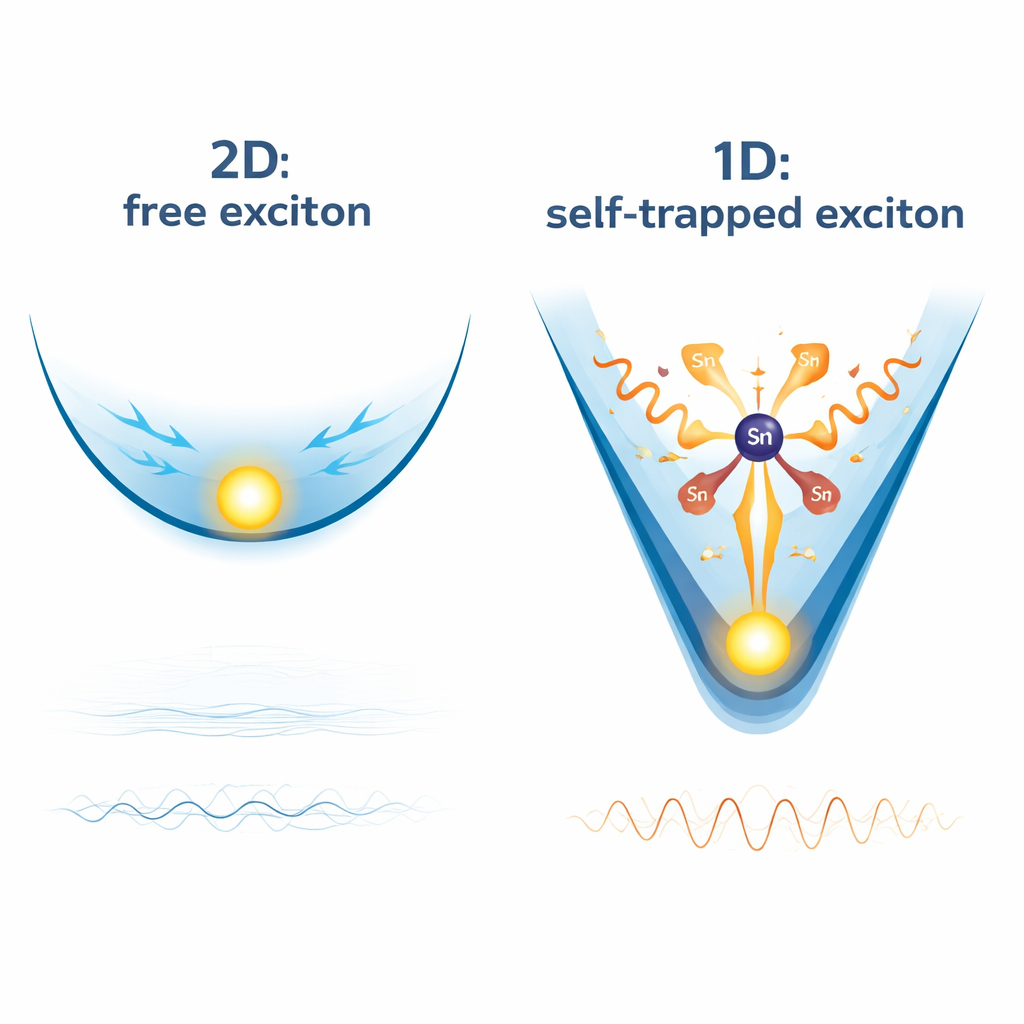
When these materials absorb light, they create excitons—bound pairs of electrons and holes that carry energy. In the 2D version, most excitons remain relatively free to move within the layers. They emit a narrow band of light with only a small shift in color compared with what was absorbed, a sign that the surrounding lattice is only gently disturbed. In the 1D version, however, excitons quickly become “self-trapped”: the exciton distorts its local environment, and that distortion in turn pins the exciton in place. This produces a very broad, strongly red-shifted glow and unusually long-lived light emission, ideal traits for white-light sources.
Filming atomic vibrations in real time
To see how atomic motions drive these behaviors, the team used ultrafast pump–probe spectroscopy, firing femtosecond laser pulses to first excite the material and then track the response. In the 2D sheets, they saw typical signatures of hot carriers that cool and then recombine, with the dynamics strongly changing as the excitation intensity increased—evidence of processes like Auger recombination, where multiple excitations interact. In contrast, the 1D chains showed a broad signal associated with self-trapped excitons whose decay hardly changed even when the researchers cranked up the light intensity by orders of magnitude. This insensitivity indicates that each exciton is so well wrapped by its local distortion that it barely “feels” its neighbors.
Vibrational fingerprints of self-trapping
Crucially, the 1D system displayed clear oscillations in the transient signals at room temperature—coherent vibrational wavepackets—while the 2D system showed similar oscillations only when cooled to low temperatures. By mathematically extracting the frequencies of these ripples and combining the analysis with detailed computer simulations, the authors identified specific tin–iodide vibrational modes that couple most strongly to the excitons. In the 1D chains, a mode involving a combination of wagging and asymmetric stretching of the tin–iodide units, near 106 cm⁻¹, dominates and provides the main pathway for excitons to become self-trapped, reshaping the local lattice in the process. In the 2D layers, the active modes are fewer, weaker, and at lower frequency, consistent with much gentler lattice rearrangements.
From crystal shape to device potential
By linking crystal dimensionality, exciton behavior, and vibrational dynamics, this study shows that simply shifting a material from 2D sheets to 1D chains can turn free-roaming excitations into strongly localized light emitters. That switch is controlled not by changing the chemistry, but by adjusting structure and the resulting strength of coupling between light-made excitons and lattice vibrations. These insights provide design rules for future lead-free tin halide materials, where engineers can dial in either efficient charge transport for solar cells or bright, stable emission for lighting and display technologies, just by tuning how the crystal is built in one, two, or potentially even zero dimensions.
Citation: He, Y., Cai, X., Araujo, R.B. et al. Dimensionality-dependent electronic and vibrational dynamics in low-dimensional organic-inorganic tin halides. Nat Commun 17, 758 (2026). https://doi.org/10.1038/s41467-026-68544-8
Keywords: tin halide perovskites, exciton-phonon coupling, self-trapped excitons, low-dimensional materials, ultrafast spectroscopy