Clear Sky Science · en
1,3-and 1,4-linked polysaccharides uptake in intestinal cells relies on clathrin/dynamin 1/Rab5-dependent endocytosis
Why Big Sugars Matter More Than We Thought
Many medicines and health supplements made from plant and fungal sugars (polysaccharides) are swallowed as pills or powders. For decades, scientists assumed these long, water-loving sugar chains were simply too large to cross the gut wall and reach our bloodstream intact. This study overturns that dogma, showing that several types of polysaccharides can, in fact, slip through intestinal cells using a highly organized cellular import system—opening new possibilities for mouth‑delivered “sugar drugs.”
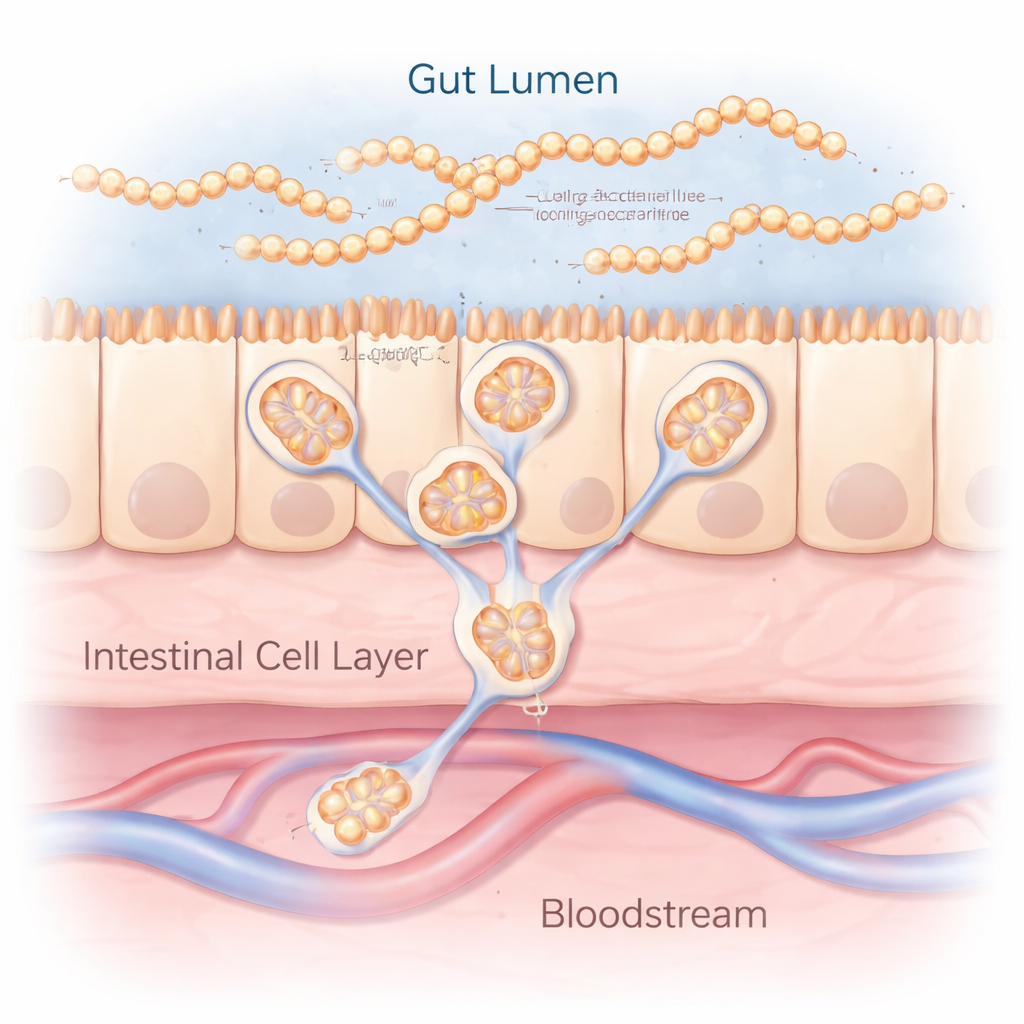
Long Sugar Chains That Break the Rules
Polysaccharides are long chains of simple sugars and are one of life’s four major building blocks, alongside proteins, fats, and DNA. They already underpin dozens of medicines, from blood thinners like heparin to joint‑health products such as chondroitin sulfate. Yet most are injected because their bulky size and strong attraction to water were thought to prevent them from entering the bloodstream when taken by mouth. The authors challenged this view by studying a panel of natural polysaccharides with different chain linkages and electrical charges, including a mushroom‑derived beta‑glucan (GFPBW1) and a plant‑derived alpha‑glucan (WGE) used as model compounds.
Crossing the Gut Wall Without Falling Apart
First, the team tested whether these large sugars could cross a layer of human intestinal‑like cells grown on a membrane. Using chemical tags and chromatography, they found that multiple polysaccharides traveled through the cell layer with surprisingly high efficiency. Importantly, their “fingerprints” before and after transport were nearly identical, implying that the chains did not need to be chopped into tiny pieces to get across. The researchers then moved to living rats and mice, giving them tagged versions of GFPBW1 and WGE by mouth. In blood samples and liver tissue, they detected intact, labeled polysaccharides—again with only minimal changes in size—demonstrating that at least a portion of these large molecules survives digestion, crosses the intestinal lining, and enters circulation.
The Cell’s Cargo Gate: Clathrin Endocytosis
How do such big molecules pass through individual intestinal cells? The study points to a cellular import route called clathrin‑mediated endocytosis, a process normally used to internalize hormones, nutrients, and even viruses. Under the microscope, incoming polysaccharides were seen colocalizing with clathrin, a scaffold protein that shapes small inward‑budding pockets in the cell membrane. When the researchers blocked clathrin chemically or depleted its heavy chain (CLTC) using genetic tools, uptake of the sugars dropped sharply in cultured cells. Mice engineered to lack clathrin specifically in their intestinal lining absorbed far less polysaccharide after oral dosing. Physical binding tests further showed that the model polysaccharides can attach directly to clathrin, strengthening the case that they hitch a ride through this coated‑pit system.
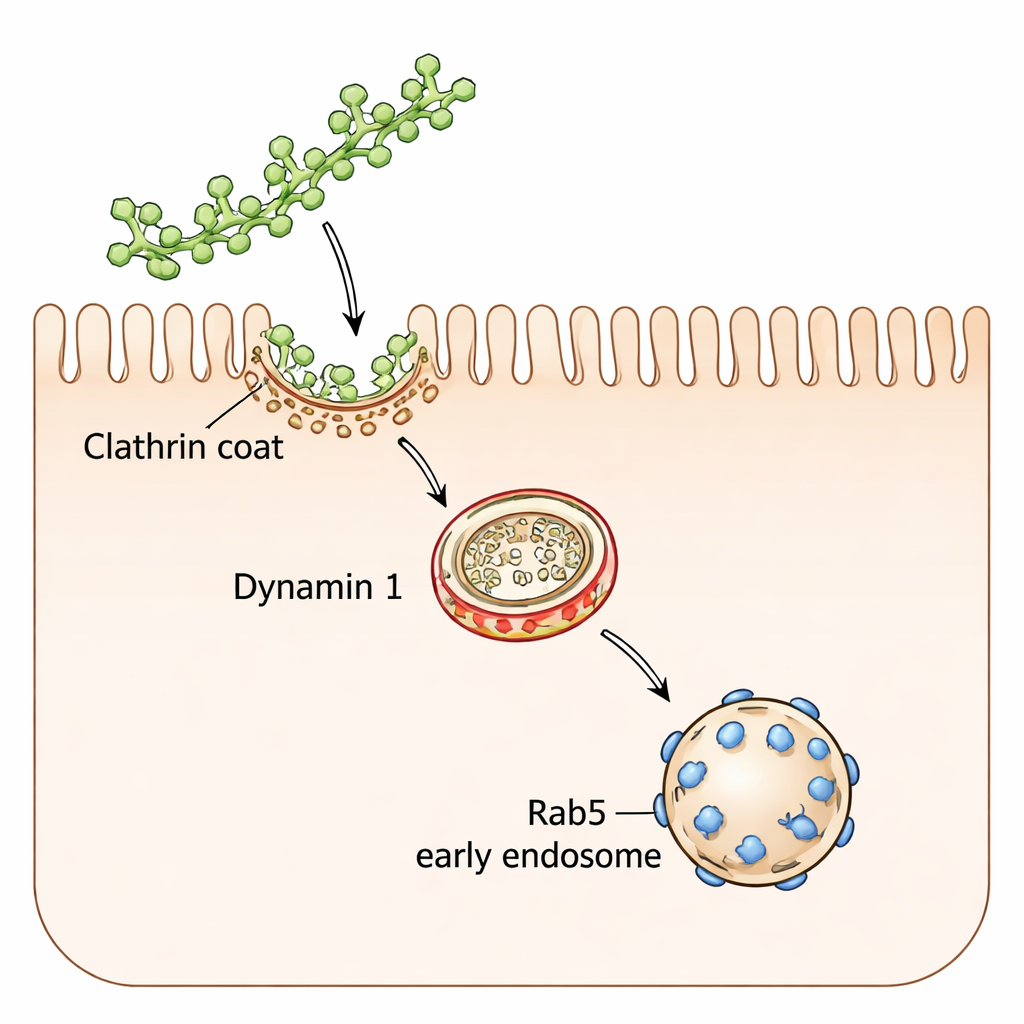
Key Helpers and Traffic Signals Inside the Cell
Clathrin did not act alone. The protein dynamin 1, which pinches off budding vesicles like a tightening ring, proved essential: inhibiting or knocking down dynamin 1 curtailed polysaccharide entry, whereas boosting its levels enhanced uptake. Another partner, Rab5—a controller of early endosomes, the cell’s initial sorting stations—was also crucial. Internalized polysaccharides frequently colocalized with Rab5, and animals lacking Rab5 in all tissues showed greatly reduced intestinal uptake. Once inside, the sugars traveled through a network of compartments, including early endosomes, lysosomes (the cell’s recycling centers), the Golgi apparatus, and the endoplasmic reticulum, although the exact route varied between normal intestinal cells and cancer‑like cells.
Specialized Cell Surface Receptors as Sugar “Docking Stations”
The study also uncovered a layer of selectivity. Certain membrane receptors—proteins that sense signals outside the cell—were needed for particular polysaccharides. The immune receptor Dectin‑1 was important for the beta‑glucan GFPBW1, while a growth‑factor receptor called BMPRIA played a major role in taking up WGE. The epidermal growth factor receptor (EGFR) also supported entry of both sugars, even though direct physical binding was not always detectable, suggesting more complex, indirect mechanisms. When these receptors were silenced, uptake of their matching polysaccharides dropped; when overproduced, uptake rose. In addition, two major signaling pathways inside cells, Wnt/β‑catenin and NF‑κB, helped regulate how readily cells internalized the sugars.
What This Means for Future Pills and Powders
Overall, the work shows that some large, natural polysaccharides can be taken up intact from the gut into the bloodstream using a coordinated system built around clathrin, dynamin 1, Rab5, and specific membrane receptors. For non‑specialists, the key message is that “too big to be absorbed” is not a hard rule: our intestinal cells have active gateways that can import certain complex sugars. Understanding these gateways and their protein helpers may guide the design of new, orally available polysaccharide‑based drugs and supplements that reliably reach targets throughout the body, potentially making injections unnecessary for some treatments.
Citation: Liao, W., Cao, D., Wang, Y. et al. 1,3-and 1,4-linked polysaccharides uptake in intestinal cells relies on clathrin/dynamin 1/Rab5-dependent endocytosis. Nat Commun 17, 1831 (2026). https://doi.org/10.1038/s41467-026-68542-w
Keywords: polysaccharide absorption, intestinal endocytosis, clathrin dynamin Rab5, oral carbohydrate drugs, beta glucan uptake