Clear Sky Science · en
Multidimensional helical dichroism from a chiral molecular nanoassembly
Why Twisted Light Matters for Molecules
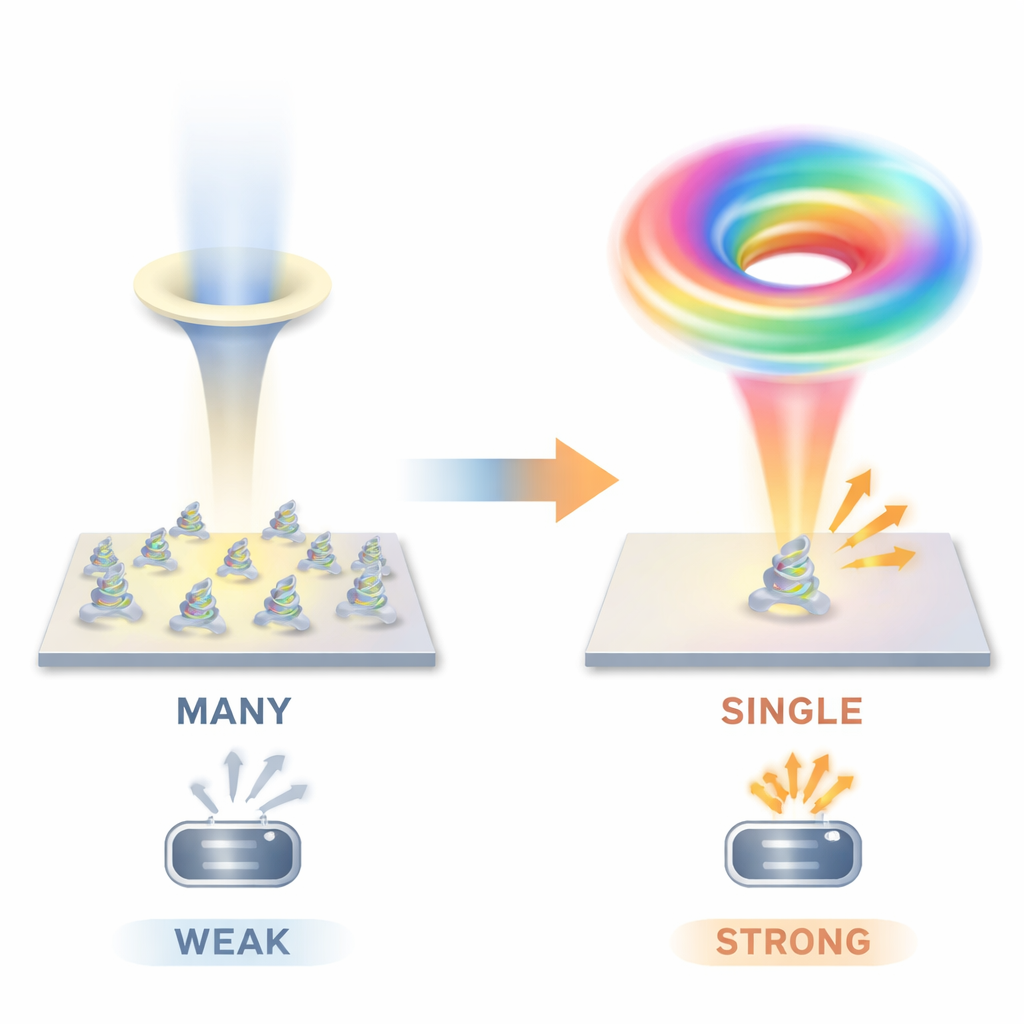
Many everyday drugs, fragrances and biological molecules come in left- and right-handed versions that can behave very differently in the body. Detecting which “handedness” is present—its chirality—is essential in medicine, chemistry and materials science, but the usual optical tests often need huge numbers of molecules to produce a measurable signal. This work shows how specially shaped “twisted” light and self-assembled nano‑scale structures can boost these chiral signals so much that even a single nanoassembly becomes easy to read.
From Mirror-Image Molecules to Tiny Helical Structures
Chiral molecules are those that cannot be superimposed on their mirror image, like left and right hands. When light interacts with such molecules, it can be absorbed slightly differently depending on the light’s own handedness. Conventional instruments use circularly polarized light—light whose electric field spins like a corkscrew—to detect this difference, a technique known as circular dichroism. Unfortunately, that effect is usually extremely weak because the wavelength of light is much larger than a single molecule, so the light averages over many molecules at once and the signal nearly vanishes.
Building Nano Helices That Echo Molecular Handedness
To get around this size mismatch, the researchers let chiral molecules assemble themselves into larger, helical nano‑structures. They mixed left‑ or right‑handed versions of the amino acid derivative cystine (L‑ or D‑cystine) with cadmium ions under alkaline conditions. The result was micrometer‑scale twisted nanoassemblies whose overall shape—right‑handed or left‑handed—directly reflected the handedness of the starting molecules. In other words, the molecular chirality was scaled up into a structure comparable in size to the wavelength of visible light, making it a much bigger “target” for light to sense.
Exploiting Light’s Orbital Twist
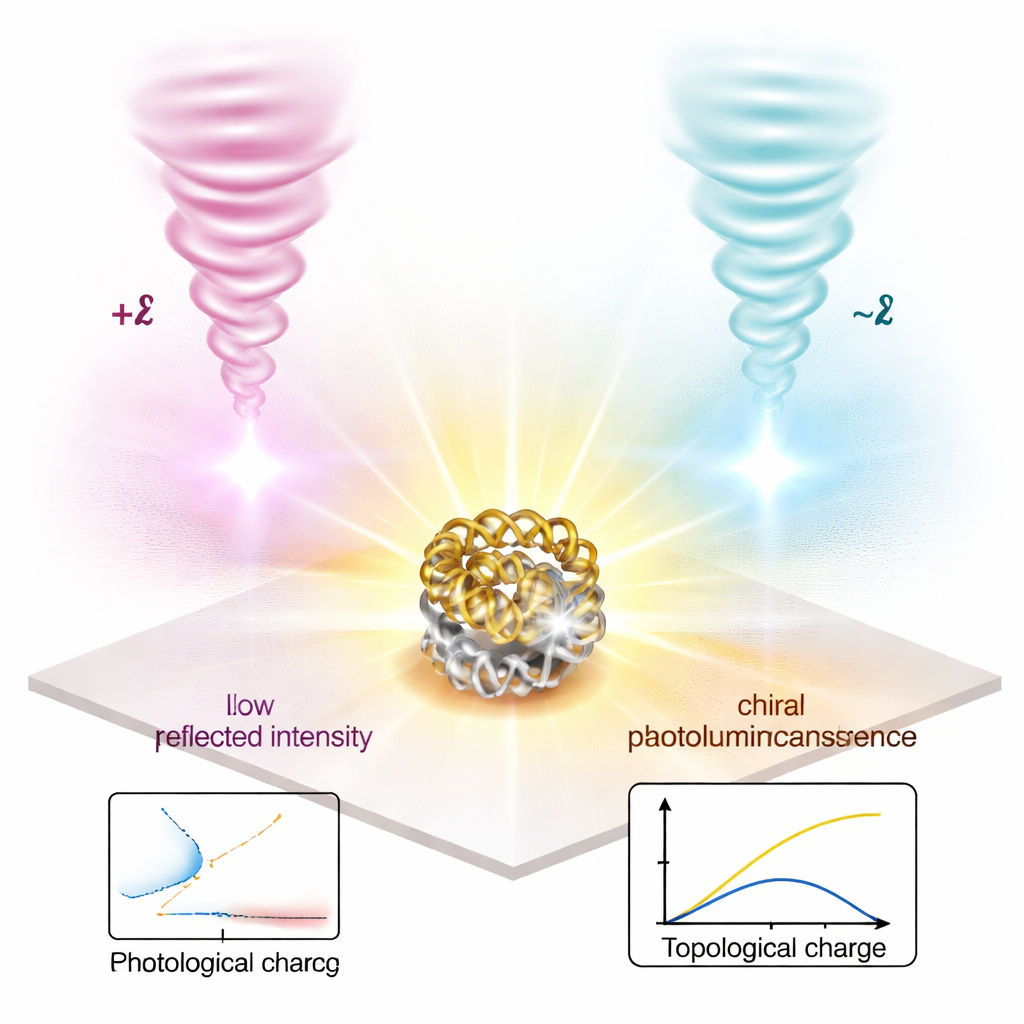
Instead of relying only on light’s spin (circular polarization), the team turned to light’s orbital angular momentum, carried by so‑called vortex beams. These beams have a helical wavefront and a donut‑shaped intensity profile, meaning the light’s phase winds around the beam axis like a spiral staircase. By focusing such a vortex beam down to the size of a single chiral nanoassembly, the researchers created a strongly twisted local light field that could couple much more efficiently to the helical structure. They then compared how much light was reflected, and how much photoluminescence was emitted, when the beam’s twist was left‑handed versus right‑handed, a difference they termed helical dichroism.
Stronger Signals from a Single Nanoassembly
The experiments showed that a single chiral nanoassembly produced dramatically different responses to vortex beams of opposite twist. For the fundamental reflected light, the asymmetry between the two directions of twist reached 0.53—a huge increase compared with the tiny values typical of standard circular dichroism. In the emitted photoluminescence, the asymmetry factor climbed even higher, up to 1.18, meaning one twisted beam produced more than double the signal of the other. These strong, mirror‑image responses for left‑ and right‑handed nanoassemblies matched detailed computer simulations and could be tuned by changing the light’s wavelength, polarization and angle of incidence, revealing a rich, multidimensional landscape of chiral light–matter interaction.
What This Means for Future Sensing
For a non‑specialist, the key message is that by letting chiral molecules build tiny helical sculptures, and then probing them with equally twisted beams of light, the authors have found a way to greatly amplify the optical fingerprints of molecular handedness. Instead of needing vast numbers of molecules, their approach can extract strong chiral signals from a single nanoassembly, and in multiple optical channels. This concept of “scaling up” molecular chirality and matching it to the twist of light could be adapted to other materials and nanostructures, opening new routes to ultra‑sensitive detection of chiral compounds in medicine, chemistry and beyond.
Citation: Jin, Y., Wang, X., Xia, Z. et al. Multidimensional helical dichroism from a chiral molecular nanoassembly. Nat Commun 17, 1829 (2026). https://doi.org/10.1038/s41467-026-68540-y
Keywords: chiral sensing, vortex light, helical dichroism, nanoassemblies, orbital angular momentum