Clear Sky Science · en
Pathfinding quantum simulations of neutrinoless double-β decay
Why this strange decay matters
Deep inside atomic nuclei, some of the rarest processes in nature may hold clues to why anything exists at all. One such process, called neutrinoless double beta decay, could reveal whether neutrinos are their own antiparticles and help explain why the universe contains more matter than antimatter. This article describes how researchers used a state-of-the-art trapped-ion quantum computer to run a pioneering, highly simplified simulation of this exotic decay, showing that today’s quantum hardware can already track key features of the process in real time.
Peeking at nuclear events in yoctoseconds
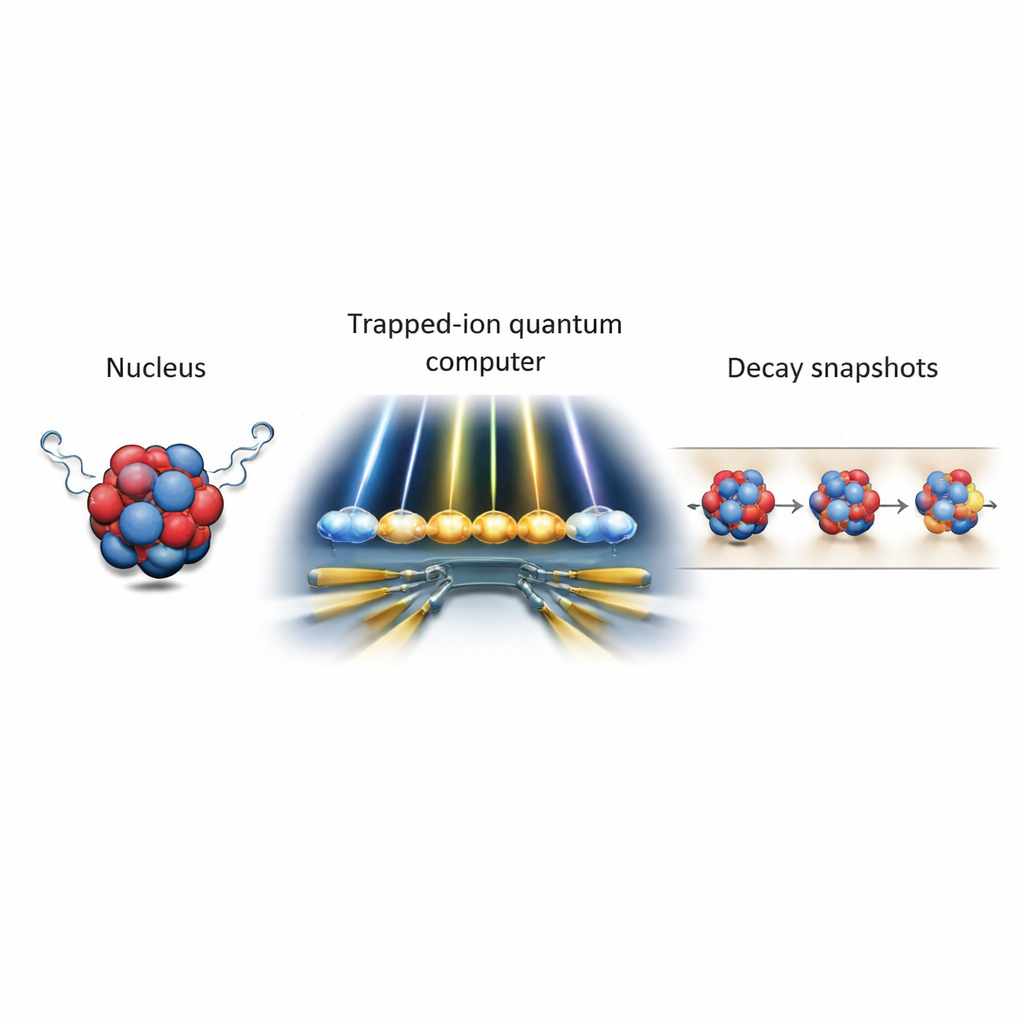
Chemists revolutionized their field when they learned to photograph molecules changing shape on femtosecond (10⁻¹⁵ second) time scales. Nuclear reactions take place on an even more extreme clock: yoctoseconds, or 10⁻²⁴ seconds. Directly probing such fleeting moments inside real nuclei is beyond current experiments, but quantum computers offer another route. By encoding a model nucleus into qubits and letting it evolve under a carefully chosen rule set (a Hamiltonian), one can, in principle, reconstruct “snapshots” of the nuclear quantum state at these unimaginably short times.
A rare decay that rewrites the rulebook
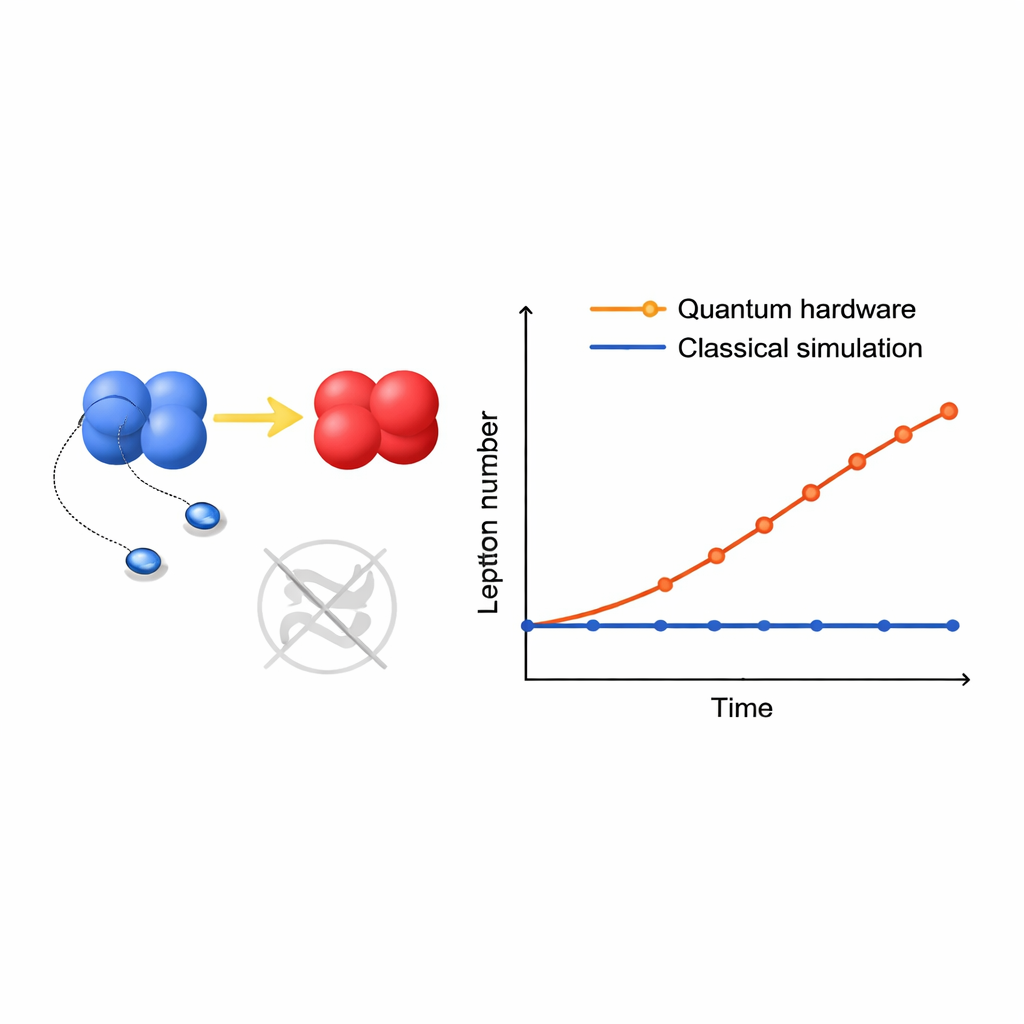
The team focused on neutrinoless double beta decay, a hypothetical process in which a nucleus effectively turns two of its neutrons into two protons and two electrons, but emits no neutrinos. In ordinary double beta decay, two neutrinos carry away lepton number, a bookkeeping quantity that distinguishes matter particles like electrons and neutrinos from other forms of matter. If a version of the decay occurs without neutrinos, lepton number must be violated, which would mean that the neutrino is a Majorana particle—its own antiparticle. That, in turn, is closely tied to ideas about how the early universe could have generated more matter than antimatter.
Building a tiny universe inside a quantum chip
Because simulating a full three-dimensional nucleus is far beyond current hardware, the researchers constructed a drastically simplified world: quantum chromodynamics (the theory of quarks and gluons) in one space dimension plus time, with just two spatial lattice sites. They included up and down quarks, electrons, and neutrinos, and represented them using 32 qubits on IonQ’s Forte-generation trapped-ion quantum computers. An extra four qubits served as “flags” to detect when the device strayed outside the intended computational space. The model incorporated a strong-force interaction between quarks, an effective weak interaction that allows quarks to transform and emit leptons, and a special neutrino mass term that explicitly breaks lepton number. The parameters were deliberately tuned so that double beta decay is favored while ordinary single beta decay is suppressed, mimicking the conditions in real experimental target nuclei.
Making fragile hardware tell a clear story
To run the simulation, the team first prepared a simple two-baryon initial state—an analog of a small nucleus—with no electrons or neutrinos present. They then used a standard “Trotterized” scheme to approximate how this state changes over time under the chosen interactions, implemented as a sequence of native two-qubit gates on the device. Because current quantum computers are noisy, the authors co-designed both the physics setup and the circuits to fit the hardware’s strengths: all-to-all connectivity, a specific entangling gate, and a limited error budget. They introduced several approximations to shorten the circuits, used spare qubits as error flags, and applied advanced error-mitigation techniques such as circuit “twirling” and aggressive post-selection of measurement outcomes that obeyed known conservation laws. With these measures, they could reliably extract key observables from circuits containing around 470 two-qubit gates.
Seeing lepton number violation emerge
The central quantities the researchers tracked were the electric charge carried by electrons and the overall lepton number as functions of time. They compared two versions of the model: one with the special neutrino mass term switched off, where lepton number should be conserved, and one with it switched on, where the rare neutrinoless decay channel opens. On IonQ’s Forte Enterprise device, the team observed that when the neutrino mass term was present, the lepton number clearly drifted away from zero over time, while it remained consistent with zero when the term was absent. At the latest simulated time, the difference between these two cases corresponded to a 10-sigma statistical signal—far beyond random chance—and closely matched ideal, noiseless simulations performed on classical computers.
What this pathfinding result really shows
This study does not yet predict how often neutrinoless double beta decay happens in real nuclei; the model is intentionally low-dimensional and uses unphysical parameter choices. Its importance lies instead in demonstrating that present-day quantum computers can already follow the real-time, many-body dynamics of a toy nuclear system and clearly resolve a lepton-number–violating signal. The work sets practical benchmarks for circuit depth, error mitigation, and qubit count, and outlines a roadmap toward more realistic nuclear simulations as hardware improves. Ultimately, such simulations could complement large underground experiments and classical calculations, helping physicists decode whether neutrinos are their own antiparticles and why our universe is made of matter rather than an equal mix of matter and antimatter.
Citation: Chernyshev, I.A., Farrell, R.C., Illa, M. et al. Pathfinding quantum simulations of neutrinoless double-β decay. Nat Commun 17, 1826 (2026). https://doi.org/10.1038/s41467-026-68536-8
Keywords: quantum computing, neutrinoless double beta decay, neutrino physics, nuclear reactions, trapped-ion quantum computer