Clear Sky Science · en
Distributed multi-parameter quantum metrology with a superconducting quantum network
Measuring the Invisible with Quantum Networks
Modern technology relies on our ability to measure tiny changes in time, fields, and forces. From GPS navigation to searching for dark matter, many frontiers now demand sensitivities beyond what ordinary instruments can deliver. This work shows how a network of superconducting quantum processors can team up as a powerful new kind of measuring device, able to read out not just one signal, but several related quantities at once, with much higher precision than classical methods.
A Quantum Network Built from Superconducting Chips
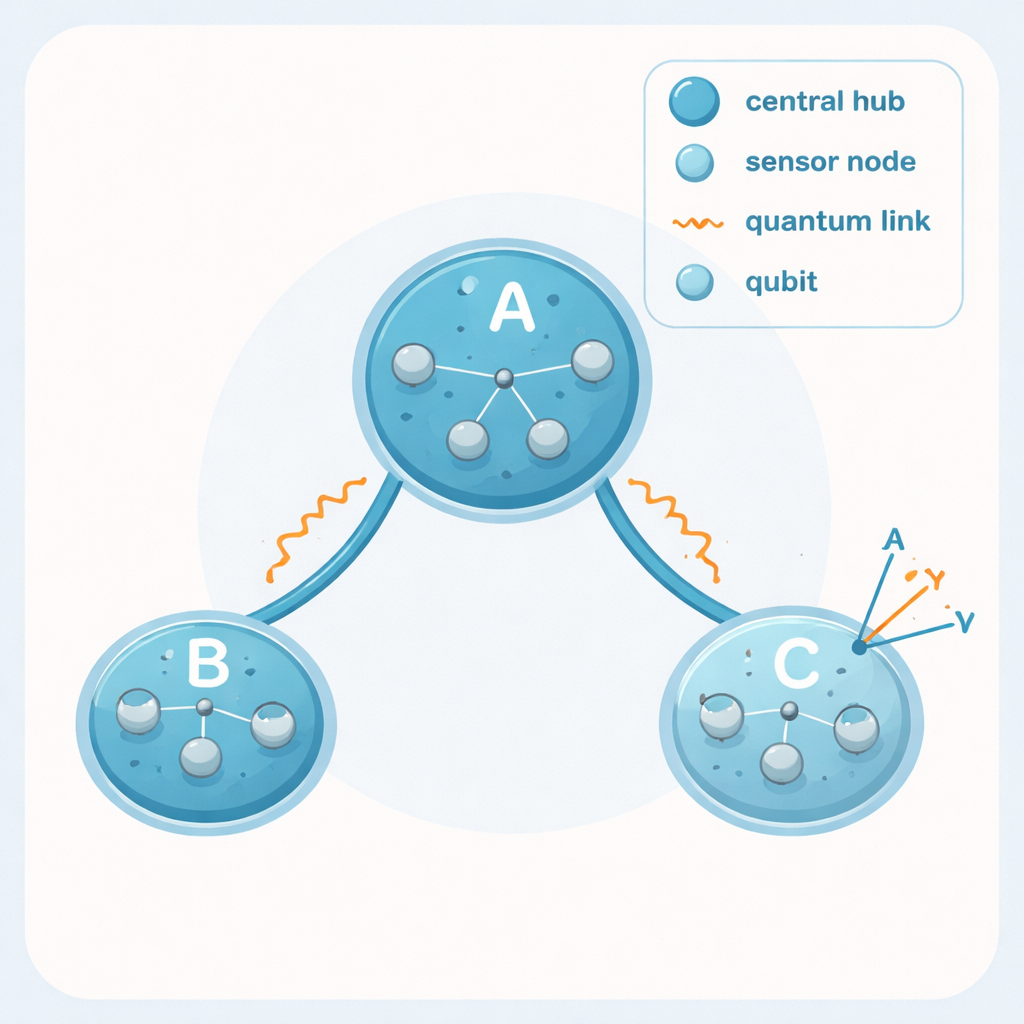
The researchers built a small quantum network made of superconducting circuits cooled to near absolute zero. At its center is a “hub” module, linked by low-loss microwave cables to several “sensor” modules. Each module contains four quantum bits, or qubits, which can be entangled—placed in shared quantum states where measuring one affects the others instantly, no matter where they are. The microwave cables act like quantum highways, shuttling delicate quantum states between chips with state-transfer efficiencies close to 99%. This modular design means more sensor nodes can be added over time, much like plugging new devices into a high-speed data network.
Turning Entanglement into a Better Field Sensor
In the first set of experiments, the team used this network to measure all three components of a magnetic-like vector field located at a remote sensor module. They started by creating an entangled pair of qubits in the central hub. One qubit stayed at the hub as an ancilla, while the other was transferred to a sensor module that “felt” the unknown field. The sensor qubit was then subjected to a carefully designed sequence: a short interaction with the field, followed by a control operation, repeated many times. After these cycles, the sensor’s state was sent back to the hub, where both qubits were measured together. By repeating this process hundreds of times and analyzing the statistics with a maximum-likelihood method, the researchers could extract precise estimates of the field’s strength and direction.
Beating Classical Limits for Multiple Quantities at Once
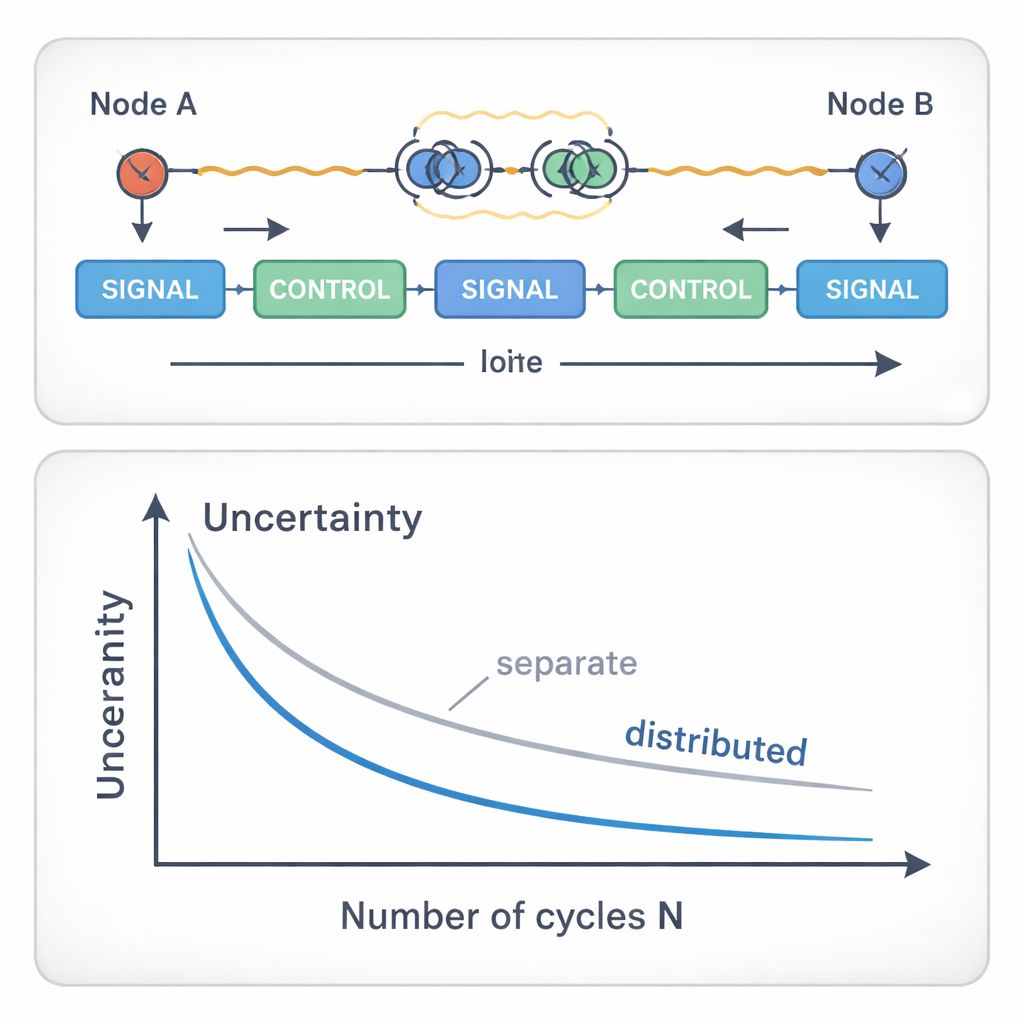
Ordinarily, trying to measure several properties of a quantum system at the same time forces trade-offs in precision, because the underlying quantities can be incompatible. Here, the team showed that by combining entangled states with an adaptive “sequential” strategy—where control pulses are gradually tuned based on earlier measurements—they could avoid these usual compromises. As they increased the number of signal–control cycles, the uncertainty in all three field parameters shrank with an inverse-square scaling, the most favorable trend allowed by quantum mechanics for the resources used. Compared with a more conventional approach that measures each parameter separately using unentangled probes, their method improved the precision (in terms of variance) by up to 13.72 decibels, meaning more than twenty times less uncertainty.
Mapping How Fields Change Across Space
The second experiment pushed the idea further by using two remote sensor modules to measure how a field changes from place to place—the gradient of the field. The researchers created a four-qubit Greenberger–Horne–Zeilinger (GHZ) state, a strongly entangled state spread across the two sensor nodes, routed through the central hub. Each pair of qubits at a sensor experienced its local field, and the entire entangled state was then processed with similar signal–control cycles and joint measurements. From the resulting data, the team could directly estimate the differences between the fields at the two locations. When they compared this distributed strategy to one that only used local entanglement within each module and then subtracted the two separate readings, the non-local approach consistently performed better, achieving a 3.44 decibel reduction in total variance for two-dimensional field gradients.
From Laboratory Demo to Quantum Sensor Networks
In plain terms, this work shows that a network of entangled superconducting qubits can act as a highly tuneable measuring machine, able to read out both the value of a remote field and how that field varies across space, with precision beyond what separate sensors can achieve. The combination of fast superconducting hardware, low-loss quantum links, and adaptive control allows the system to reach fundamental quantum limits while handling several parameters at once. As these techniques are scaled up and combined with error correction and more complex network layouts, they could enable practical quantum-enhanced sensor networks for applications such as electromagnetic field monitoring, navigation, and searches for faint signals from new physics.
Citation: Zhang, J., Wang, L., Hai, YJ. et al. Distributed multi-parameter quantum metrology with a superconducting quantum network. Nat Commun 17, 1825 (2026). https://doi.org/10.1038/s41467-026-68535-9
Keywords: quantum sensing, superconducting qubits, quantum networks, entanglement-enhanced metrology, magnetic field gradients