Clear Sky Science · en
Hypersensitive detection of single millimeter vascular emboli from adhesive in vivo
Why safer surgical glues matter
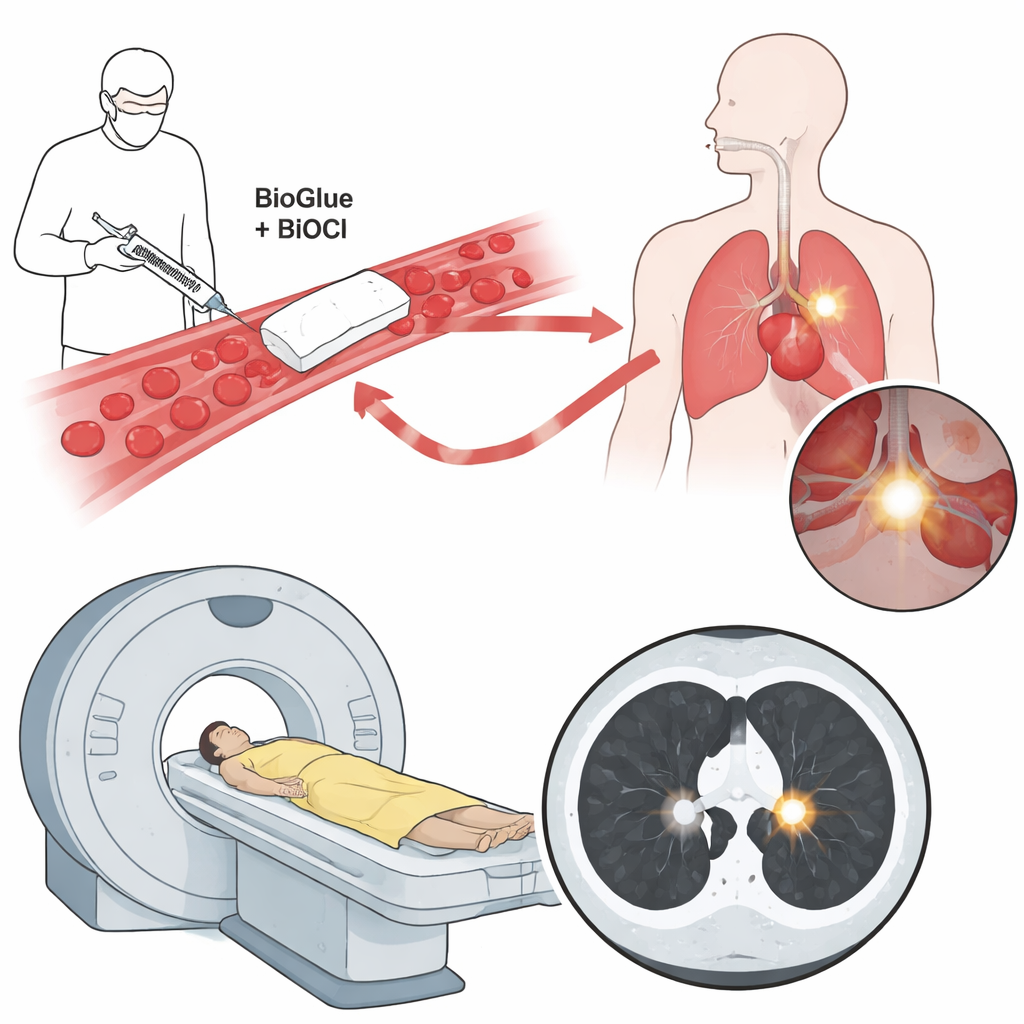
Modern surgery increasingly relies on medical glues to quickly stop bleeding and seal fragile tissues. These products can shorten operations, reduce blood loss, and improve recovery. But in rare cases, tiny pieces of glue can break off, travel through the bloodstream, and block vital vessels in the lungs, heart, or brain. Because current scans struggle to see these glue fragments directly, they can be hard to diagnose before serious damage occurs. This study introduces a simple way to make surgical glue visible on standard hospital CT scanners, so even millimeter‑sized clots of glue can be found and monitored inside the body.
A hidden risk in a common surgical tool
Commercial tissue glues such as BioGlue are widely used to seal blood vessels and control bleeding. Although highly effective, they carry a small but serious risk: loose bits of hardened glue can enter the circulation and lodge in arteries, especially in the lungs. Unlike blood clots, these glue emboli do not respond to blood‑thinning drugs and typically require surgical or catheter‑based removal. Presently, doctors mostly detect them indirectly, by noticing where contrast dye stops flowing on CT angiography, or by using invasive tools like intravascular ultrasound and optical probes. These approaches are not ideal for early, routine screening and cannot easily distinguish glue from other material such as calcium deposits.
Making glue glow on CT scans
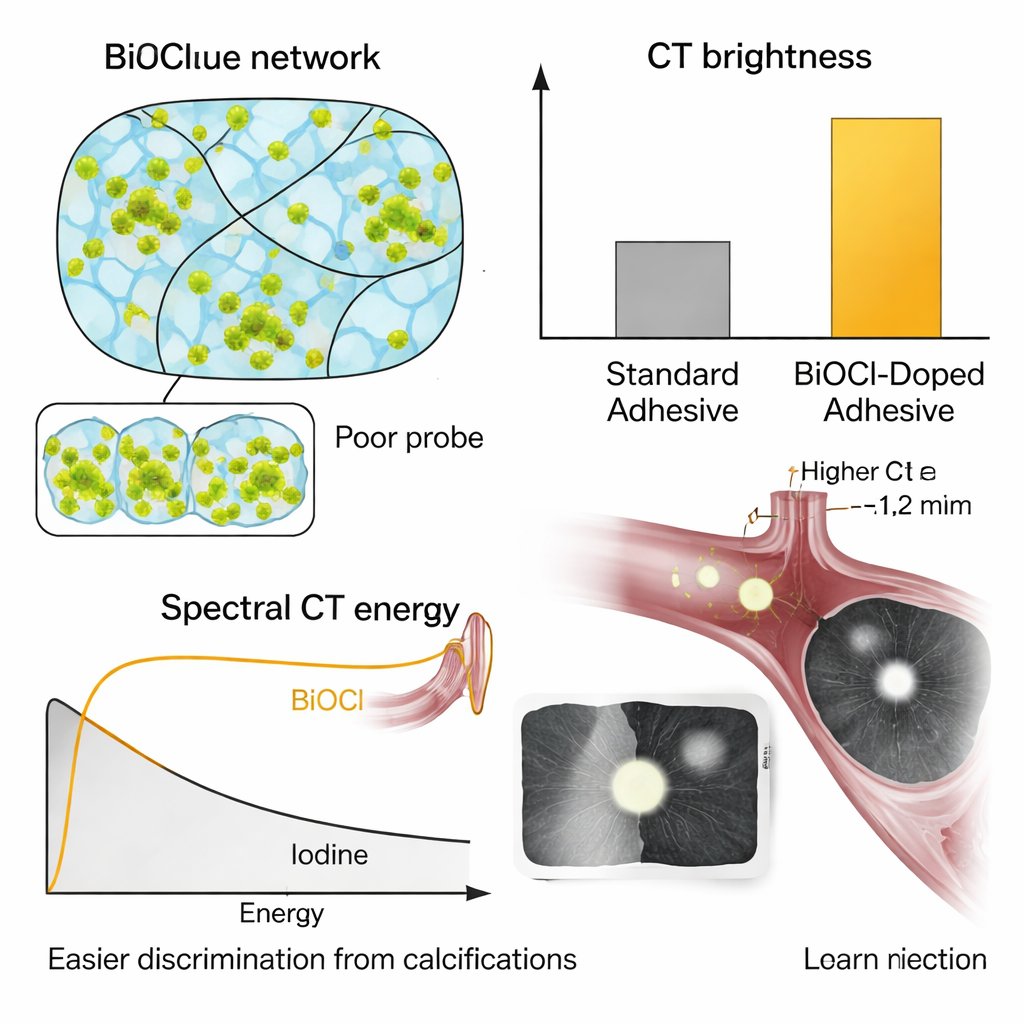
The researchers’ idea is straightforward: mix a highly X‑ray‑visible ingredient into the glue so that both the glue at the surgical site and any fragments that break off show up clearly on CT. They chose a bismuth‑based compound called bismuth oxychloride (BiOCl), because bismuth is excellent at blocking X‑rays, is relatively inexpensive, and is already used in several medicines. The team compared several bismuth materials and conventional iodine contrast agents. BiOCl turned out to disperse evenly in the glue, stay put instead of washing out, and provide strong CT contrast without altering how quickly the glue sets or how firmly it sticks. With an optimized bismuth level, the doped glue (called Bi‑BioGlue) appeared much brighter than soft tissues on CT while remaining physically stable and releasing almost no bismuth ions over time.
Proving it still works as a lifesaving sealant
Any change to a surgical adhesive must preserve its core job: stopping bleeding. In tests on pig blood vessels, Bi‑BioGlue bonded tissues just as strongly as regular BioGlue. In a rat liver injury model, both versions sealed a deep cut within about 30 seconds and reduced blood loss by nearly 80 percent compared with no treatment. CT scans in living rats showed that a small blob of Bi‑BioGlue attached to a major vein or liver surface stayed visible for weeks as it gradually shrank, allowing doctors to track its location and slow degradation over a 42‑day period. Laboratory and animal safety studies suggested low toxicity: key organs looked normal under the microscope, blood tests remained stable, and the animals maintained normal weight.
Finding tiny emboli and telling them apart from look‑alikes
The crucial test was whether this labeled glue could reveal very small emboli in the body. The team carved Bi‑BioGlue into tiny cubes and implanted them into rats’ veins so they would travel to the lungs. With carefully chosen CT settings, they could reliably detect emboli as small as 1.2 millimeters lodged in pulmonary arteries, appearing as bright spots against the background of blood vessels and lung tissue. They then used an advanced form of CT called spectral CT, which analyzes how different materials absorb X‑rays across energy levels. Because bismuth has a much higher characteristic energy than iodine or calcium, Bi‑BioGlue kept its strong signal even at high X‑ray energies, while iodine contrast and calcium‑based “calcified nodules” faded. This allowed the scanner to distinguish glue emboli from common confounding features such as lung or vascular calcifications.
What this could mean for patients
This work shows that a simple additive can turn a widely used surgical glue into its own built‑in tracking agent, enabling noninvasive CT detection of small glue emboli and long‑term monitoring of glue left inside the body. Importantly, the approach does not change how surgeons use the adhesive or how well it seals tissues; it simply makes the material visible. Although the current results come from rat models and focus on the lungs, the same strategy could, in principle, help doctors monitor glue behavior and detect emboli in coronary, carotid, or brain arteries in future large‑animal and human studies. If proven safe and effective in people, CT‑visible glues like Bi‑BioGlue could add an important safety layer to many operations by turning an invisible surgical risk into something doctors can see and act on early.
Citation: Liu, R., Li, S., Gao, X. et al. Hypersensitive detection of single millimeter vascular emboli from adhesive in vivo. Nat Commun 17, 1823 (2026). https://doi.org/10.1038/s41467-026-68534-w
Keywords: surgical adhesives, pulmonary embolism, CT imaging, bismuth contrast, spectral CT