Clear Sky Science · en
Demonstration of measurement-free universal logical quantum computation
Why Faster, More Reliable Quantum Computers Matter
To turn today’s fragile quantum prototypes into useful machines, we must keep delicate quantum bits (qubits) under control while they run complex algorithms. A major obstacle is that most leading error-correction schemes constantly stop to “ask” qubits what state they are in—measurements that are slow, noisy, and technically demanding. This paper reports the first experimental demonstration of a different route: running a fully universal, fault-tolerant quantum algorithm on encoded qubits without any mid‑circuit measurements, using a trapped‑ion processor. That shift could make future quantum computers faster, simpler, and easier to scale.
Protecting Quantum Information Without Constant Checkups
Quantum error correction spreads the information of one logical qubit across several physical qubits so that mistakes can be spotted and handled. Traditionally, this protection relies on frequent measurements during the computation, followed by quick, conditional corrections—an approach that is especially awkward for hardware such as trapped ions and neutral atoms, where measurements are much slower than logic gates and can disturb neighboring qubits. The authors instead explore “measurement‑free” protocols. Rather than reading out error signals into classical electronics, they coherently copy that information into helper qubits and use only quantum gates to feed it back into the computation. The noisy helper qubits are then reset or replaced, quietly dumping entropy without pausing the algorithm for a measurement step.
Teleporting Quantum States Between Protected Blocks
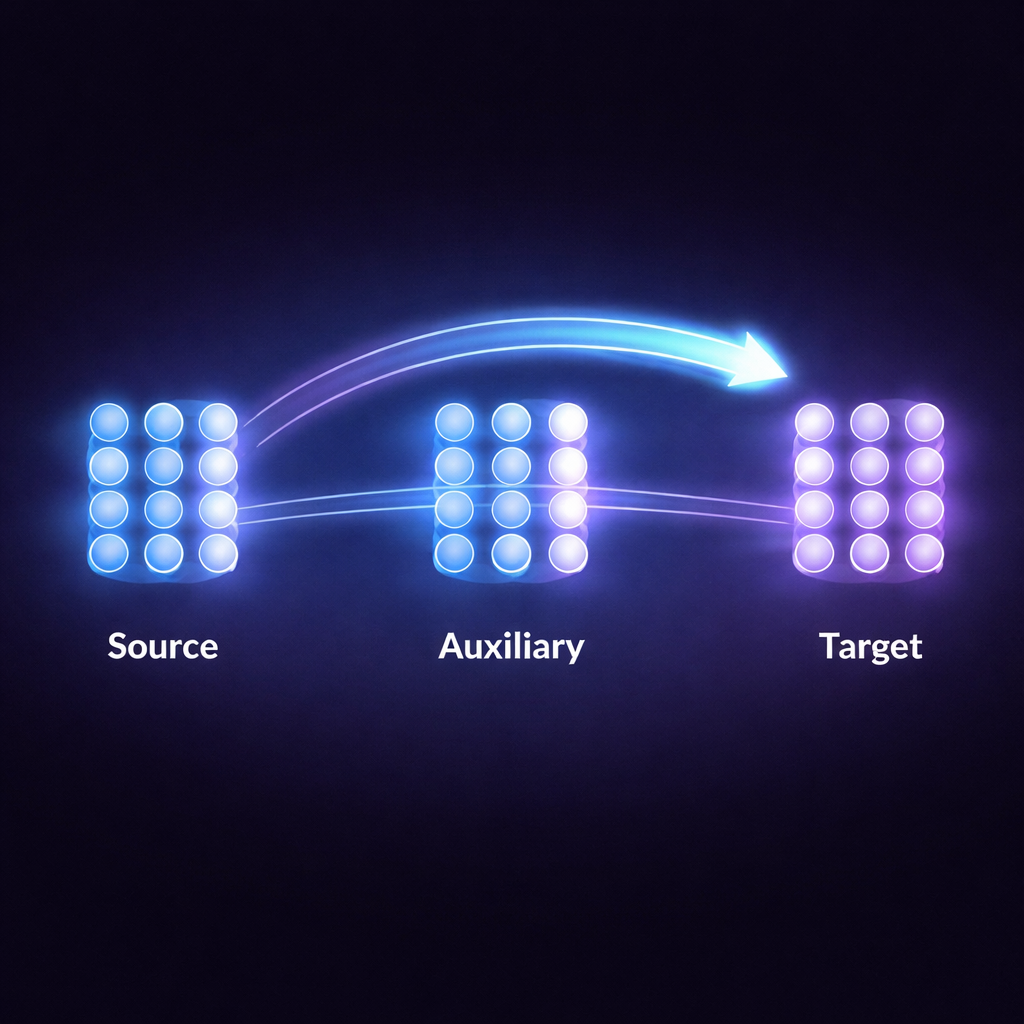
A key building block is moving a protected quantum state from one encoded block to another—logical teleportation—without ever measuring in the middle. Using a small four‑qubit error‑detecting code, the team implements a scheme where a “source” block and a “target” block never touch directly. Instead, both blocks interact only with an auxiliary register of qubits. Information about joint properties of the two logical qubits is coherently mapped onto the auxiliary qubits, which then act as controls for feedback operations that complete the teleportation. By carefully arranging the circuits so that any single physical fault remains detectable, the protocol is fault‑tolerant. Experiments on a 16‑ion device show that logical states can be teleported with fidelities above 90 percent, in line with detailed numerical simulations.
Building a Universal Quantum Toolbox Without Mid‑Circuit Readout
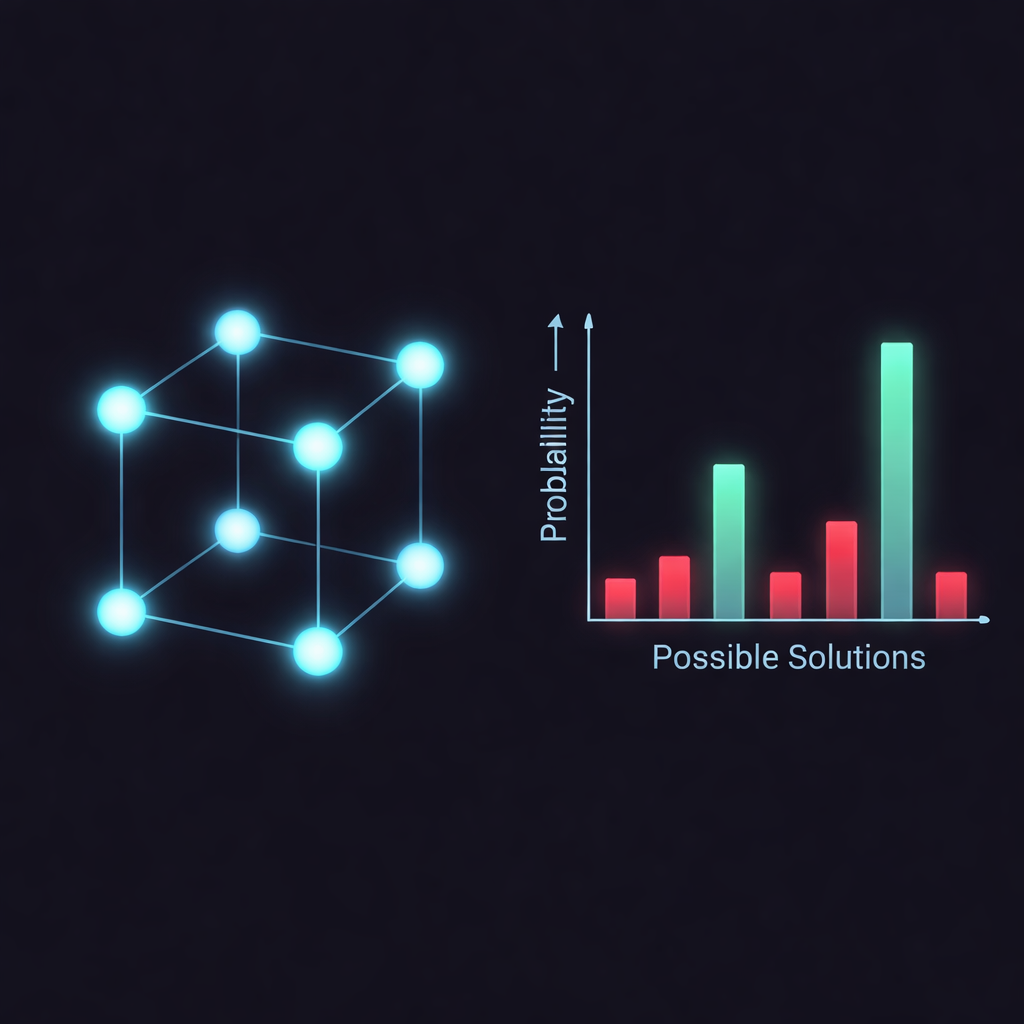
Teleportation alone is not enough; a practical quantum computer also needs a universal set of logical gates that can implement any algorithm. The authors construct such a toolbox on an eight‑qubit error‑detecting code that simultaneously hosts three logical qubits arranged like the corners of a cube. This code naturally supports a powerful three‑qubit gate, known as CCZ, through simple single‑qubit rotations that do not spread errors. What was missing was a high‑quality logical version of the Hadamard gate, which mixes logical 0 and 1 and is essential for most algorithms. The team realizes this gate using a technique called state injection: they prepare a special resource state in a second small code, couple it coherently to the data code, and replace the usual measurement‑and‑correction step with a purely quantum feedback gadget. This measurement‑free logical Hadamard uses only coherent gates and resets, yet remains fault‑tolerant by design.
Running Grover’s Search on Encoded Qubits
With measurement‑free teleportation and a universal gate set in hand, the researchers implement Grover’s search algorithm on three logical qubits encoded in eight physical ions. Grover’s algorithm is a flagship example of how quantum mechanics can speed up the search through an unsorted list, here of eight possible answers. The team redesigns the standard Grover circuit to use only their available logical gates—Hadamard, controlled‑NOT, and CCZ—and executes it on their trapped‑ion processor. In the experiment, the two correct answers appear with a combined probability of about 40 percent in a single run. That falls just short of the best possible classical strategy for this tiny problem size, but simulations show that modest improvements in gate fidelity or qubit coherence—both already demonstrated in related hardware—would push the quantum success probability above the classical limit.
What This Means for the Future of Quantum Machines
For non‑specialists, the main message is that it is possible to perform fully programmable, error‑protected quantum computations without constantly stopping to measure—and thereby disturb—the system. By showing measurement‑free teleportation between encoded blocks, constructing a universal set of logical gates on a compact eight‑qubit code, and using this toolbox to run a full instance of Grover’s algorithm on logical qubits, the work charts a practical route toward faster and more scalable quantum processors. As hardware improves, these ideas could help transform early laboratory prototypes into machines that reliably outperform classical computers on meaningful tasks, all while relying less on slow, error‑prone measurements in the middle of a computation.
Citation: Butt, F., Pogorelov, I., Freund, R. et al. Demonstration of measurement-free universal logical quantum computation. Nat Commun 17, 995 (2026). https://doi.org/10.1038/s41467-026-68533-x
Keywords: quantum error correction, fault-tolerant quantum computing, trapped-ion qubits, measurement-free protocols, Grover search algorithm