Clear Sky Science · en
Twist-stacked black phosphorus for wide-spectral chiral photodetection
Why twisting light and matter matters
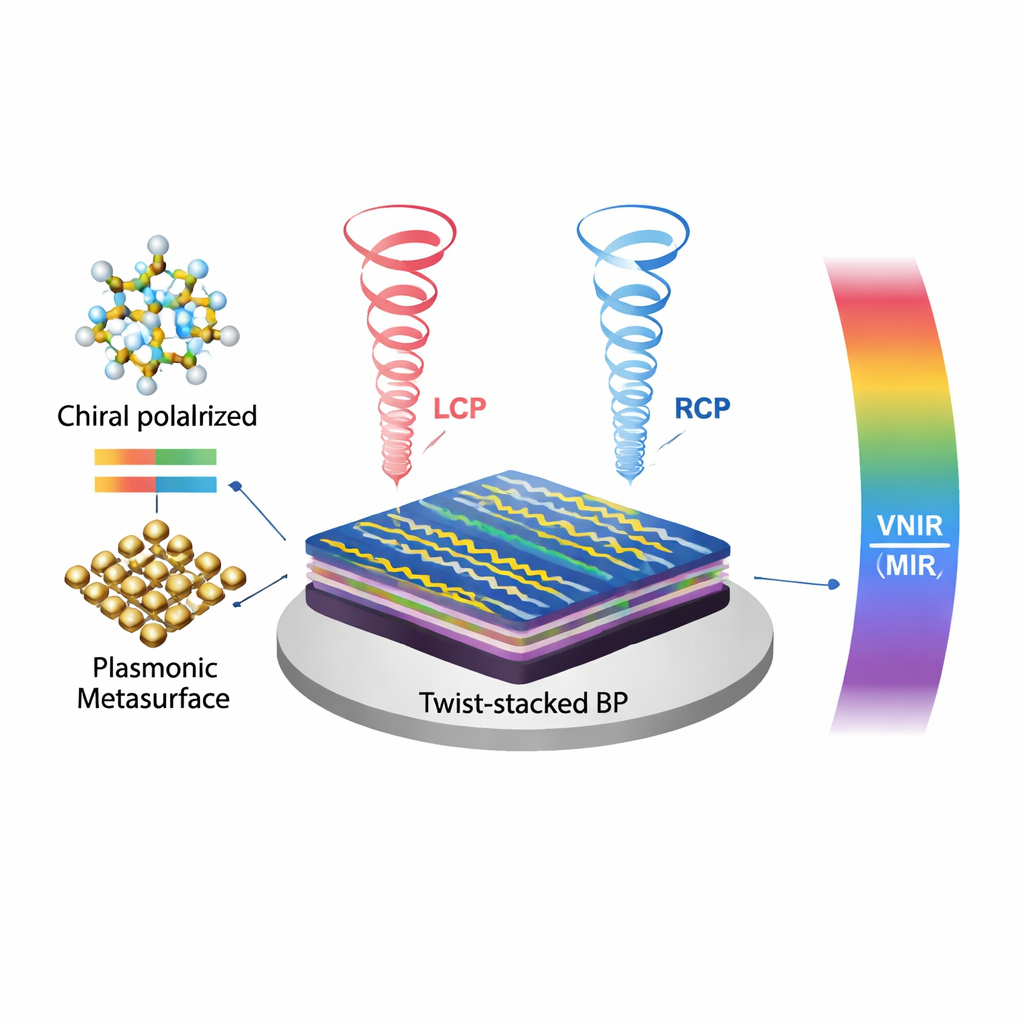
Cameras and sensors usually only measure how bright light is, not the way it twists as it travels. Yet the “handedness” of light—whether it spirals left or right, known as circular polarization—carries rich information used in secure communications, medical imaging, and even quantum technologies. This paper shows how a carefully twisted stack of ultrathin black phosphorus can act as a tiny on-chip detector that not only sees this twist in light, but does so across an unusually wide range of colors, from visible light to mid‑infrared.
The twist in the story
The authors build on a simple problem: existing circularly polarized light (CPL) detectors either work only over a narrow color band or struggle to clearly tell left‑handed from right‑handed light. Organic chiral materials can strongly distinguish handedness but are typically limited to shorter wavelengths and can be confused by ordinary, non‑twisting light. Artificial metallic structures called metasurfaces can be tuned to specific colors, but each device is locked to a narrow band. The team turns instead to black phosphorus, a two‑dimensional semiconductor known for its sensitivity to infrared light and compatibility with silicon chips. On its own, black phosphorus is “achiral,” meaning it has no built‑in preference for left or right twists of light, so it normally responds only to linear polarization. The key idea of this work is to introduce chirality not by changing the chemistry, but by twisting layers of black phosphorus against each other.
Building a tiny chiral sandwich
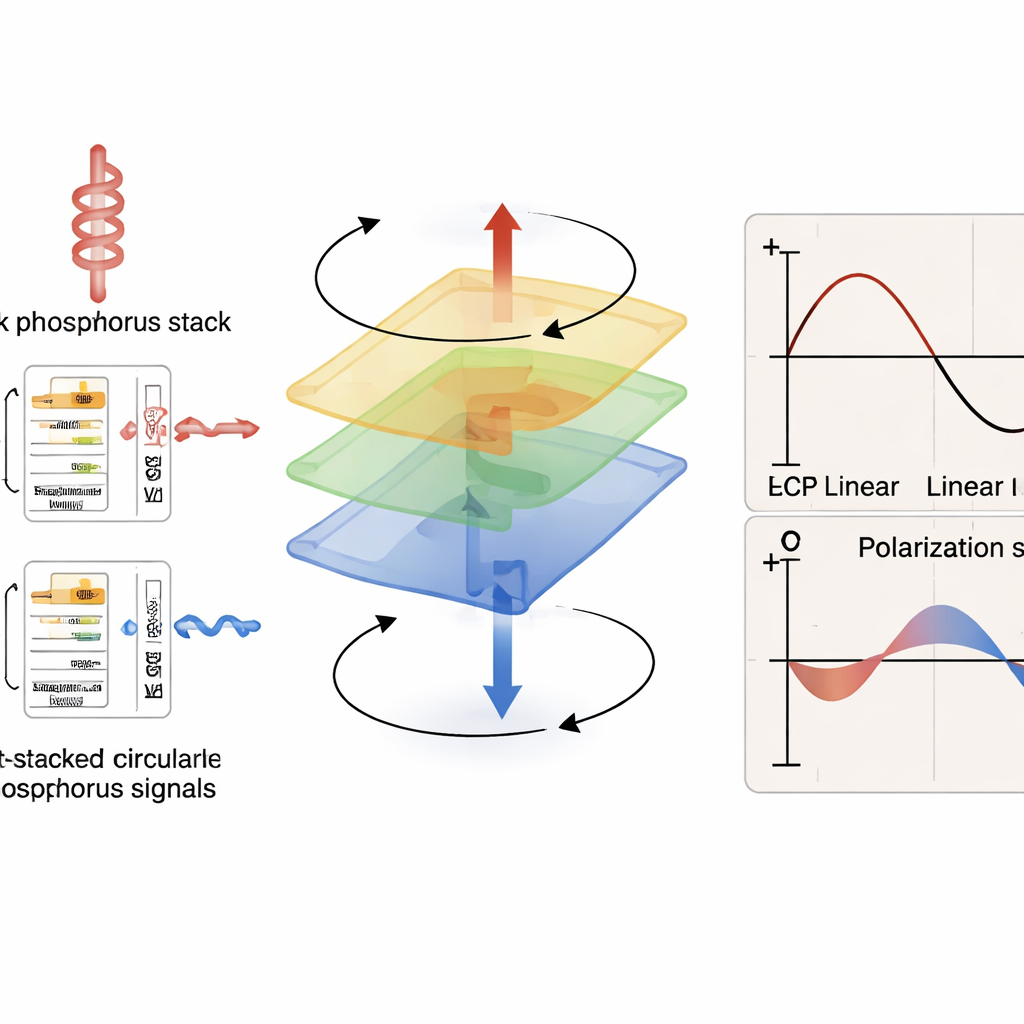
The core device is a three‑layer “sandwich” of black phosphorus. A thicker middle layer is placed between two thinner top and bottom layers, each twisted by a different angle relative to the middle one. These twist angles break the mirror symmetry of the stack and create two chiral junctions—one between top and middle, and one between middle and bottom. When circularly polarized light hits this structure, a quantum effect called the circular photogalvanic effect drives electrons in opposite directions depending on whether the light is left‑ or right‑handed. In the authors’ design, the currents from the two twisted junctions add together, giving a strong signal that flips sign when the handedness of the light is reversed. At the same time, the thickness differences between layers create mirror‑symmetric internal electric fields that make currents generated by ordinary linearly polarized light largely cancel out. This clever symmetry engineering lets the device “listen” mainly to the twist of light and ignore much of the background.
From theory to real devices
To understand and optimize this effect, the team first used computer simulations of twisted black phosphorus bilayers at different angles. They found that twisting reshapes the electronic bands so that some electron states extend between layers, providing channels for vertical current flow when the material absorbs light. They then fabricated actual three‑layer devices inside a controlled glove box to prevent degradation. Experiments with near‑infrared light showed that the overlapping region of all three layers exhibits a strong chiral optical response, much stronger than simpler two‑layer stacks. When they wired only adjacent layers together, the devices could sense circular polarization but the signal was muddied by linear components. However, when they connected the top and bottom layers—embracing the full sandwich—the current cleanly switched from positive under left‑handed light to negative under right‑handed light, making the two states easy to tell apart without complex post‑processing.
Seeing across a broad rainbow of heat and light
Beyond polarization, the researchers tested how broadly in wavelength the detector works. Thanks to the intrinsic properties of black phosphorus, the device responds from the visible all the way to mid‑infrared, covering colors important for fiber‑optic communications and thermal imaging. They demonstrated operation under red, telecom‑band, and mid‑infrared lasers, and even measured performance using a glowing blackbody source that mimics real‑world thermal radiation. The detector achieved responsivities up to about 1 ampere per watt in some modes and around 0.1 ampere per watt for circular polarization imaging, with low noise and competitive sensitivity compared to specialized infrared sensors. By adjusting a gate voltage—an electrical knob that tunes the charge distribution between layers—they could strengthen the circularly polarized response and improve the contrast in reconstructed images of simple patterns.
What this means for future technologies
For non‑experts, the takeaway is that the authors have found a way to make an inherently non‑chiral material behave as if it were chiral, simply by twisting and stacking its layers in a smart way. This twist‑stacked black phosphorus device can distinguish left‑ and right‑handed light with a strong, easily read bipolar signal, while working across a very wide slice of the spectrum at room temperature. Such a platform could shrink bulky optical setups into chip‑scale components for secure optical links, advanced sensors, and imaging systems that read hidden polarization information in scenes—from biological tissues to warm machinery—without the need for external filters and polarizers.
Citation: Jiang, H., An, L., Chen, X. et al. Twist-stacked black phosphorus for wide-spectral chiral photodetection. Nat Commun 17, 1824 (2026). https://doi.org/10.1038/s41467-026-68531-z
Keywords: circularly polarized light, black phosphorus, twisted 2D materials, infrared photodetectors, on-chip imaging