Clear Sky Science · en
Artificial gauge fields and dimensions in a polariton hofstadter ladder
Light on a One-Way Track
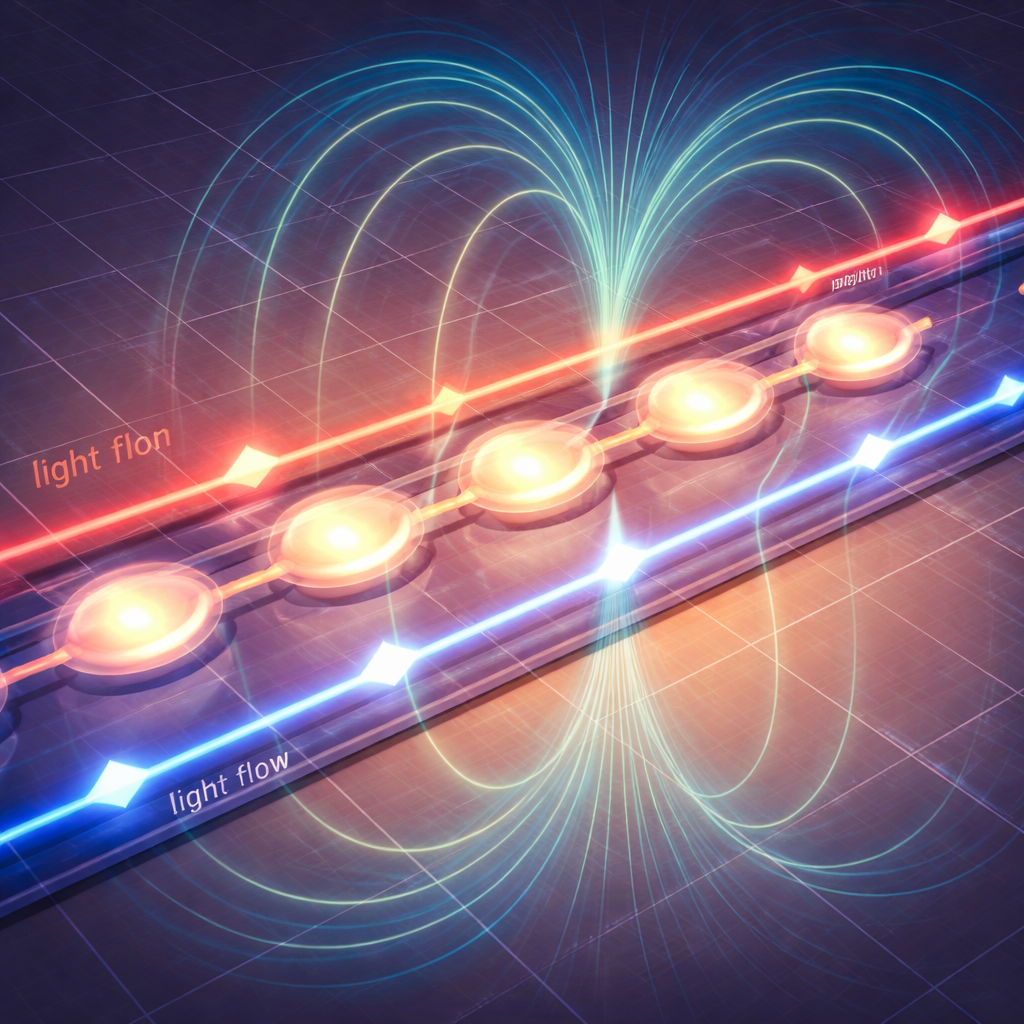
Imagine being able to send light down a microscopic track so that one “color” of polarization can only go left while the other can only go right, almost impossible to disrupt. This paper reports just such a device, built from tiny semiconductor pillars that guide hybrid light–matter waves called polaritons. By cleverly shaping and rotating these pillars, the researchers create an artificial magnetic effect for light, opening pathways toward ultra-compact, robust lasers and optical circuits that could form the backbone of future photonic technologies.
Turning Neutral Light into a Charged Imitator
Normally, magnetic fields act on charged particles like electrons, not on neutral particles such as photons. The team sidesteps this limitation using an idea known as an artificial gauge field. Instead of using a real magnetic field, they engineer the environment so that polaritons pick up extra phases, or twists, as they move—exactly as charged particles would in a magnetic field. This is done in a structure inspired by a famous theoretical model called the Hofstadter lattice, where particles moving on a grid in a magnetic field form intricate energy patterns and special “edge states” that flow along the boundaries without easily scattering.
Building a Ladder for Light
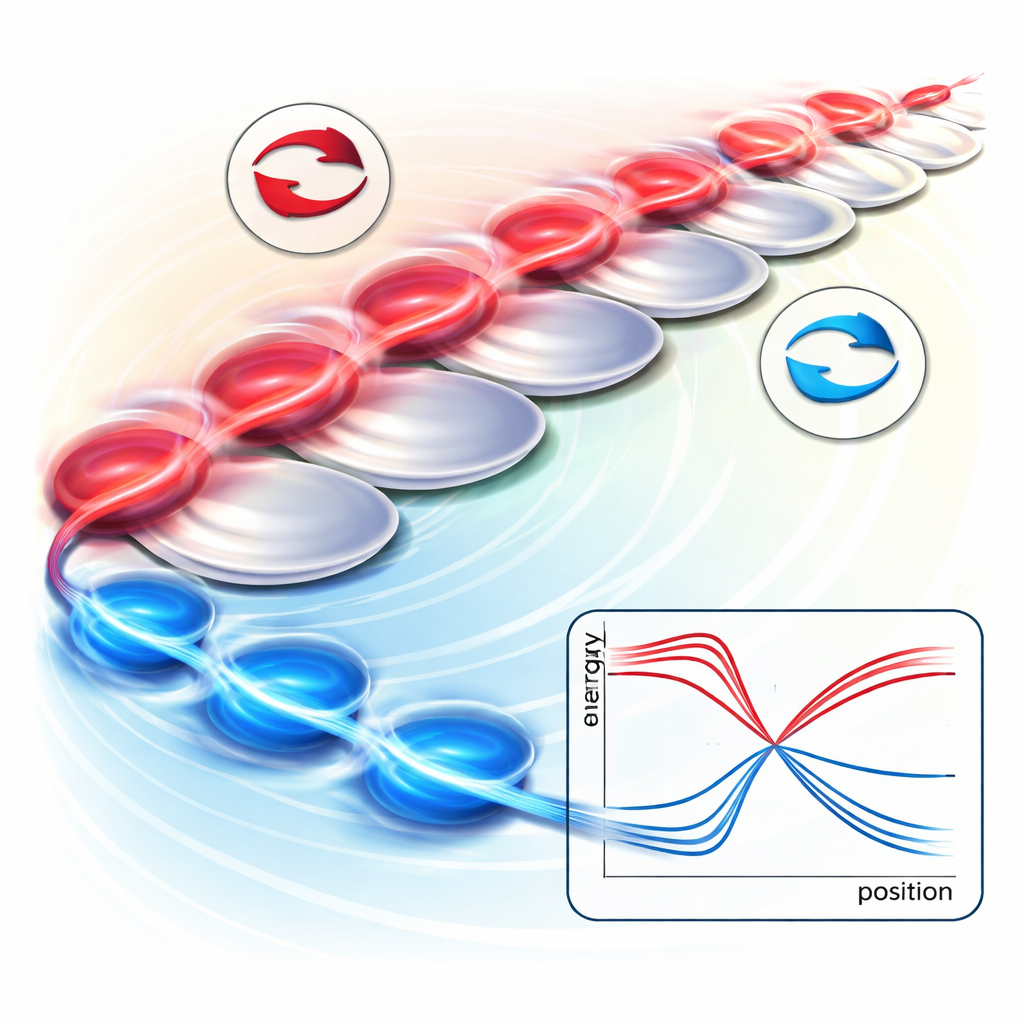
In the experiment, light is strongly coupled to excitons—bound electron–hole pairs—in a carefully grown semiconductor microcavity, forming polaritons. These polaritons are confined in a one-dimensional chain of overlapping elliptical micropillars, each only a few micrometres across. The elliptical shapes split the basic light mode into two preferred linear polarizations aligned with the long and short axes of each ellipse. By rotating each ellipse relative to its neighbors in a repeating three-pillar pattern, the researchers force polaritons to acquire a controlled phase when they hop between polarization states. In effect, the chain behaves like a narrow strip—or “ladder”—of the Hofstadter lattice, with the two circular polarizations acting as opposite edges of this ladder.
Watching Topological Light in Action
To check that the structure truly mimics this exotic lattice, the team first studies its energy bands by measuring how the emitted light depends on angle, which corresponds to polariton momentum. They observe a set of bands that match detailed simulations and, crucially, find that states moving in opposite directions have opposite circular polarizations—just as expected for topological edge channels. When the system is pumped harder with a continuous-wave laser, the polaritons condense into a lasing state that has a non-zero group velocity, meaning the condensate itself travels along the chain. Real-space imaging then reveals that one circular polarization predominantly moves in one direction, while the opposite polarization moves the other way, realizing a polariton version of the topological spin Hall effect.
Robust Paths for Tiny Light Waves
Theoretical simulations show that these spin-polarized edge-like modes are remarkably robust. Even when the sizes, polarization splittings, or orientations of the micropillars are randomly disturbed far beyond typical fabrication errors, the directed propagation of one polarization to one side and the opposite polarization to the other largely survives. This robustness arises from the topological nature of the underlying Hofstadter-like bands: as long as the effective artificial magnetic flux through each tiny “loop” in the structure does not change qualitatively, the special edge channels remain intact and continue to guide polaritons along preferred directions.
Why This Matters for Future Devices
For a non-specialist, the key message is that the authors have shown how to pack the advantages of topological protection—normally realized in larger, two-dimensional photonic structures—into a compact, one-dimensional chain only a few micrometres wide. By using the circular polarization of light as an extra, artificial dimension, they eliminate the need for strong real magnetic fields while keeping the desired one-way, hard-to-disrupt transport. This approach points toward new families of tiny, energy-efficient devices in which information is carried not just by the presence of light but by its polarization, enabling topological polariton lasers, logic elements, and potentially high-power surface-emitting light sources that are far more tolerant of imperfections than conventional designs.
Citation: Widmann, S., Bellmann, J., Düreth, J. et al. Artificial gauge fields and dimensions in a polariton hofstadter ladder. Nat Commun 17, 1586 (2026). https://doi.org/10.1038/s41467-026-68530-0
Keywords: topological photonics, exciton polaritons, artificial gauge fields, polarisation control, micropillar lattices