Clear Sky Science · en
Precision bounds for characterising quantum measurements
Why better quantum measurements matter
As quantum technologies move from the lab into real devices, everything depends on how well we can measure what is going on inside them. Measurements turn fragile quantum states into the usable, yes-or-no signals that drive quantum computers, sensors, and communication systems. This paper shows how to calculate the best possible precision with which we can calibrate those quantum measuring devices themselves, closing a key gap in our understanding of how reliably quantum hardware can be controlled.
Three ways to look at a quantum device
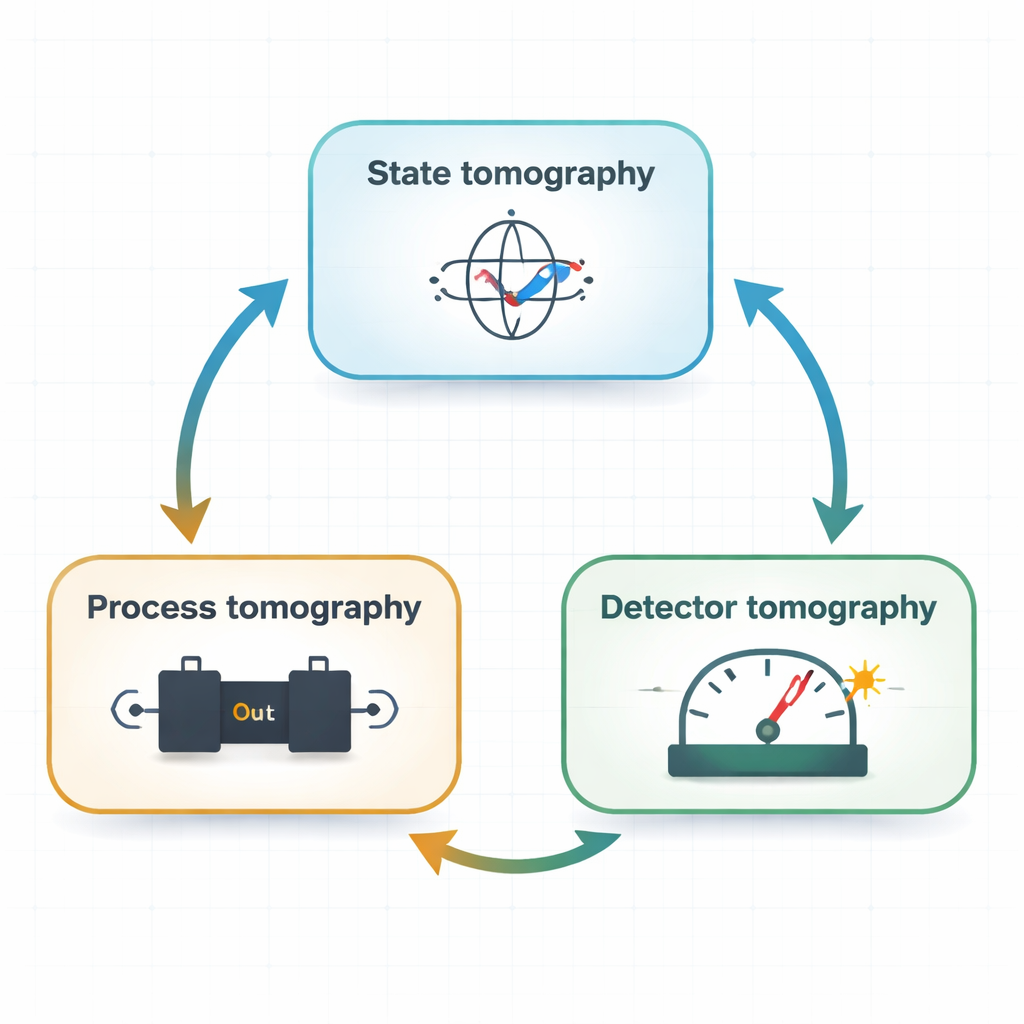
Any quantum information protocol rests on three pillars: the quantum states we prepare, the processes that transform them, and the detectors that read them out. For states and processes, physicists already have a powerful toolbox based on a quantity called quantum Fisher information, which tells you how sharply you can estimate an unknown parameter and what the ultimate error bars must be. Until now, there was no equally general, information-theoretic way to do the same for detectors. The authors introduce such a framework, called detector quantum Fisher information, that puts measurements on the same theoretical footing as states and processes. This completes the “triad” of optimal state, process, and detector characterisation and provides a unified language for precision limits across quantum technologies.
Defining how much a detector can tell you
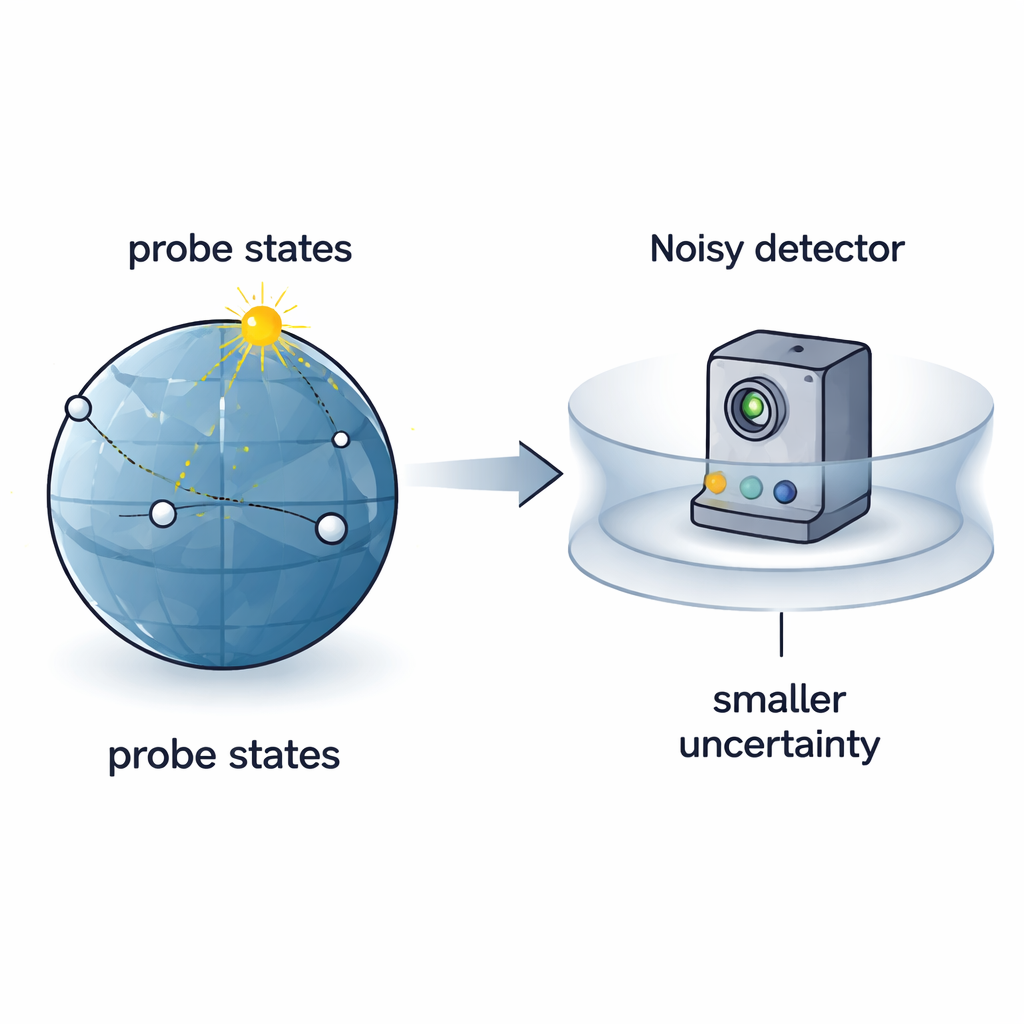
To calibrate a detector, you send in known quantum states and record how often each outcome occurs, then work backwards to infer the detector’s internal parameters, such as noise levels or inefficiencies. The key question is: what choice of probe states gives you the most information about those unknown parameters, and what is the smallest possible uncertainty on your estimates? Instead of directly searching over all possible probes—an intractable task for realistic devices—the authors recast the problem in terms of operator quantities associated with each detector outcome. From these they construct two versions of detector quantum Fisher information: a “spectral” version that tracks the largest information-carrying direction, and a simpler “trace” version that is easier to compute but somewhat looser. Both give rigorous lower bounds on how small the average estimation error can be, and both can be evaluated without guessing the best probe in advance.
From simple qubits to real hardware
The paper shows how these abstract bounds play out in concrete examples. For a noisy two-outcome qubit detector—think of a device that should distinguish the logical 0 and 1 states, but sometimes flips the result—the authors compute their detector information and show that the spectral version exactly matches the true, optimised information. In that case, the best probes are simply the basis states 0 and 1 themselves, and no exotic quantum tricks are needed. They prove that this tightness extends to a broad and experimentally important class of “phase-insensitive” detectors, which includes standard single-photon counters and related photonic devices. For more general detectors, the spectral bound may not be exactly reachable, but the authors show how to compute an even tighter, still rigorous bound using modern optimisation methods without having to explore every possible quantum probe.
Optimising detectors on today’s quantum computers
To demonstrate practical relevance, the team implements their ideas on an IBM superconducting quantum processor. They study a qubit measurement that suffers from “dephasing” noise, which blurs the phase information of the qubit. Their theory predicts a particular probe state that should make the noise strength most easily and precisely measurable. Running large numbers of experiments with both optimal and non-optimal probe states, they compare the observed estimation errors with their new precision bounds. The data confirm that the optimal probe identified by detector quantum Fisher information saturates the theoretical limits as closely as the real hardware allows, providing what the authors describe as the first provably optimal detector calibration experiment on a quantum computing platform.
From better measurements to better quantum technologies
Finally, the authors extend their framework to multi-parameter problems, such as full detector tomography or simultaneous estimation of several noise processes, and show how it interfaces neatly with existing methods for optimising quantum processes themselves. They also explore when entangled probe states really help and when they do not, finding that for common phase-insensitive detectors the advantage disappears, but that more complex scenarios can still benefit. In everyday terms, this work supplies a precise ruler for judging how well we can possibly calibrate quantum measuring devices, and it tells experimentalists exactly how to design probes that come as close as nature allows. That capability is crucial for scaling up quantum computers, improving advanced sensors, and ensuring that the numbers we read off future quantum machines can be trusted.
Citation: Das, A., Yung, S.K., Conlon, L.O. et al. Precision bounds for characterising quantum measurements. Nat Commun 17, 1821 (2026). https://doi.org/10.1038/s41467-026-68529-7
Keywords: quantum metrology, detector tomography, quantum Fisher information, quantum measurements, quantum noise calibration