Clear Sky Science · en
Upcycling carbon fibre wastes in solid-flames
Turning Tough Waste into a Useful Resource
Modern aircraft, wind turbines, and high-performance sports gear all rely on carbon-fibre composites, which are light, stiff, and built to last. But that durability becomes a problem when offcuts, expired materials, and worn-out parts pile up as hard-to-recycle waste. This study presents a fast, low-energy way to transform those stubborn leftovers into more valuable materials, offering a path toward cleaner manufacturing and a more circular economy.
A New Fire That Burns in Solids
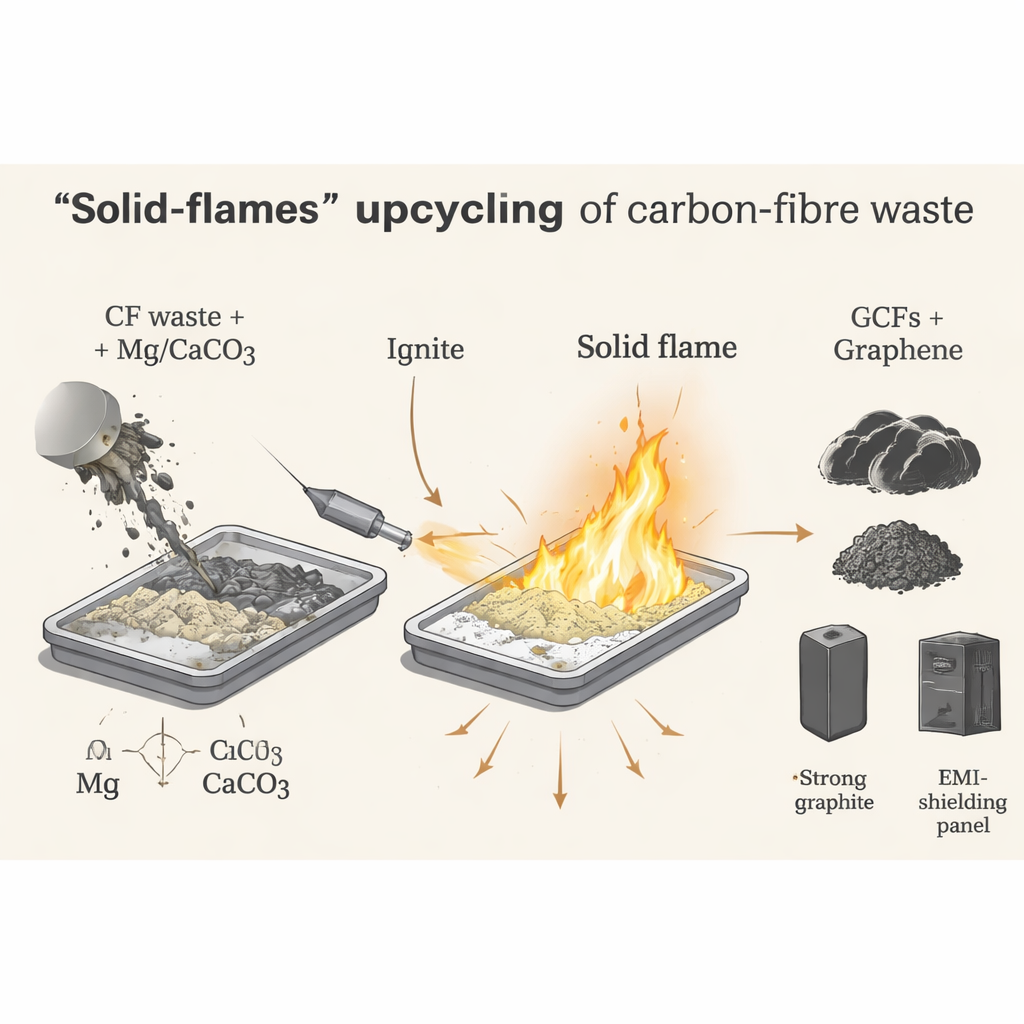
The researchers introduce a process they call a “solid-flames” upcycling technique. Instead of burning carbon-fibre scraps in air or soaking them in harsh chemicals, they mix the waste with two common powders: magnesium (Mg) and calcium carbonate (CaCO3). When this blend is briefly ignited inside a vacuum chamber, a self-sustaining reaction races through the mixture like a flame, despite everything being in solid form. In just seconds, the intense heat breaks down the epoxy resin that normally clings stubbornly to the fibres, and at the same time drives the formation of thin carbon sheets known as graphene. The end products are roughened carbon fibres coated with graphene flakes—called graphene-grafted carbon fibres (GCFs)—plus separate graphene powders.
From Smooth Fibres to Graphene-Covered Surfaces
Using advanced microscopes and surface measurements, the team shows that the formerly smooth carbon fibres gain a dense coating of tiny graphene flakes. This coating makes the fibre surface more than an order of magnitude rougher and boosts its surface area by up to about 170 times. Tests on different types of real-world waste—short offcuts, sticky prepreg tapes, and fully cured composite pieces—all show similar transformations. By contrast, when fibres without epoxy are treated in the same way, very little graphene sticks to their surfaces. This indicates that the epoxy, once broken down by the solid-flame reaction, actually supplies the carbon needed to grow and attach the graphene, achieving recycling, surface upgrading, and graphene production in a single step.
How the Atoms Rebuild Themselves
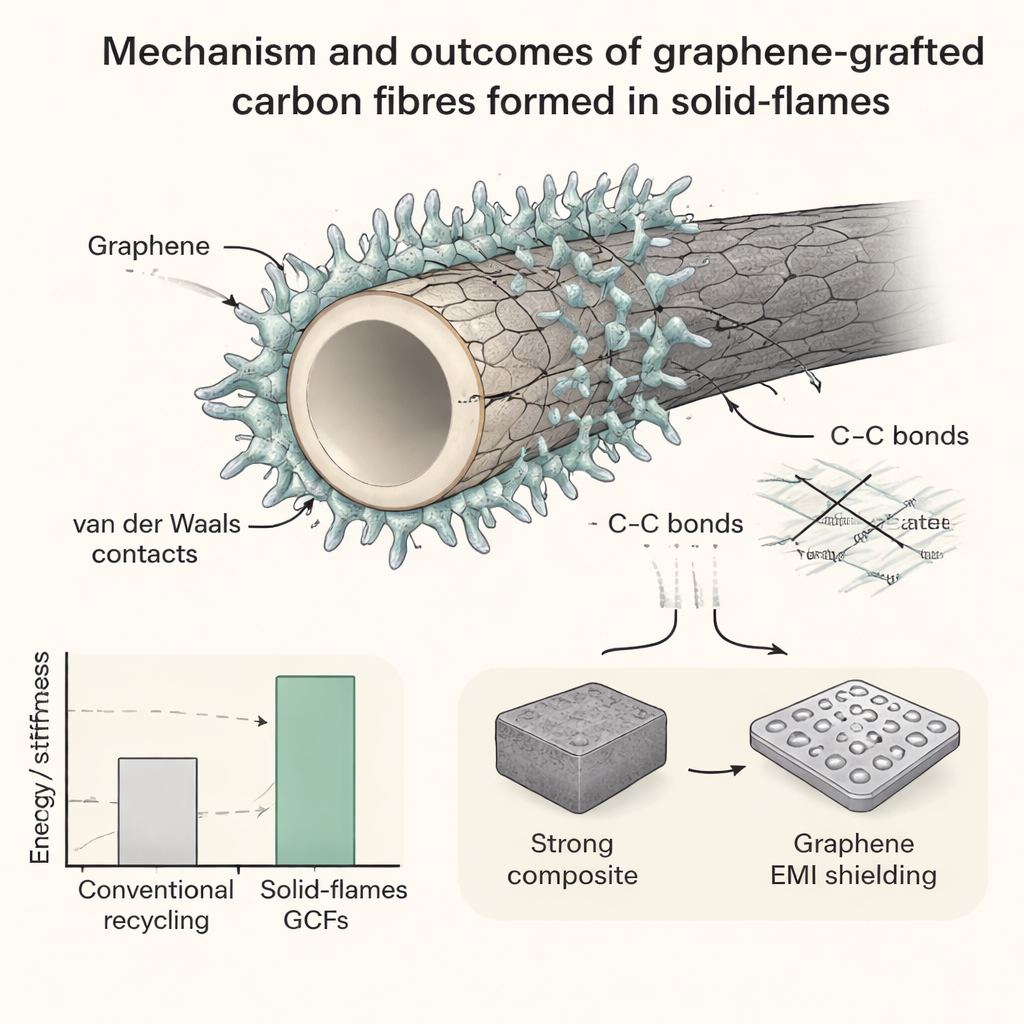
To understand what happens during those few scorching microseconds, the authors combine computer simulations with spectroscopy, a set of techniques that read out the local bonding of atoms. They find that magnesium plays a crucial role: it helps snap strong carbon–oxygen bonds in epoxy fragments that would otherwise resist further change. Once those links are severed, carbon atoms can rearrange and join into larger, flatter clusters that evolve into graphene. At the same time, some of these new graphene layers connect directly to the underlying fibre through sturdy carbon–carbon bonds, rather than simply resting on top through weak attraction. Calculations and nanoscale scratching tests reveal that this bonded interface is stiff and resistant to peeling, allowing forces to transfer efficiently from the graphene shell into the fibre core.
Stronger Composites and Better Shielding
The practical value of these upcycled materials is demonstrated in two directions. First, the graphene-grafted fibres are mixed with graphite powder and hot-pressed into dense blocks. With about 10 percent GCF content, these blocks show more than a fourfold increase in bending strength compared with plain graphite, and they outperform similar materials reinforced with ordinary recycled carbon fibre or other common carbon additives. Simulations and imaging suggest that the graphene-coated surfaces spread out stress and prevent cracks from starting at weak interfaces. Second, the free graphene powder is compressed into a plate that conducts electricity well and blocks over 99.95 percent of high-frequency electromagnetic radiation. Because this graphene can be produced at a fraction of the cost of commercial graphene, it could be attractive for shielding electronics in vehicles and consumer devices.
Cleaner, Cheaper, and Ready to Scale
Beyond performance, the solid-flames approach scores well on sustainability metrics. Life cycle and economic analyses indicate that it uses far less energy than making new carbon fibre, emits less greenhouse gas than conventional recycling or incineration, and produces graphene more efficiently than standard chemical methods. The starting powders are inexpensive, the waste acid solutions can be recycled, and the heat released by the reaction could potentially be harnessed for other uses. In simple terms, the method turns a growing mountain of hard-to-handle composite scrap into useful ingredients for stronger structural parts and effective electromagnetic shields, pointing toward a more circular future for carbon-fibre technology.
Citation: Ren, Q., Sheng, J., Li, J. et al. Upcycling carbon fibre wastes in solid-flames. Nat Commun 17, 1443 (2026). https://doi.org/10.1038/s41467-026-68528-8
Keywords: carbon fibre recycling, graphene, solid-flame upcycling, composite materials, electromagnetic shielding