Clear Sky Science · en
Atmospheric deposition enhances marine methane production and emissions from global oceans
Why ocean air matters for our climate
The oceans quietly release methane, a powerful greenhouse gas, into the atmosphere—even from sunlit, oxygen-rich surface waters where traditional methane-producing microbes should not thrive. This puzzle, known as the “marine methane paradox,” has nagged scientists for years. The new research behind this article shows that air pollution falling onto the sea surface does more than fertilize ocean life: it can also tip the chemistry of surface waters in ways that boost methane production and emissions, subtly but measurably feeding back on climate change.
Dust, smog, and an invisible nutrient shift
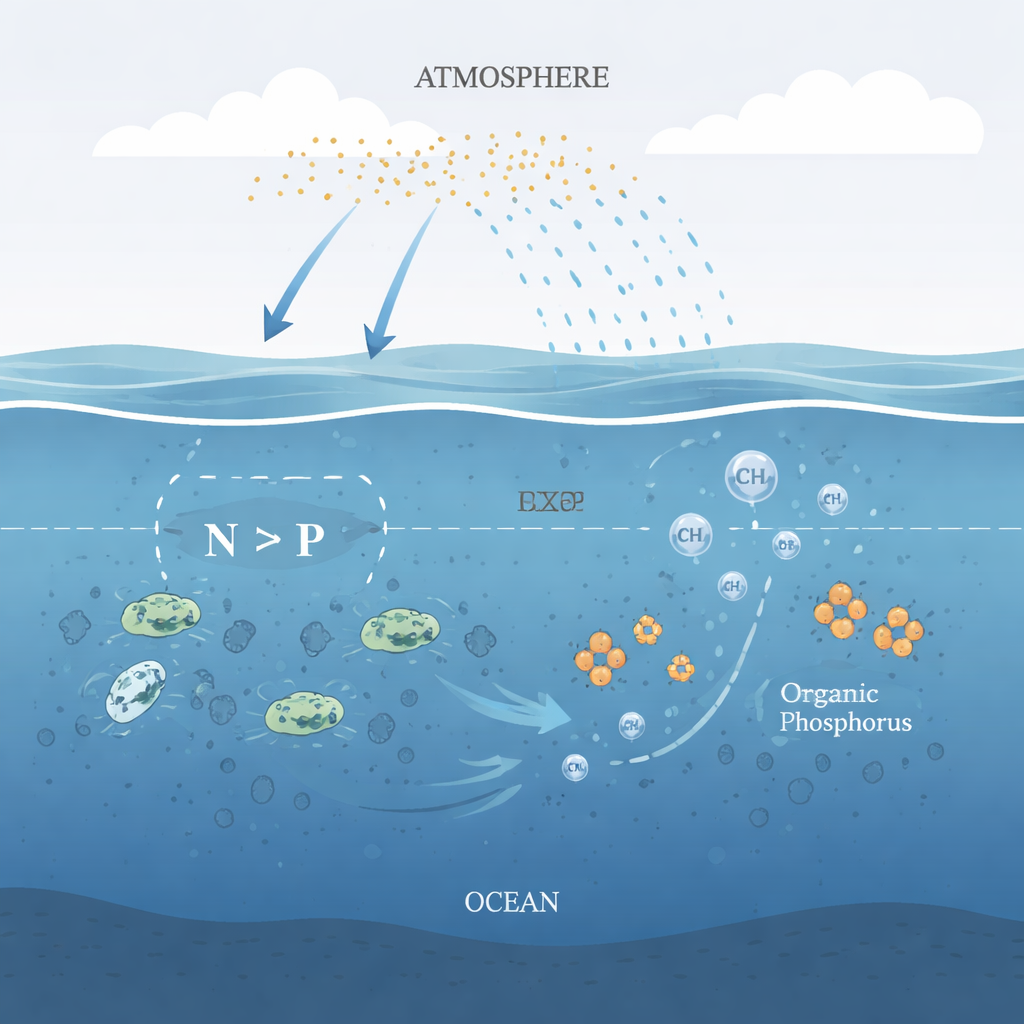
Human activities release huge amounts of reactive nitrogen into the air through fossil fuel burning and agriculture. Much of this nitrogen eventually falls back to Earth in tiny airborne particles and rain, including over the open ocean. The study reveals that this atmospheric fallout is strongly unbalanced: it delivers far more nitrogen than phosphorus, another key nutrient. When this excess nitrogen mixes into the surface ocean, it pushes the local chemistry toward phosphorus scarcity. Microbes that once struggled to find nitrogen suddenly have plenty, but now face a shortage of phosphorus, a shift that forces them to mine new sources of this nutrient.
How starving microbes make methane
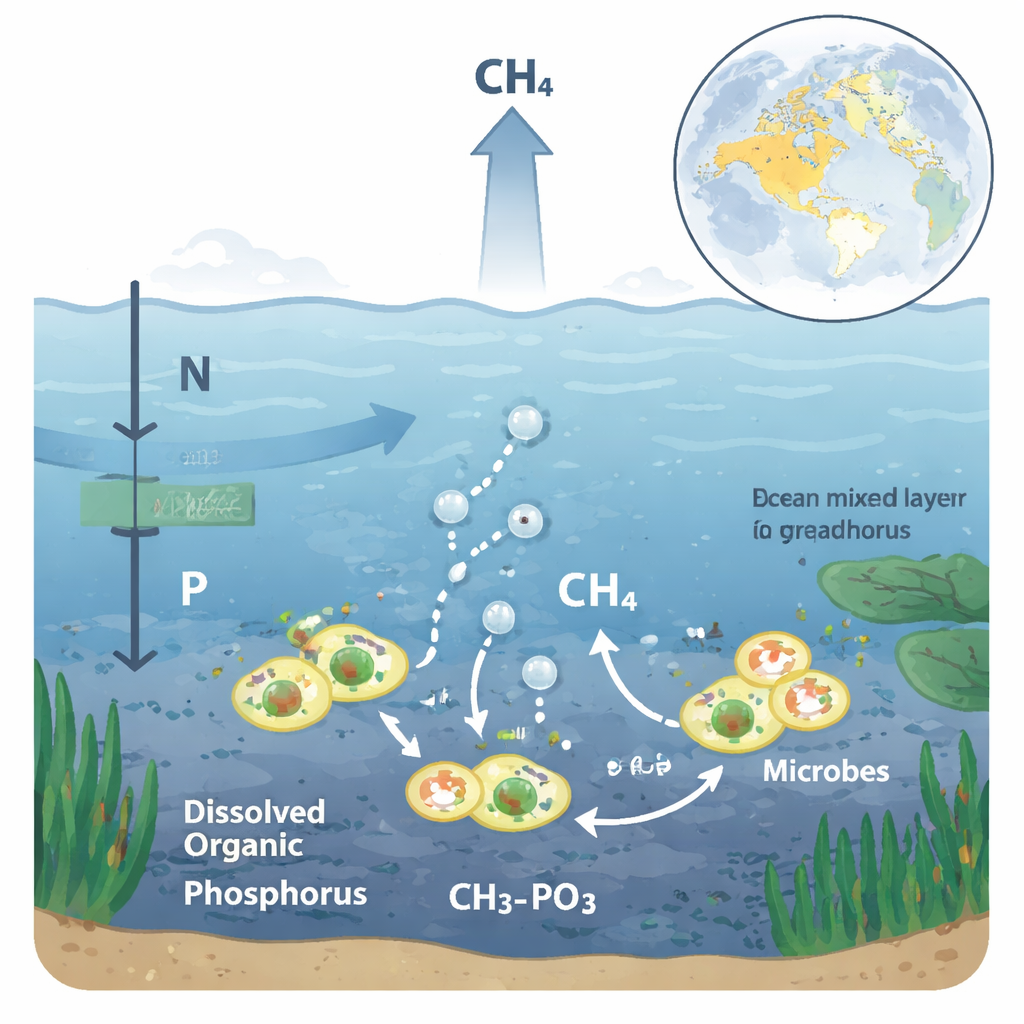
To cope with phosphorus limitation, many marine microbes tap a large, dissolved pool of organic phosphorus compounds. One of these compounds, methylphosphonate, has a carbon–phosphorus bond. When microbes break this bond to free up phosphorus they can use, methane is released as a byproduct. In shipboard experiments in the Northwest Pacific, the researchers added real atmospheric aerosols and nitrogen-rich nutrients to seawater that was already nudged toward phosphorus stress. Microbes responded quickly: they ramped up enzymes that strip phosphorus from organic molecules and produced substantially more methane when methylphosphonate was present. Importantly, adding nitrogen alone—without extra phosphorus—intensified phosphorus stress and drove higher methane production, confirming that nutrient imbalance, not just more food in general, is the trigger.
A global microbial response to fallout from the sky
Field measurements showed that surface waters in the Northwest Pacific are already oversaturated in methane relative to the atmosphere, pointing to ongoing in-ocean production. To see how widespread this mechanism might be, the authors turned to global DNA datasets from ocean surveys. They focused on a key gene, called phnJ, which encodes part of the enzyme machinery that breaks carbon–phosphorus bonds. Using machine-learning models that link gene abundance to environmental conditions, they predicted where this gene is most common. The results show high phnJ prevalence in ocean regions with low phosphate, and a clear statistical connection between higher atmospheric nitrogen deposition and higher predicted phnJ abundance. In other words, places that receive more nitrogen from the air tend to host more microbes genetically equipped to degrade phosphonates and potentially make methane.
From lab bottles to the whole ocean
To estimate the global impact, the team combined their experiments with maps of ocean nutrients, dissolved organic phosphorus, and nitrogen deposition. They built a mathematical relationship between the nitrogen-to-phosphorus ratio in seawater and the fraction of methylphosphonate converted to methane. Applying this relationship worldwide, they calculated how much extra methane production arises when atmospheric nitrogen is mixed into the surface layer. Their analysis suggests that, in the ocean’s mixed layer, methane production from methylphosphonate could rise by about 2–3 percent on average, and locally by much more in heavily impacted regions. This translates to roughly 0.05 teragrams (50 billion grams) of additional methane produced per year, with atmospheric methane emissions from the open ocean increasing by on the order of a few percent.
What this means for the climate story
To a layperson, these numbers may sound small, but they matter because they expose a hidden side effect of air pollution. Atmospheric nitrogen deposition has been viewed as a mixed blessing: it can stimulate ocean plant growth and help draw carbon dioxide out of the air, but also boosts nitrous oxide, another potent greenhouse gas. This study adds methane to that list. By pushing surface waters toward phosphorus starvation, excess nitrogen from the atmosphere encourages microbes to tap organic phosphorus and, in doing so, leak methane to the air. As human-driven nitrogen emissions and ocean stratification continue, this nutrient imbalance and the associated methane release are likely to intensify in some regions, slightly eroding the climate benefit of carbon drawn down into the ocean and underscoring how tightly connected the air we pollute is to the gases the ocean returns to our atmosphere.
Citation: Zhuang, GC., Mao, SH., Zhang, HH. et al. Atmospheric deposition enhances marine methane production and emissions from global oceans. Nat Commun 17, 1811 (2026). https://doi.org/10.1038/s41467-026-68527-9
Keywords: ocean methane, atmospheric nitrogen deposition, marine microbes, nutrient limitation, climate feedbacks