Clear Sky Science · en
3D Printing of glasses with tunable UV–VIS–IR photoluminescence via low-temperature nanoscale engineering
Lighting Up Glass in New Ways
Imagine everyday glass objects—like lenses, light covers, or even decorative sculptures—not just being transparent, but glowing in any color from ultraviolet to visible to infrared, and doing so efficiently and for a very long time. This research shows how scientists can "teach" 3D-printed glass to emit tunable light across a huge range of colors by growing tiny light sources, called quantum dots, directly inside the glass at low temperatures.
Why Glowing Glass Matters
Glass is already central to modern technology, from fiber‑optic cables to phone screens and precision lenses. Yet most 3D‑printed glass so far has mainly taken advantage of its shape and transparency, not its potential to handle light in more advanced ways. Quantum dots—nanometer‑scale crystals that can emit bright, pure colors—are excellent candidates to give glass new optical functions. The problem is that traditional 3D‑printed glass needs high‑temperature treatment that tends to damage or clump these fragile nanocrystals, ruining their performance. The study tackles this conflict head‑on by separating glass shaping from quantum‑dot formation, and doing the second step gently at lower temperatures inside a specially engineered porous glass.
Building a Porous Playground for Light
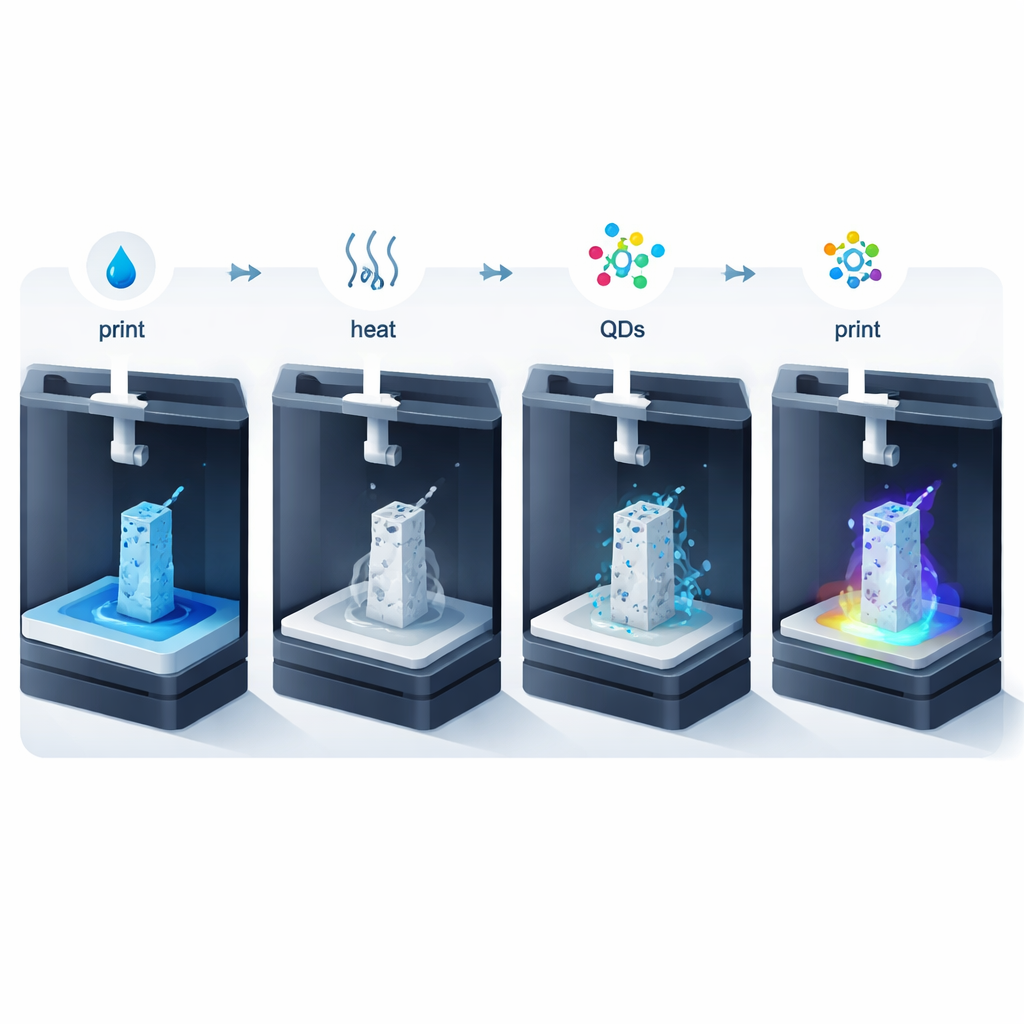
The researchers first 3D‑print a special kind of nanoporous glass using a sol–gel ink and a digital light processing printer. The printed piece starts as a wet gel, is dried into a rigid "xerogel," and then heated to a moderate 650 °C to burn away organics and form a strong, transparent glass riddled with uniform nanosized pores. Metal ions such as lead, cadmium, silver, indium, or zinc are built into this glass network from the start, acting as raw material for future quantum dots. The result is a clear, mechanically robust glass object—anything from a model of the Oriental Pearl Tower to a dragon sculpture—with a sponge‑like interior on the nanometer scale, yet still over 90% transparent in the visible range.
Growing Quantum Dots Gently and Precisely
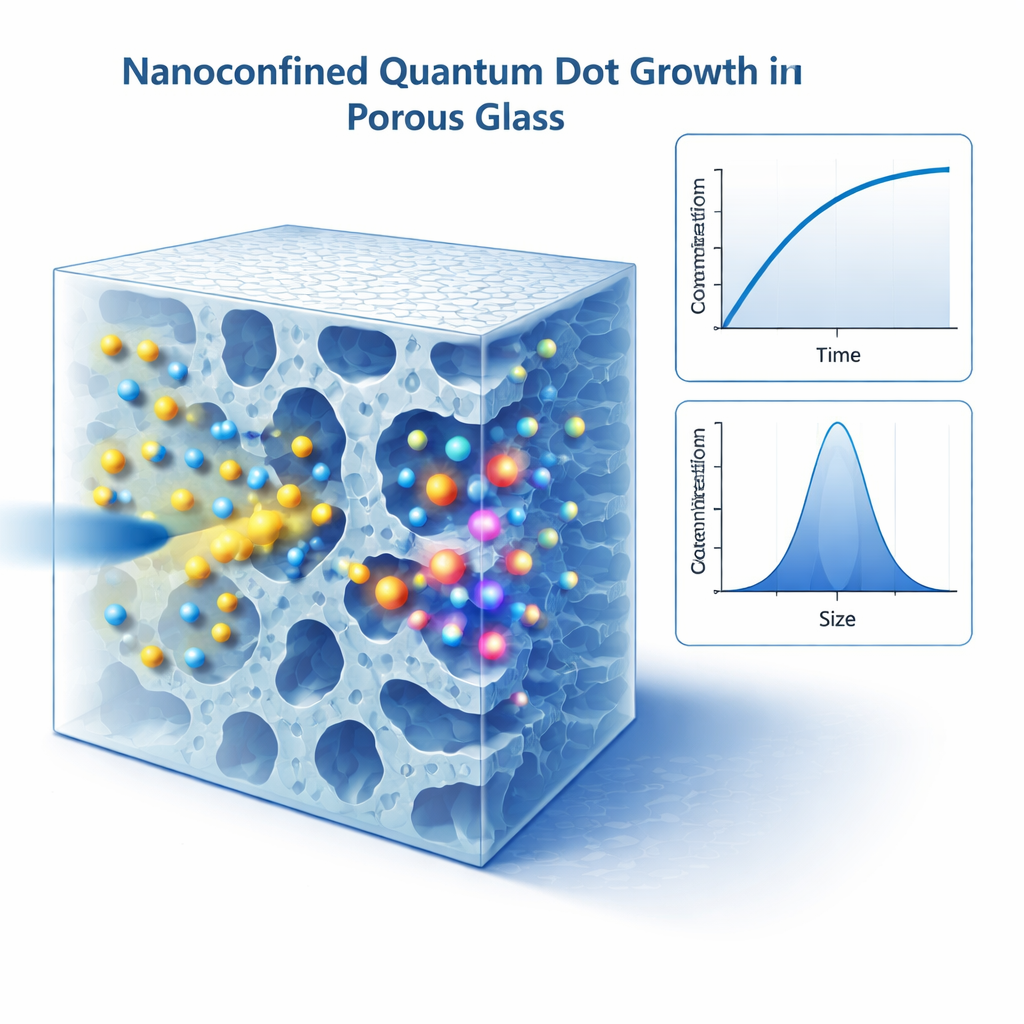
Once the porous glass is formed, the real magic happens in a low‑temperature liquid bath. The 3D‑printed glass is soaked in carefully chosen precursor solutions that diffuse into the nanopores. There, the metal ions already inside the glass meet the incoming ions from solution, and quantum dots crystallize directly within the tiny channels. Because the pores are only a few nanometers wide, they act like nanoscale molds, limiting how large the quantum dots can grow and keeping them evenly spaced. By changing the chemical recipe—such as switching halide ions or tuning pore size—the team can control both the composition and the size of the quantum dots, and thus dial in emission colors from the ultraviolet around 300 nm all the way out to near‑infrared at about 2 micrometers, with lifetimes spanning from tens to hundreds of nanoseconds.
Stability and Smart Use of the Nano-Environment
The porous glass does more than just provide a physical cage. At the atomic level, chemical bonds form between the quantum dots and the glass network, especially between lead atoms in the dots and oxygen atoms in the glass. Advanced X‑ray and computational studies show that these bonds help “heal” defect sites on the quantum dot surfaces that would normally trap charge and waste light as heat. This dual physical and chemical confinement boosts the light‑emitting efficiency to as high as about 82% for perovskite quantum dots in glass and greatly improves stability. Compared with ordinary quantum dots in solution or thin films, these glass‑embedded dots keep most of their brightness for months in air and under humidity and strong laser illumination, making them far more practical for real‑world devices.
From Catalysts to Hidden Messages
Because the method works with many different quantum dot materials and is compatible with complex 3D shapes, it opens the door to multifunctional devices. The team demonstrates 3D‑printed domes coated with tiny surface features that mimic natural light‑harvesting structures. When loaded with quantum dots, these domes can drive the conversion of carbon dioxide into useful fuels like carbon monoxide and methane under light, and more intricate surface micro‑architectures significantly boost the reaction rates. They also show how spatially patterning different quantum dots allows information to be “written” into glass and later revealed or erased using specific chemical treatments and light, hinting at applications in optical encryption and anti‑counterfeiting.
A New Class of Designer Photonic Glass
By combining 3D printing, nanoporous glass, and low‑temperature quantum dot growth, this work establishes a versatile platform for custom‑designed glowing glass. Instead of being limited to fixed colors or simple shapes, engineers can now specify, voxel by voxel, where and how glass objects emit light across the UV–visible–IR spectrum. This fine‑grained control, together with long‑term stability and compatibility with many quantum dot types, sets the stage for new generations of lenses, sensors, light sources, and integrated photonic components that seamlessly bridge the quantum scale of electrons and the everyday scale of devices.
Citation: Zhou, F., Yang, Y., Feng, K. et al. 3D Printing of glasses with tunable UV–VIS–IR photoluminescence via low-temperature nanoscale engineering. Nat Commun 17, 1809 (2026). https://doi.org/10.1038/s41467-026-68523-z
Keywords: 3D-printed glass, quantum dots, photoluminescence, nanoporous materials, photonic devices