Clear Sky Science · en
Prenatal Zika virus exposure disrupts social-emotional development and cortical visual function in infant macaques
Why this research matters to parents and public health
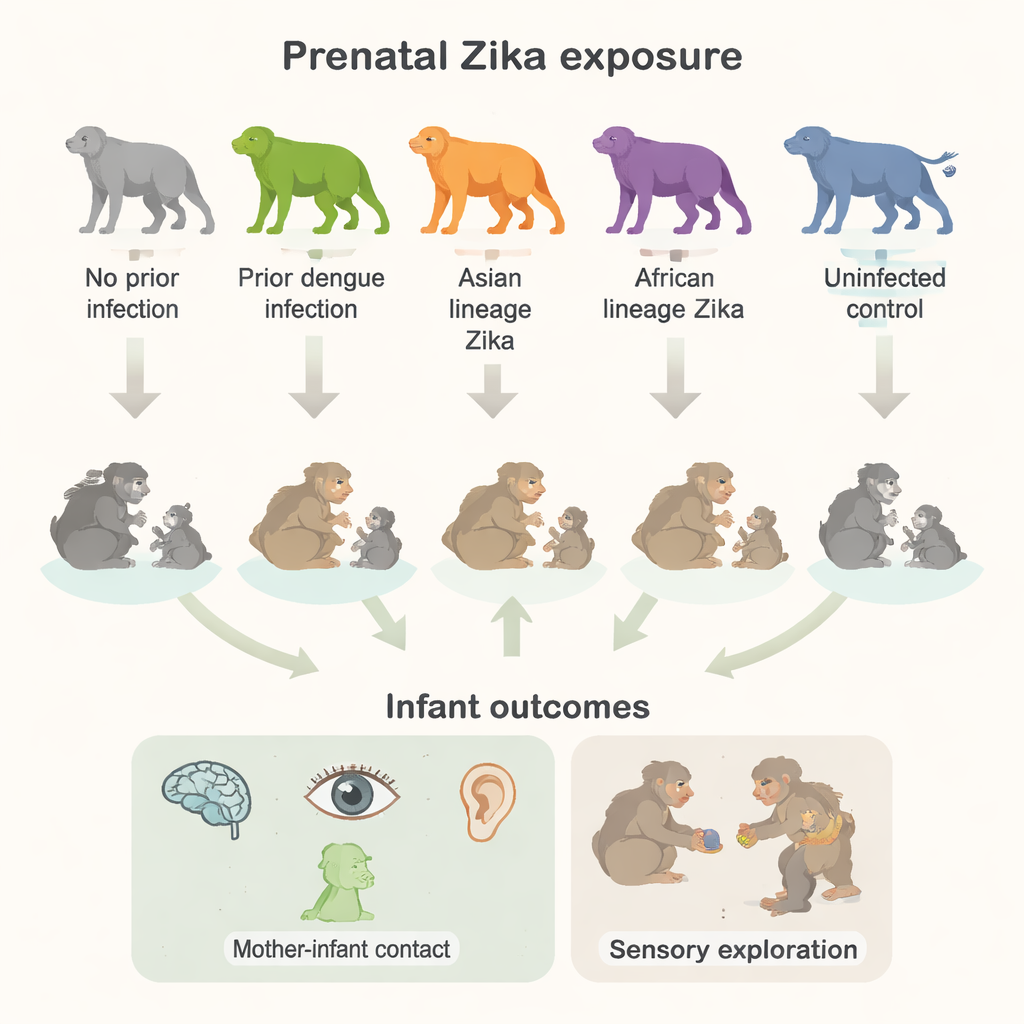
Zika virus is best known for causing severe birth defects like microcephaly, but many babies exposed in the womb are born looking healthy. This study asks a crucial question for families and doctors: can prenatal Zika exposure quietly alter a child’s emotional, social, hearing, or visual development, even when there are no obvious birth defects? Using rhesus macaques, whose pregnancy and brain development closely resemble humans, the researchers tracked exposed infants for a full year to reveal hidden, longer-term effects.
Following mothers and babies through pregnancy
The team infected pregnant macaques with Zika virus during the first trimester, a key window when the brain and senses are forming. Some mothers had no prior infections, some had earlier dengue infection, and others received different genetic lineages of Zika; a separate group served as uninfected controls. The scientists carefully measured how long virus remained in the mothers’ blood, how much virus reached the placenta, and how strong the mothers’ antibody responses were. They then followed 41 infants—29 Zika-exposed and 12 controls—from birth to 12 months, monitoring growth, behavior, hearing, and vision, and comparing outcomes against the various maternal infection patterns.
Hidden changes in social attachment and sensory curiosity
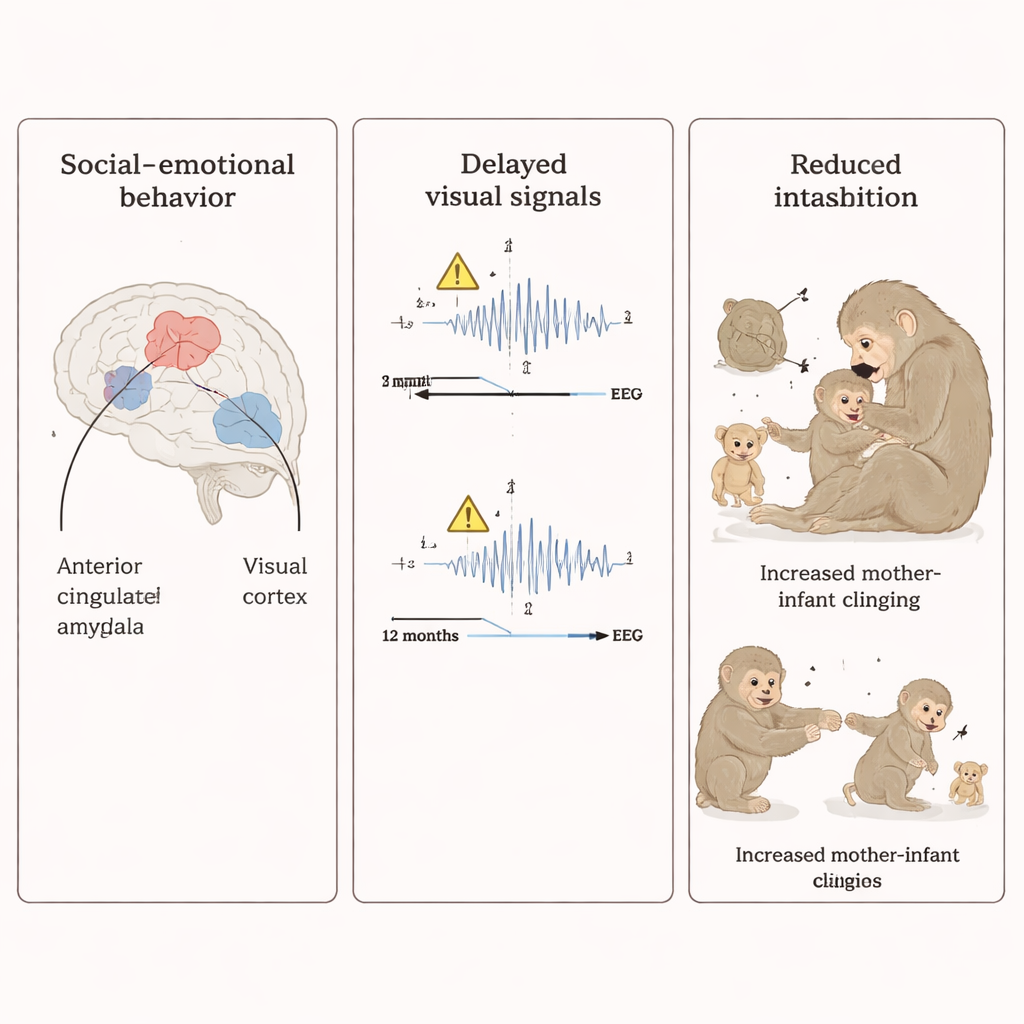
At one year of age, Zika-exposed infants showed clear differences in how they related to their mothers and their surroundings. Compared with controls, exposed infants spent much more time clinging to their mothers’ chests, staying in close proximity, and nursing, behaviors that normally decline as young macaques become more independent and seek out peers. Yet these same infants moved around their enclosures just as much as controls, suggesting the extra clinging was not due to weakness or poor motor skills, but to altered social-emotional development. When offered new sensory objects such as feathers, cotton balls, or brushes, Zika-exposed infants were more likely to approach them quickly on the first day, showing reduced hesitation toward novel sights and textures. Over subsequent days, as the objects became familiar, their responses began to resemble those of control animals.
Vision and hearing: subtle, shifting effects
Despite earlier reports of eye deformities in some Zika-affected pregnancies, these Zika-exposed infants generally had normal eye structure and normal electrical responses from the retina itself. However, tests that record signals in the visual part of the brain told a different story. At three months of age, exposed infants had weaker visual responses in the cortex, pointing to delayed development of brain circuits that interpret what the eyes see. By 12 months, these responses had largely caught up to the control group, suggesting a temporary but real lag in visual brain maturation. Hearing tests hinted at more frequent mild hearing loss in exposed infants than in controls, particularly at certain sound frequencies, but the numbers were too small for firm statistical conclusions, and some losses appeared transient rather than permanent.
Maternal infection markers fall short as risk predictors
A major goal of the study was to test whether features of the mother’s infection—such as how long the virus stayed in her blood, how much virus reached the placenta, what lineage of Zika she carried, or whether she had prior dengue infection—could predict which infants would develop problems. Surprisingly, none of these maternal measures reliably forecasted social-emotional changes, sensory approach behavior, visual brain delays, or hearing loss. Formal statistical analyses also showed that the behavioral differences were not simply caused by the visual or hearing changes; instead, prenatal Zika exposure appeared to act directly on brain circuits that regulate attachment, inhibition, and emotional responses.
What this means for children exposed to Zika
For a lay audience, the main message is that a baby exposed to Zika during pregnancy may face developmental challenges even if born without obvious physical defects, and even when the mother’s infection looked mild or brief. In this macaque model, prenatal Zika exposure led to clingier, less independent infants and to an unusually bold response to new sensory experiences, along with early but partly reversible changes in how the brain processes visual information. Because standard maternal lab tests did not predict which infants were affected, the authors argue that medical care should not stop at birth. Instead, all Zika-exposed children should receive careful, long-term screening of social, emotional, hearing, and visual development so that any subtle delays can be identified and treated during the critical early years of life.
Citation: Ausderau, K.K., Boerigter, B., Razo, E.R. et al. Prenatal Zika virus exposure disrupts social-emotional development and cortical visual function in infant macaques. Nat Commun 17, 1803 (2026). https://doi.org/10.1038/s41467-026-68517-x
Keywords: Zika in pregnancy, infant brain development, macaque model, hearing and vision, social-emotional behavior