Clear Sky Science · en
Reentrant melting of scarred odd crystals by self-shear
When spinning grains behave in strange ways
Imagine a tabletop full of tiny toy tops, all spinning and jostling inside a circular fence. You might expect them to either settle into an orderly pattern or remain jumbled forever. This study shows something far stranger: by carefully tuning how many tops spin clockwise versus counterclockwise, the same crowded assembly can freeze into a crystal, melt back into a fluid, and even shear past itself—all without changing how many particles are present. This reveals a new way in which simple, driven objects can mimic and even surpass the behaviors of ordinary solids and liquids.
Frustration built in by shape and defects
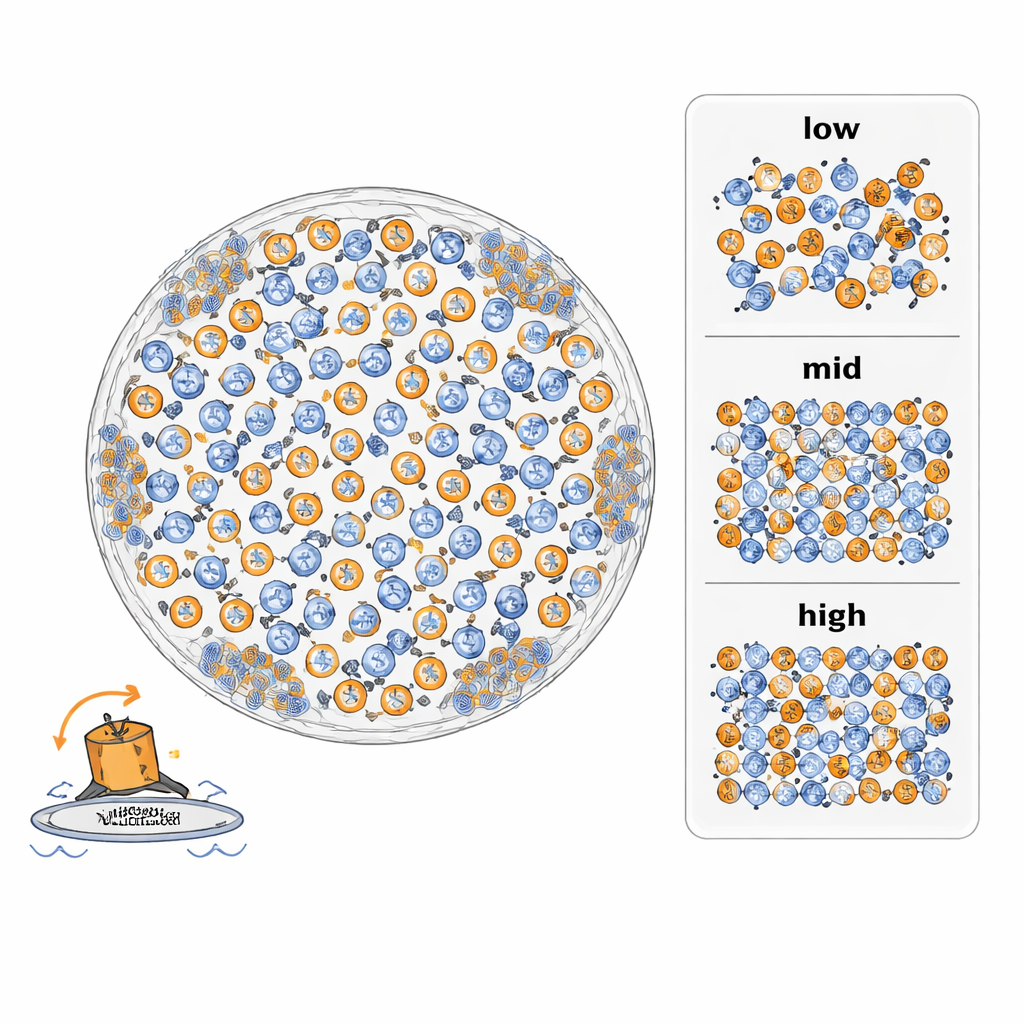
The researchers work with thousands of millimeter-scale “granular spinners”: 3D-printed dome-shaped particles with tilted legs that sit on a vibrating plate. Vertical shaking makes each dome spin, clockwise or counterclockwise depending on how its legs are tilted. Because their footprints are circular, these spinners can pack into a regular triangular lattice, like coins in a tightly stacked tray. But the team confines them in a circular arena, a geometry that cannot be perfectly tiled by this lattice. As a result, unavoidable defects—extra or missing neighbors in the packing—appear. At large system sizes, these defects assemble into short, string-like features called grain boundary scars, which thread through the otherwise ordered crystal and are fixed in place by the overall geometry.
Turning up odd behavior with chirality
The key control knob is the “chiral activity” of the assembly—the net bias toward clockwise or counterclockwise spinning. When there are equal numbers of each, the average torque is zero; when one type dominates, the system develops strong internal twisting forces that couple compression to rotation. This is a hallmark of so-called odd elastic materials, which break both mirror symmetry and time-reversal. By varying the fraction of clockwise spinners while keeping the overall area coverage fixed, the team can dial the odd mechanical response from nearly passive to strongly active, without changing the packing density itself. They then use high-speed imaging and numerical simulations to map how the internal structure and flow patterns respond.
A crystal that melts, re-forms, and melts again
At a representative density near the usual solid–liquid boundary for hard disks, the authors observe a striking reentrant transition. With no net chirality, the interior behaves like a dense liquid, with only short-ranged order. At intermediate net chirality, the bulk region inside the arena abruptly becomes a nearly perfect single crystal, as quantified by a high hexagonal bond-order parameter. Increasing the bias further melts this crystal back into a liquid-like state, even though the number of particles per unit area is held constant. Measurements of how particles are distributed across the radius show that chiral activity redistributes density: odd stresses generated by spinning collisions can either squeeze the bulk and promote crystallization or pull it apart and induce melting, depending on the relative directions of particle spin and large-scale flow.
Self-shearing and the role of scars
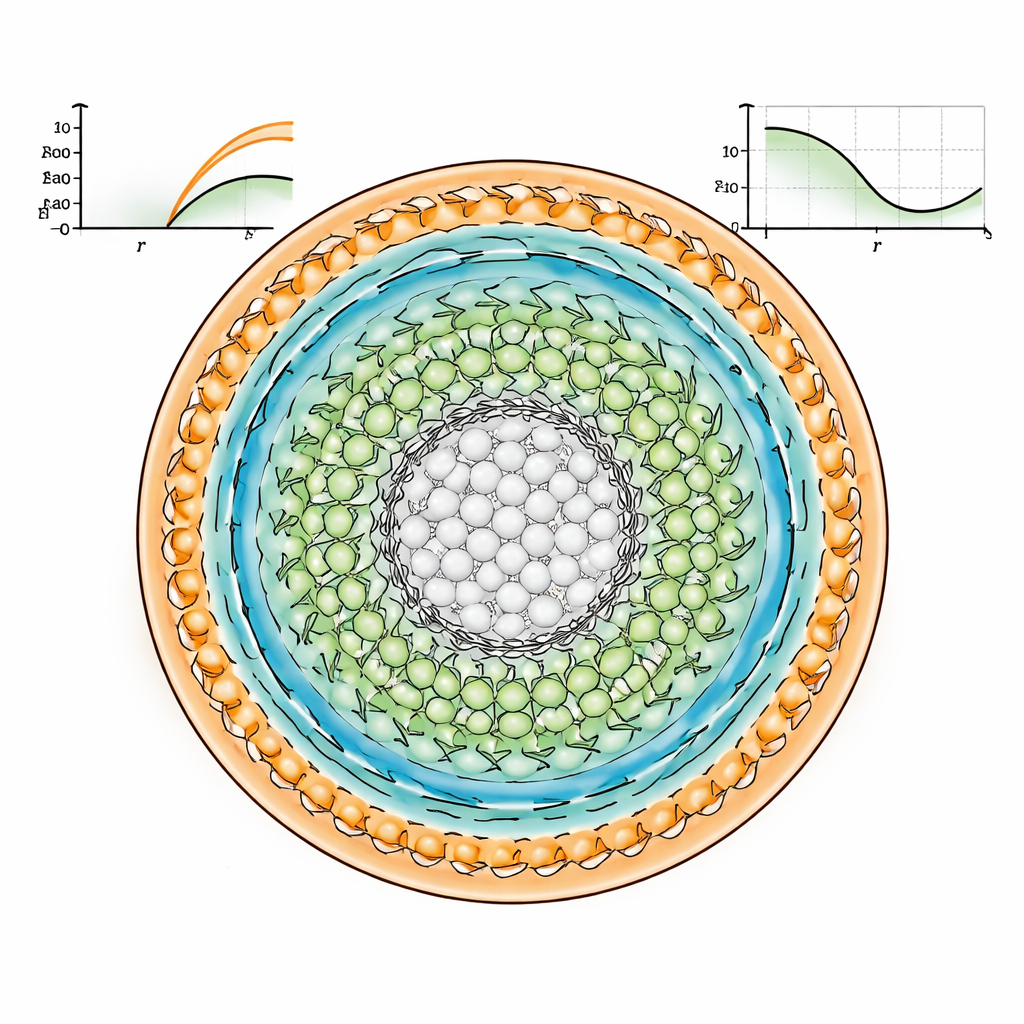
To understand how flows and structure are connected, the team analyzes the rotation rate of particles in concentric annuli. In conventional spinner solids, edge flows tend to drag the whole system into rigid-body rotation. Here, something different happens: at certain chirality values, the outer layers slide in one azimuthal direction while the interior flows the other way, a phenomenon the authors call self-shearing. The sharp change of flow direction occurs right where the grain boundary scars sit. These defect strings locally reduce the density and frictional coupling, acting as a weak slip ring that decouples the boundary from the bulk. Simulations confirm that the scars coincide with minima in the resistive torque transmitted across layers, showing that geometry-controlled defect patterns can channel and reshape activity-driven flows.
Why this odd melting matters
For a non-specialist, the key message is that how we confine and “frustrate” an active material can be just as important as what it is made of. By engineering the shape and size of the container, scientists can plant robust defect structures that steer motion, stress, and even phase changes in systems of driven particles. In this work, confinement-induced scars and chiral spinning combine to compress or dilate different regions, causing a crystal to solidify, liquefy, and solidify again as one simply changes the mix of clockwise and counterclockwise spinners. Such control over flow and rigidity at fixed density hints at future materials that can switch between solid and fluid states, redirect transport, or perform mechanical tasks on demand, powered only by internal activity and clever geometry.
Citation: Tiwari, U., Arora, P., Sood, A.K. et al. Reentrant melting of scarred odd crystals by self-shear. Nat Commun 17, 1802 (2026). https://doi.org/10.1038/s41467-026-68510-4
Keywords: active matter, granular spinners, topological defects, odd elasticity, reentrant melting