Clear Sky Science · en
Unveiling the metallogenic continuum of an Archean craton
Ancient Roots of Modern Metals
Many of the metals that power our modern world—gold, nickel, copper and the platinum‑group elements used in electronics and clean‑energy technologies—come from ore bodies formed billions of years ago. This study looks deep beneath Western Australia’s ancient Yilgarn Craton to ask a deceptively simple question: did very different types of metal deposits, scattered hundreds of kilometres apart, actually grow from the same deep geological “root system” in Earth’s mantle?
A Hidden Connection Across a Continent
The Yilgarn Craton is one of Earth’s oldest pieces of continental crust and hosts some of the richest gold camps on the planet, as well as a giant deposit of platinum‑group elements, nickel and copper at Gonneville‑Julimar near Perth. Traditionally, these magmatic nickel‑copper‑PGE deposits and hydrothermal orogenic gold deposits have been studied as unrelated systems because they form in different rocks, at different depths, and by different immediate processes. By focusing on the 20‑million‑year window between 2.675 and 2.655 billion years ago, the authors show that key deposits on opposite sides of the craton formed at the same time, hinting at a shared deep origin. 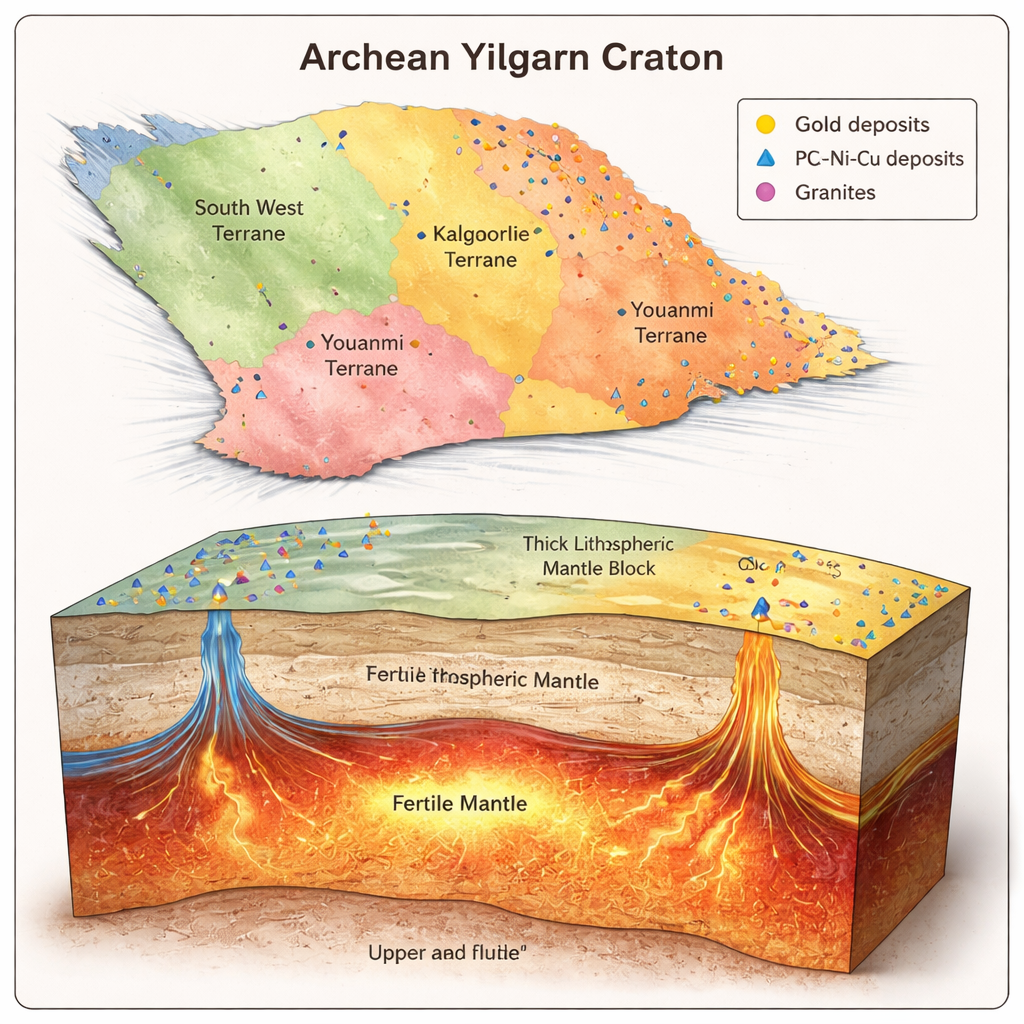
Fingerprints of a Common Mantle Source
To test this idea, the researchers compared three types of clues. First, they examined the timing of events: gold deposits in the Kalgoorlie and Kurnalpi Terranes, early gold in the South West Terrane, and the Gonneville‑Julimar magmatic sulfide deposit all cluster tightly in age. Second, they looked at the enrichment of certain “chalcophile” elements—those that like to bond with sulfur, such as bismuth, tellurium, platinum and palladium. Both the Yilgarn gold systems and Gonneville‑Julimar show unusual enrichment in these elements, suggesting their parent magmas or fluids tapped a mantle source already loaded with metals and volatiles. Third, they used tiny variations in sulfur isotopes as a tracer. Across hundreds of kilometres, both the gold ores and the Gonneville‑Julimar sulfides share a narrow range of positive values in an isotope parameter called Δ³³S, matching signatures found in nearby granites. This distinctive pattern is difficult to generate locally and instead points to a large, pre‑existing sulfur reservoir in the lithospheric mantle that had been modified by recycled ancient crust.
Recycling Old Crust to Fertilise the Mantle
The authors propose that before these deposits formed, older submarine volcanic and sedimentary rocks were pushed downward into the mantle beneath the craton. As these buried rocks heated up, they released water, other volatiles and sulfur carrying a non‑standard isotopic signal inherited from Earth’s early, oxygen‑poor atmosphere. These fluids infiltrated the surrounding mantle, lowering its melting point and enriching it in sulfur and metal‑loving elements. The result was a long‑lived, “fertile” mantle zone—an underground reservoir primed to generate magmas and fluids unusually rich in metals and volatiles. Later, when tectonic or thermal events triggered partial melting in this zone, the resulting hydrous magmas and metal‑bearing fluids rose along large crust‑spanning structures, feeding different types of ore systems at different crustal levels.
One Deep System, Many Types of Ore
In this picture, the contrast between a deep PGE‑Ni‑Cu intrusion like Gonneville‑Julimar and shallower gold veins in Kalgoorlie or Kurnalpi is mainly a matter of plumbing and conditions along the way. Deeper, hotter settings and higher degrees of melting favoured the accumulation of platinum‑group elements and nickel in ultramafic intrusions. Shallower, cooler, structurally focused zones promoted the concentration of gold in quartz‑rich veins and shear zones. Yet in both cases, the same enriched mantle reservoir supplied metals, sulfur and water, leaving behind shared chemical “birthmarks”: positive Δ³³S, signs of hydrous mantle sources, and enrichment in incompatible chalcophile elements such as Bi‑Te‑PGE. Granites with matching sulfur signatures act as additional probes of this hidden reservoir, helping to map where and when the mantle beneath the craton was fertilised. 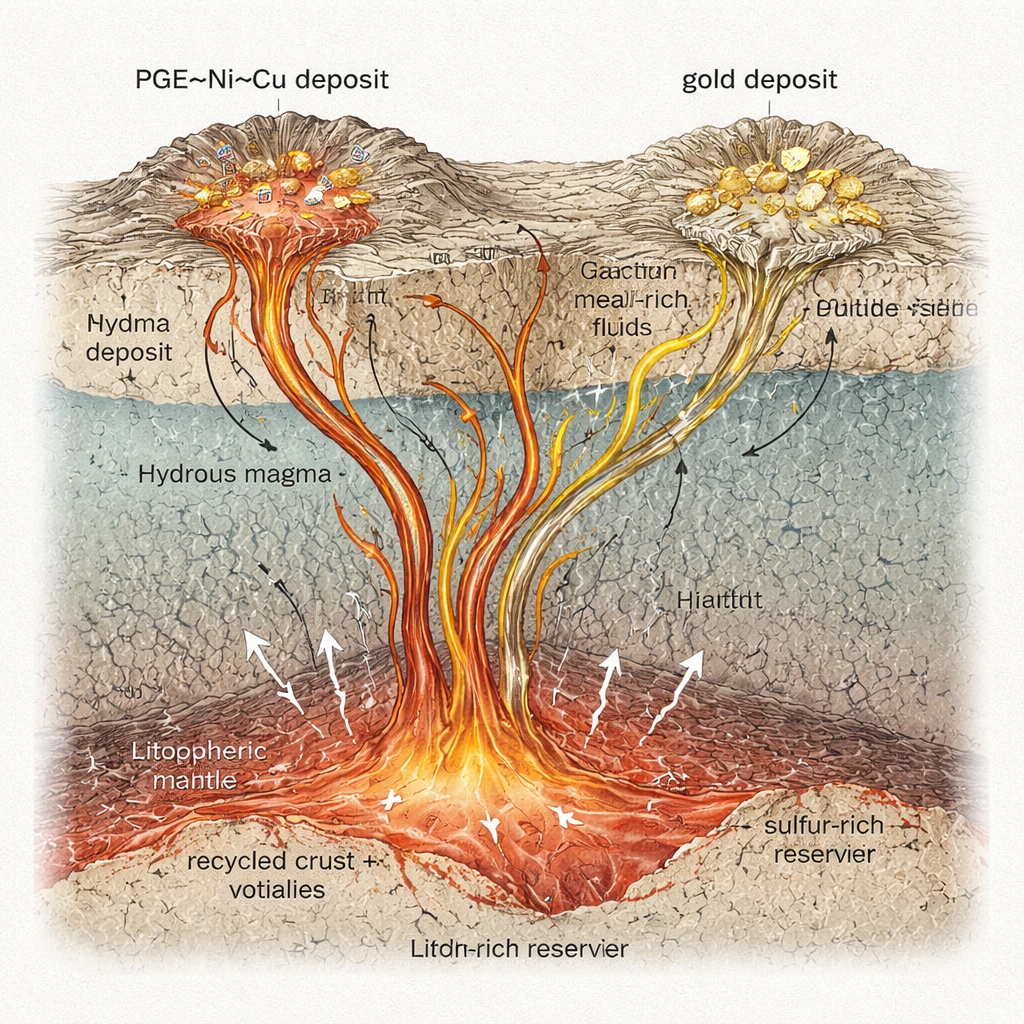
Rethinking How We Hunt for Metals
For non‑specialists, the main message is that very different ore deposits can be surface expressions of a single, deep‑seated system. Rather than treating each deposit as an isolated curiosity, the study argues that mineral exploration should target times and places where the mantle beneath a region was made unusually rich in volatiles and metals by crustal recycling. Chemical tracers such as sulfur isotopes in granites can reveal these fertile zones long after the original processes ended. This unified view of a “metallogenic continuum” not only explains how world‑class gold and PGE‑Ni‑Cu deposits formed together in the Archean Yilgarn Craton, it also offers a practical framework for finding new resources needed for future technologies while reducing the environmental footprint of exploration.
Citation: Demmer, M., Ezad, I. & Fiorentini, M. Unveiling the metallogenic continuum of an Archean craton. Nat Commun 17, 1798 (2026). https://doi.org/10.1038/s41467-026-68507-z
Keywords: Yilgarn Craton, mantle fertility, orogenic gold, magmatic Ni-Cu-PGE, sulfur isotopes