Clear Sky Science · en
Morphology-modified contributions of electronic transitions to the optical response of plasmonic nanoporous gold metamaterial
Why tiny holes in gold matter
Gold is famous for its shine, but when it is turned into a sponge‑like metal full of nanoscale holes, its interaction with light changes in surprising ways. This study explores how the fine structure of “nanoporous gold” alters the behavior of energized electrons, potentially improving technologies such as sensors, solar energy devices, and light‑driven chemical reactors.
From smooth metal to nano‑sponge
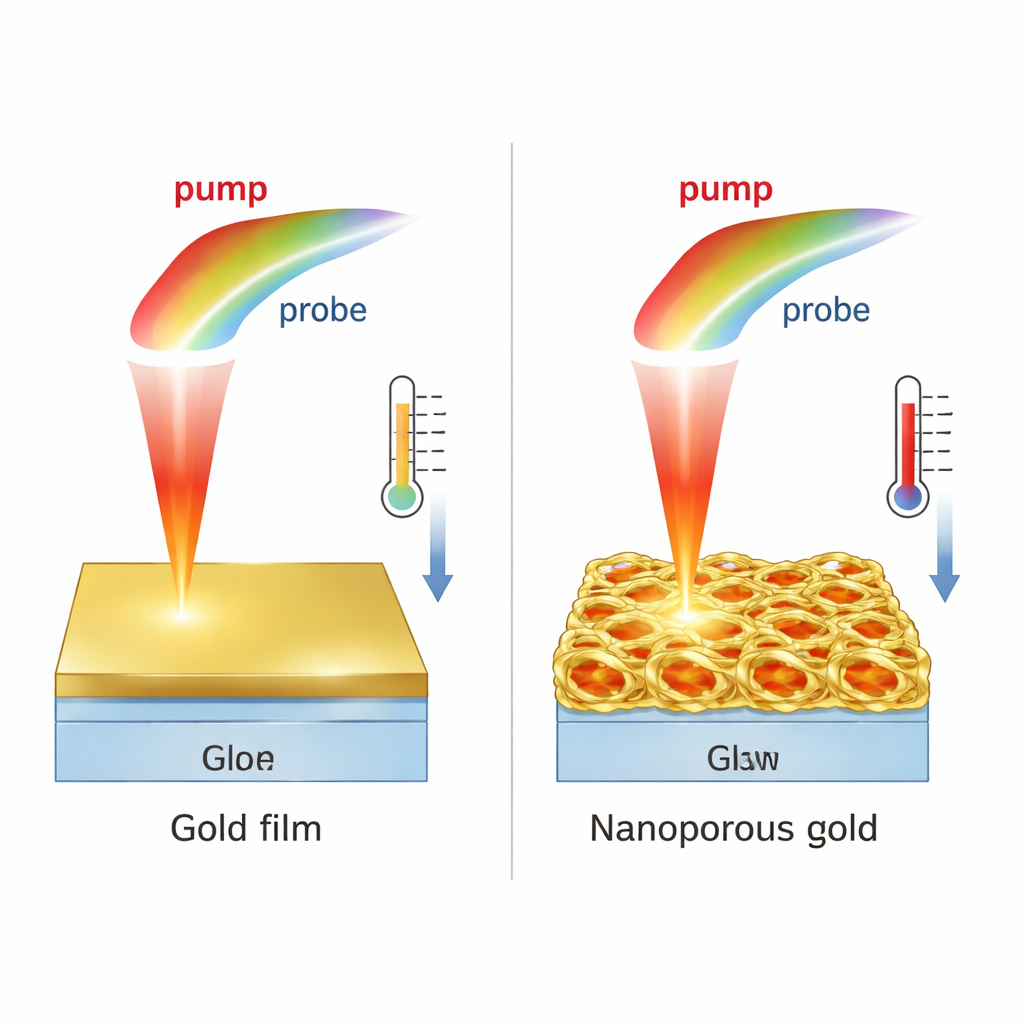
Ordinary thin gold films are continuous, like a flat metal mirror. In nanoporous gold, much of the material is removed, leaving a three‑dimensional network of thin gold ligaments and tiny voids. This architecture makes the material behave like a “metamaterial,” whose overall optical properties can be tuned by changing its internal structure rather than its chemical composition. The large internal surface area and intricate pathways for electrons are known to boost catalytic reactions; here, the authors ask how this same structure reshapes the way electrons absorb and release light energy on ultrafast time scales.
Watching hot electrons cool down
To probe these processes, the team compared a standard flat gold film with a nanoporous gold film using pump–probe laser spectroscopy. A very short infrared laser pulse (the pump) first heats electrons in the metal, and a second, broadband light pulse (the probe) measures how the metal’s transmission changes as the excited electrons relax. In the flat film, the strongest change appears around a wavelength of about 540 nanometers, matching a well‑known electronic transition in gold. In nanoporous gold, however, the signal is not only stronger and longer‑lived, it also stretches to longer wavelengths. This indicates that the porous structure allows more electrons to be promoted between energy bands using lower‑energy light, and that these “hot” electrons stay hot for several trillionths of a second longer than in the smooth film.
How heat and structure work together
Using a refined heat‑flow model that tracks energy in electrons and the crystal lattice, the researchers showed that nanoporous gold absorbs more pump energy per unit of metal than the flat film. Because the same incoming light is concentrated into less actual gold volume, the electron gas in the porous film reaches much higher temperatures—several thousand degrees above room temperature—before cooling. A hotter electron distribution partially empties electronic states near the Fermi level, making it easier for lower‑energy photons to trigger additional transitions. Calculations based on this model faithfully reproduce the measured spectra and their dependence on laser power, supporting the idea that morphology‑driven heating, rather than a change in the underlying band structure, explains the broadened response.
Seeing localized light modes in the nano‑maze
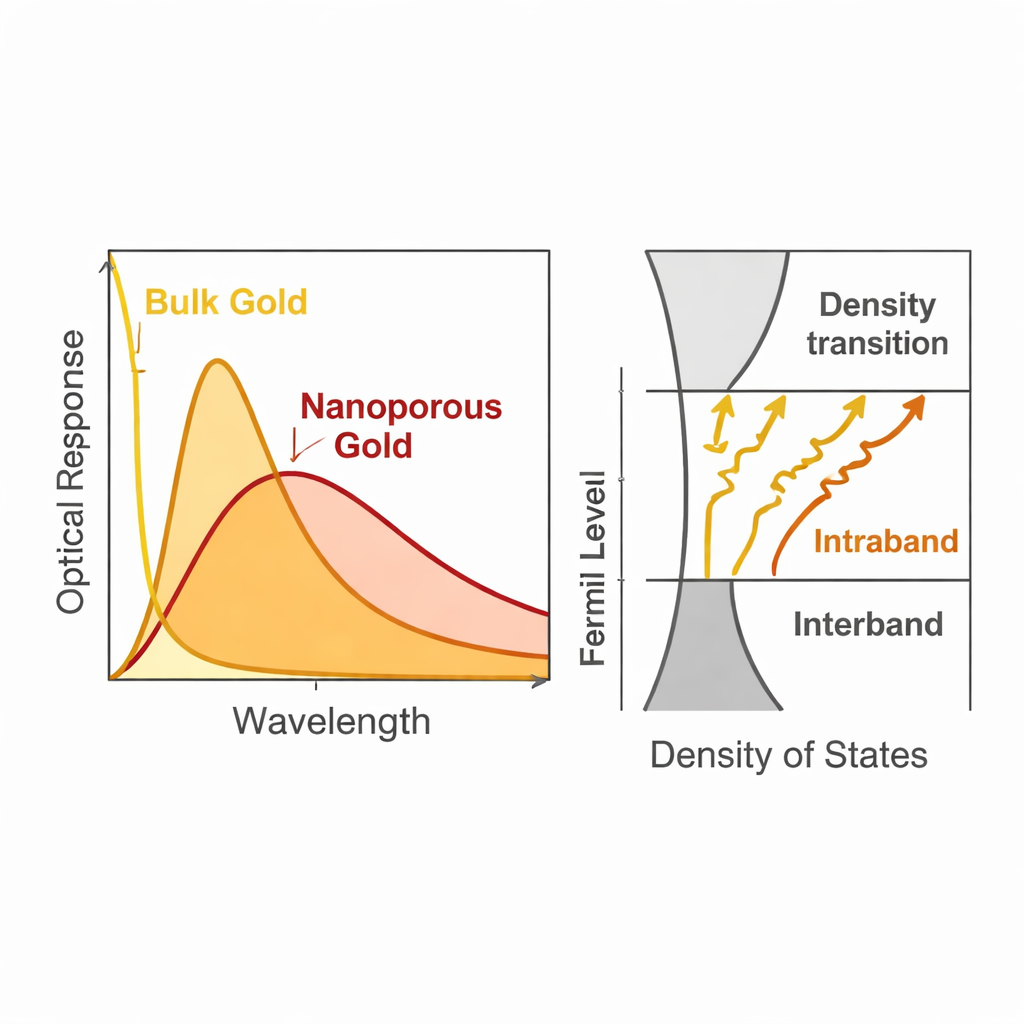
The team then used cathodoluminescence microscopy, in which a focused electron beam scans the surface while emitted light is recorded, to map how the materials glow under excitation. The flat gold film shows a nearly uniform emission peak near 540 nanometers. In contrast, nanoporous gold exhibits a patchwork of bright spots and colors across the visible range, a signature of many localized plasmon resonances—tiny pockets where light is strongly concentrated by the curved ligaments and gaps. To understand what electronic processes feed these resonances, the authors turned to atomistic simulations that assign charges and dipoles to each gold atom. These calculations reveal that, in nanoporous gold, contributions from both “intraband” (within one band) and “interband” (between bands) transitions remain significant over a wider wavelength range than in bulk gold, confirming that the porous structure fundamentally redistributes how electrons participate in optical excitations.
Shaping light–matter interaction by design
Taken together, the experiments and simulations demonstrate that simply introducing nanoscale porosity into gold is enough to change which electronic transitions dominate its optical response, and to slow down how quickly excited electrons cool. For non‑specialists, the key message is that engineers can tune not just how much light a metal absorbs, but which electrons are involved and on what time scales, by sculpting its internal structure. This opens a route to custom‑designed gold “sponges” that generate and manage hot carriers more efficiently, with potential payoffs for light‑driven chemistry, advanced photodetectors, and other nanophotonic devices that rely on turning fleeting bursts of light into useful electronic energy.
Citation: Tapani, T., Pettersson, J.M., Henriksson, N. et al. Morphology-modified contributions of electronic transitions to the optical response of plasmonic nanoporous gold metamaterial. Nat Commun 17, 829 (2026). https://doi.org/10.1038/s41467-026-68506-0
Keywords: nanoporous gold, plasmonic metamaterials, hot electrons, ultrafast spectroscopy, light-matter interaction