Clear Sky Science · en
Low thermal inertia of carbonaceous asteroid Bennu driven by cracks observed in returned samples
Why Cracked Space Rocks Matter
Asteroids are leftovers from the birth of the Solar System, and some of them occasionally cross Earth’s path. To predict how these bodies behave—and how to nudge them safely away if needed—scientists must understand what they are made of and how their surfaces respond to sunlight. NASA’s OSIRIS-REx mission brought home samples from the near-Earth asteroid Bennu, allowing researchers to test long-standing ideas about its unusual ability to heat up and cool down quickly. This study uses those samples to show that tiny cracks inside Bennu’s rocks, not just loose dust, are the key to its puzzling thermal behavior.
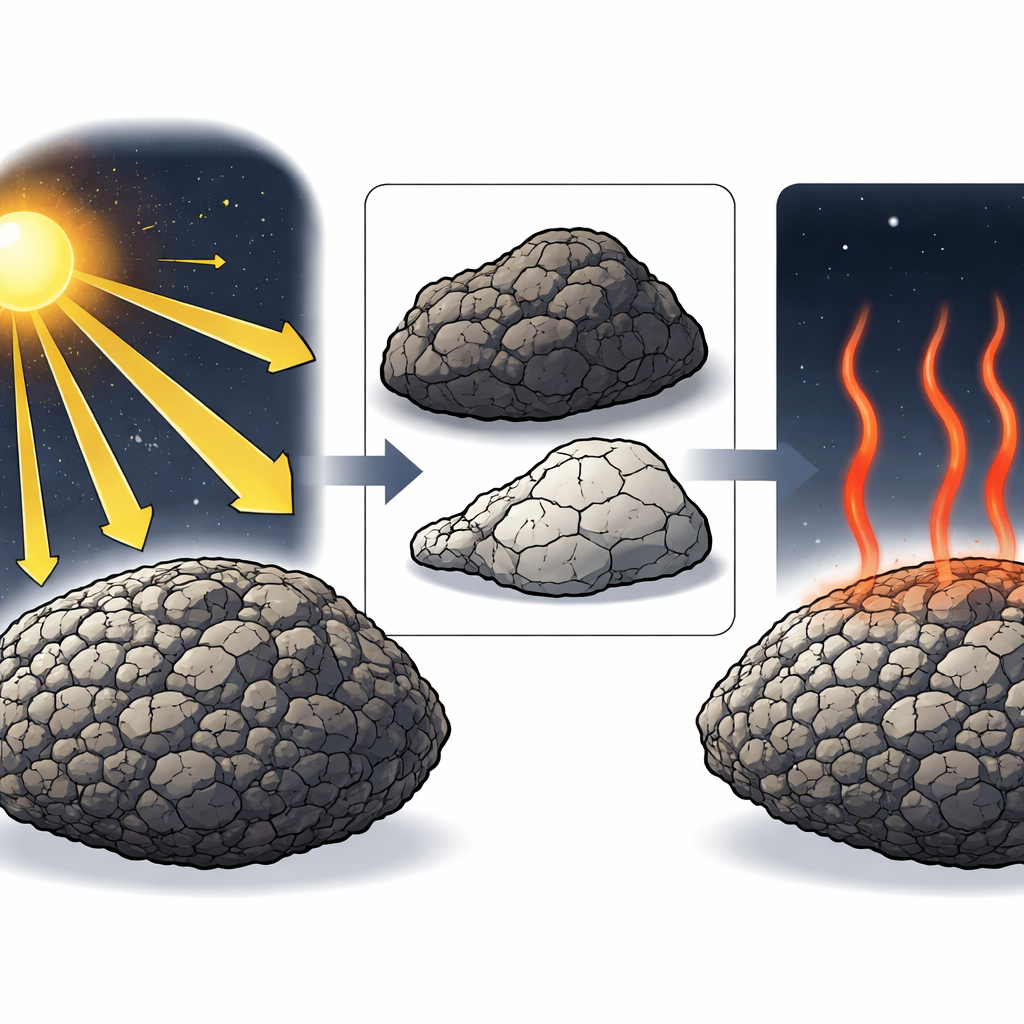
Reading an Asteroid’s "Temperature Memory"
When sunlight warms an asteroid and it later cools off, its surface does not instantly follow the changing temperature. How slowly or quickly heat moves through the material—a property called thermal inertia—acts like the object’s “temperature memory.” Before OSIRIS-REx arrived, Bennu’s low thermal inertia led many to picture a surface blanketed in fine dust and sand. Instead, close-up images revealed a rugged world dominated by boulders. Even more surprising, the darkest boulders—which cover much of Bennu—appeared to have far lower thermal inertia than typical meteorites and Earth rocks, hinting that something inside them must be blocking the flow of heat.
Two Families of Space Rocks
The returned samples contain millimeter-scale fragments that echo the boulders seen on Bennu’s surface. One set, called hummocky particles, are very dark, rough, and nodular, similar to the low–thermal-inertia boulders. Another set, angular particles, are somewhat brighter, with flatter faces and straighter fractures, resembling the brighter, higher–thermal-inertia boulders. By measuring how quickly heat spreads through individual particles in vacuum, the team found that angular pieces have consistently higher thermal inertia, while hummocky pieces show a broader spread, including some spots with very low thermal inertia comparable to Bennu’s darkest boulders.
Cracks, Pores, and Hidden Voids
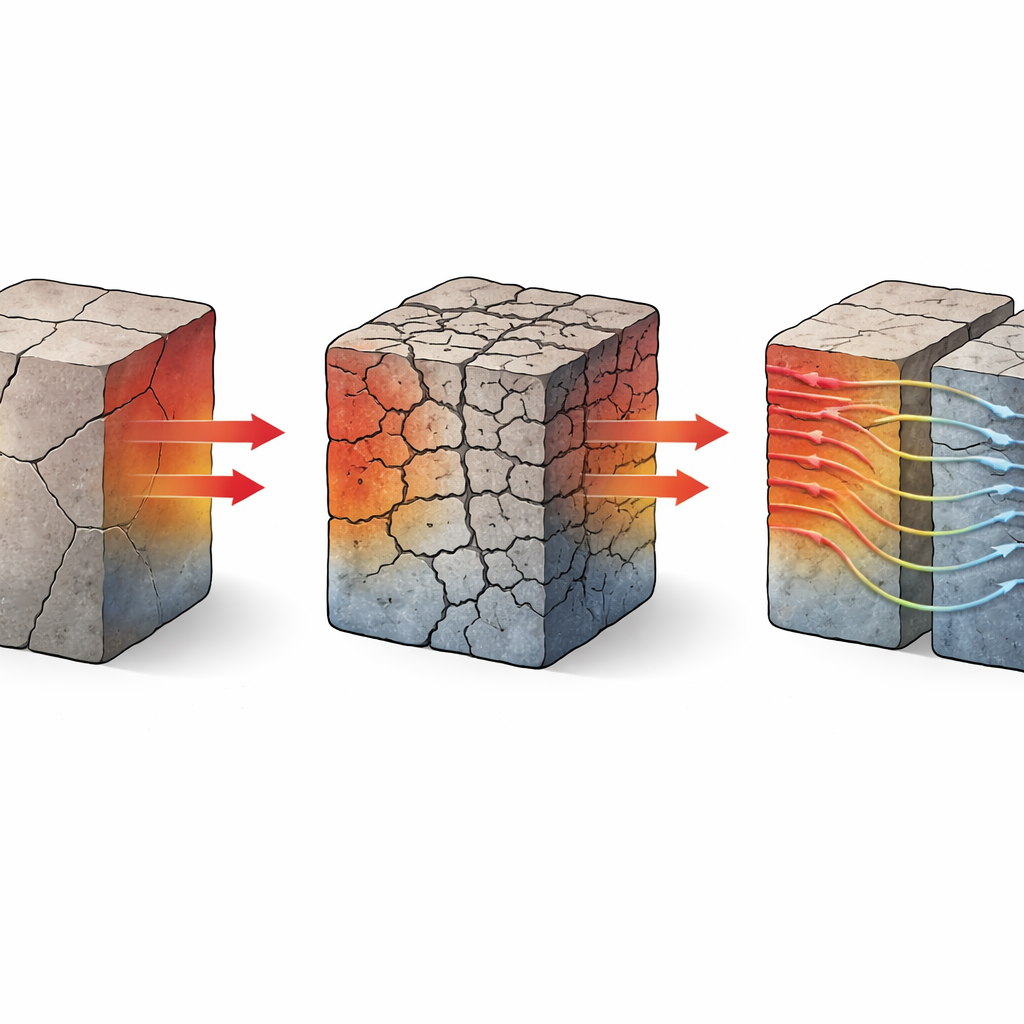
To understand why these small fragments behaved so differently, the researchers imaged their interiors using high-resolution X-ray scans. Hummocky particles are riddled with dense networks of short, jagged cracks and clusters of tiny pores, whereas angular particles contain fewer, longer, and straighter fractures and almost no obvious pore clusters in the measured regions. On average, both types of rocks are much lighter than solid rock because more than half of Bennu’s volume is empty space, most of it in pores too small to resolve directly. Computer models using the mapped crack networks showed that these fractures can strongly choke off pathways for heat: in hummocky particles, cracks alone can cut thermal conductivity by about 40 percent, while in angular particles they reduce it by at most about 10 percent.
Rocks That Break—or Just Fracture
Cracks also affect how Bennu’s rocks respond to stress. When scientists gently split representative samples in a controlled setting, the angular stone tended to break cleanly along long, planar fractures, easily falling into blade-like pieces. The hummocky stone, although far more densely cracked, behaved differently: many pre-existing cracks did not turn into new breaks, and the resulting fragments kept the same hummocky look. This suggests an interlocking, partially cemented fabric that allows the rock to become heavily fractured without crumbling into dust. At the microscopic level, material in hummocky particles is softer and more compliant than in angular particles, again consistent with a weaker but more ductile framework that can host a maze of cracks without shattering.
Connecting Bennu to Other Asteroids
The team compared Bennu’s samples with those from another carbon-rich asteroid, Ryugu, which also shows mysteriously low thermal inertia. Ryugu’s returned rocks are generally denser, but they display similar crack-rich interiors in some specimens and show pockets of very low thermal inertia where nearby fractures were captured in the measurements. Taken together, the evidence points to crack networks, built atop an already porous, water-altered rock matrix, as the main reason both asteroids warm and cool so readily. These cracks likely formed through a mix of internal processes on their long-lost parent bodies and later surface effects such as micro-meteoroid impacts and repeated day–night temperature swings.
What This Means for Bennu and Beyond
For the general reader, the key takeaway is that Bennu’s unusual thermal behavior is not primarily due to soft, powdery dust, but to hard rocks laced with intricate fracture systems. In Bennu’s darker, hummocky boulders, dense networks of cracks and tiny voids act like a maze that forces heat to take long, inefficient paths, giving the asteroid a very low thermal inertia despite its boulder-covered surface. Brighter, angular boulders, with fewer and straighter cracks, hold and transmit heat more like ordinary meteorites. This new understanding helps scientists better interpret telescope measurements of other asteroids, refine models of their internal structure and evolution, and improve predictions for how such bodies would respond to natural forces—or to a deliberate deflection attempt—should they ever threaten Earth.
Citation: Ryan, A.J., Ballouz, RL., Macke, R.J. et al. Low thermal inertia of carbonaceous asteroid Bennu driven by cracks observed in returned samples. Nat Commun 17, 2443 (2026). https://doi.org/10.1038/s41467-026-68505-1
Keywords: asteroid Bennu, thermal inertia, rock fractures, OSIRIS-REx samples, carbonaceous asteroids