Clear Sky Science · en
Intrinsically stretchable 2D MoS2 transistors
Electronics That Can Stretch Like Skin
Imagine a fitness tracker, medical patch, or soft robot whose electronic circuits bend, twist, and stretch as easily as rubber — without losing computing power. This paper describes a new kind of transistor, the basic on–off switch of electronics, built from ultrathin flakes of a material called molybdenum disulfide (MoS₂). These devices stay fast and reliable even when stretched, pointing toward future wearable gadgets and flexible displays that feel more like fabric than hardware.
Why Stretchable Circuits Are Hard to Build
Today’s chips are made on rigid silicon, which cracks long before your skin does. Engineers have tried to get around this by cutting stiff materials into serpentine or kirigami shapes that can stretch like springs. While clever, these patterns complicate manufacturing and limit how closely parts can be packed. Truly “intrinsically” stretchable electronics instead aim to make every active layer — the conductors, insulators, and semiconductors — soft and stretchable themselves. The challenge is that when you soften semiconductors enough to stretch, they typically lose the high performance needed for serious computation.
Flakes Instead of Fibers or Plastics
Until now, most intrinsically stretchable transistors have relied on two families of materials: flexible plastics that conduct charge and networks of carbon nanotubes. Plastic semiconductors can stretch, but they often trade away speed and switching sharpness. Nanotube networks can move charges quickly, yet they leak too much current when “off” and are difficult to tune into the n-type behavior needed to build full logic circuits. 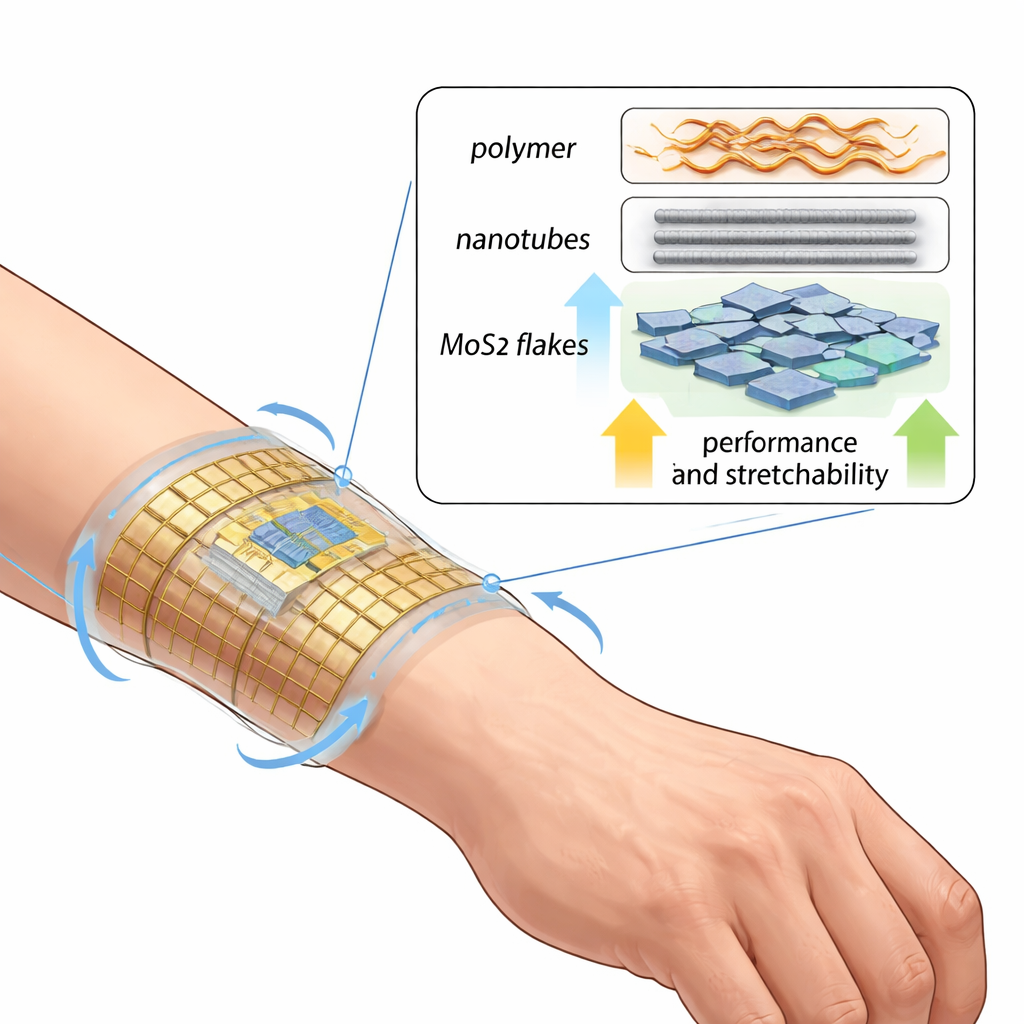
Building Wafer-Scale Stretchable Transistors
To turn these flakes into practical devices, the team designed a multilayer stack where every part can deform. A rubbery polymer forms the base and encapsulating layers. Between them sit a stretchy metal network for the gate, source, and drain electrodes, and a carefully engineered soft insulating layer that allows the transistor to switch at relatively low voltages. The MoS₂ flakes are first processed and heat-treated on a hard wafer for quality, then gently peeled off and transferred onto the soft stack without damage. Using standard photolithography, the researchers patterned thousands of transistors across an industry-standard 8‑inch wafer, demonstrating compatibility with modern manufacturing.
Staying Fast Even Under Strain
The resulting n-type transistors show impressive numbers for such soft devices: electron mobility — a measure of how quickly charges move — averages about 8 cm²/V·s and reaches up to 12.5 cm²/V·s, while the on/off current ratio exceeds ten million. Crucially, these figures hold up under 20% stretching, whether the device is pulled along or across the direction of current flow. In some cases, a small amount of stretching even boosts performance, likely because gentle tension subtly alters the MoS₂ electronic structure to help electrons move more freely. The transistors also survive at least 200 stretch-and-release cycles at 15% strain with little change in behavior, showing that the soft stack can repeatedly deform without failing.
How the Flakes Accommodate Stress
To see what happens inside the film, the authors used optical microscopy and Raman spectroscopy, a technique that tracks tiny shifts in vibrational “fingerprints” of the crystal lattice. 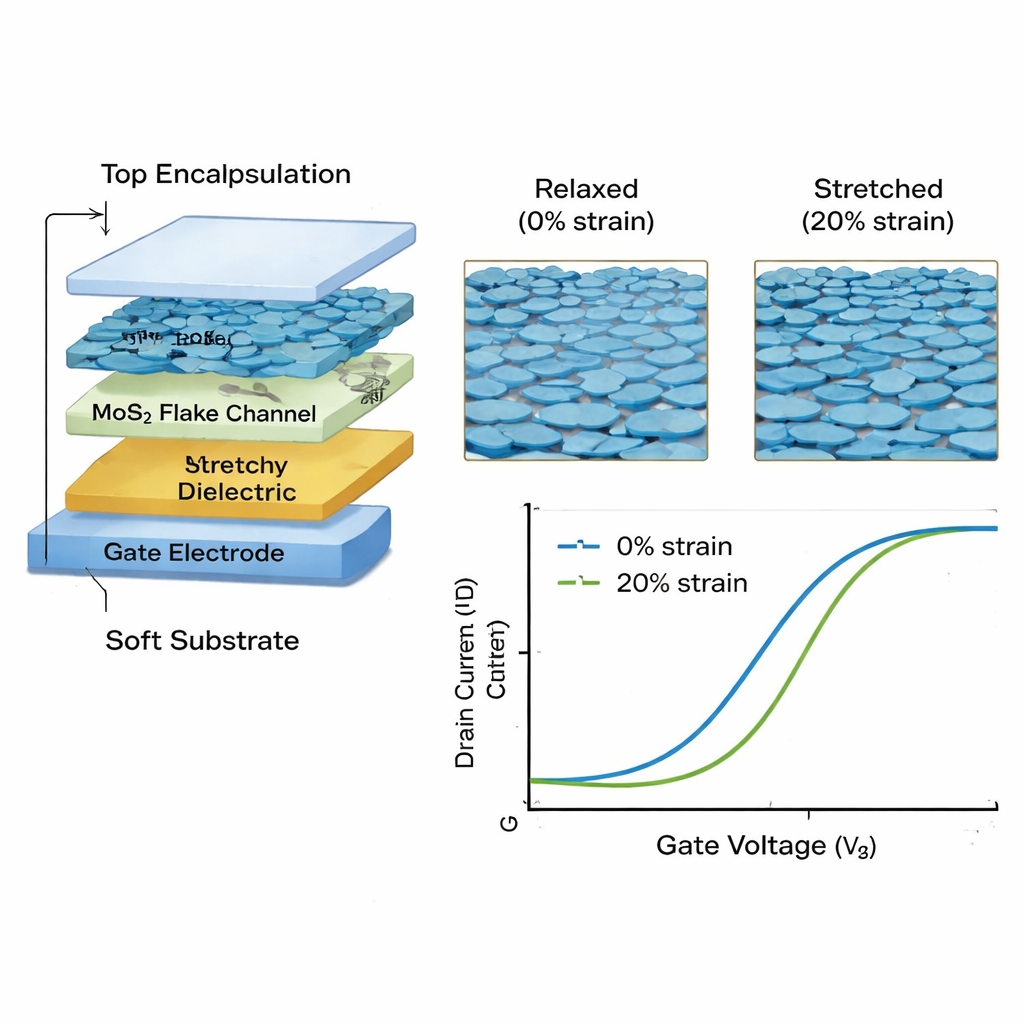
What This Means for Future Wearable Tech
For non-specialists, the central message is that the authors have shown a realistic recipe for making high-performance, fully stretchable electronic switches using a 2D crystal material. Their MoS₂ flake transistors combine the softness needed to conform to skin and moving parts with the low leakage and high speed expected from advanced electronics. Although further work is needed to withstand even larger stretches and millions of cycles, this approach helps close a major gap: reliable n-type building blocks for soft logic circuits. In time, similar devices could form the backbone of comfortable medical monitors, electronic skins, and deformable gadgets that move with us rather than against us.
Citation: Kim, K., Kuzumoto, Y., Jung, C. et al. Intrinsically stretchable 2D MoS2 transistors. Nat Commun 17, 1796 (2026). https://doi.org/10.1038/s41467-026-68504-2
Keywords: stretchable electronics, MoS2 transistors, wearable devices, 2D materials, soft circuits