Clear Sky Science · en
Enabling water-based high-density nanoparticles assembly by using silk fibroin as an adsorbate
Bringing Water and Electronics Together
Modern electronics are usually built with harsh chemicals and high heat, which makes it hard to combine them with living cells, soft tissues, or delicate biological molecules. This study shows how a natural silk protein, similar to what silkworms spin into cocoons, can help tiny particles organize themselves into smooth, dense layers using only water. That opens the door to gentle, eco-friendlier manufacturing of sensors, circuits, and optical devices that can sit safely on or inside the body.
How Silk Helps Tiny Building Blocks Behave
At the heart of this work are nanoparticles—particles thousands of times smaller than the width of a human hair—that can act as insulators, conductors, or light-handling elements, depending on what they are made of. Getting these particles to spread evenly and pack tightly into thin films is essential for making reliable devices, but it is difficult to do with water alone, especially on slippery, water-repelling plastics. The researchers turned to silk fibroin, a protein extracted from silkworm cocoons, which naturally has both water-loving and water-hating parts. When mixed into water-based nanoparticle solutions, silk fibroin spontaneously coats the particle surfaces, forming nanometer-thick shells that change how the particles interact with each other and with solid surfaces. 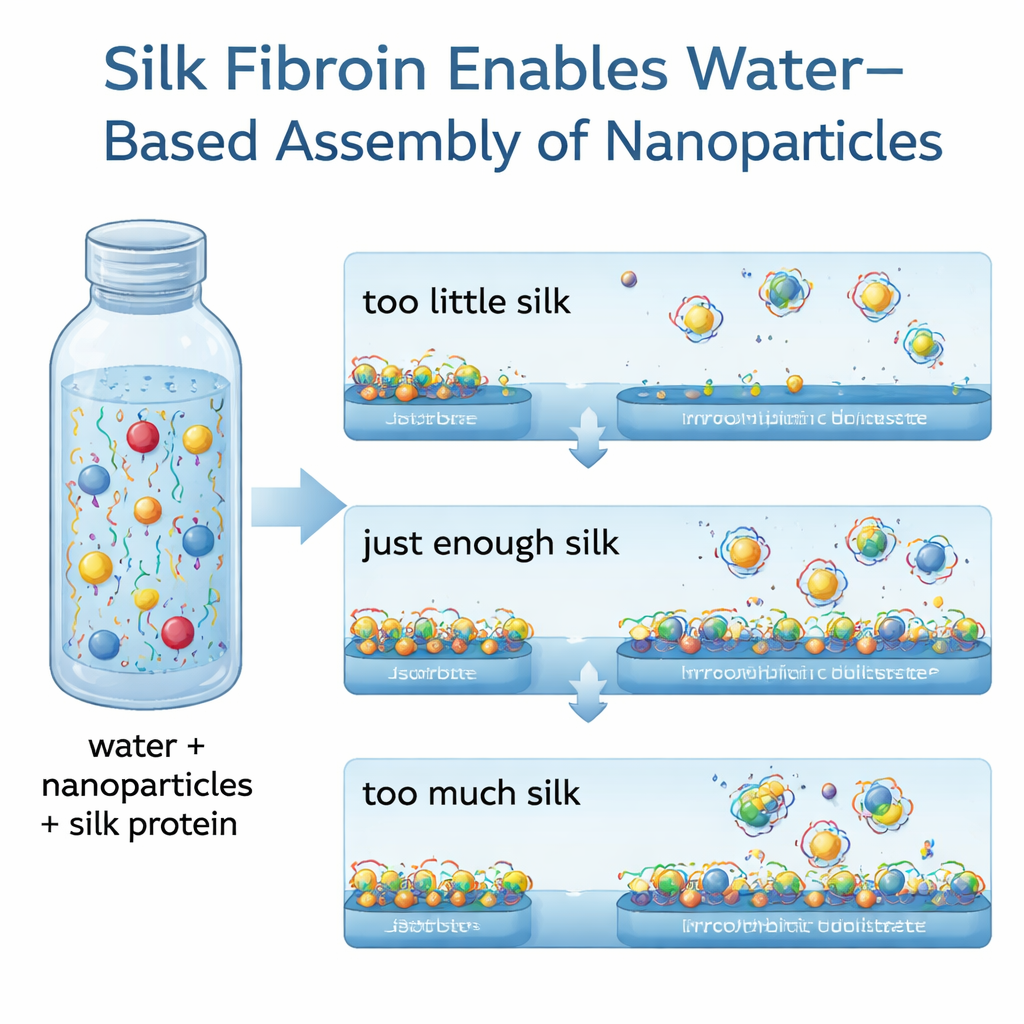
Finding the Sweet Spot for Stickiness
The team carefully measured how much silk protein ended up on the nanoparticles as they increased the silk concentration in water. Using high-resolution microscopes, infrared mapping, and light-scattering techniques, they watched thin silk layers grow from just a few billionths of a meter thick to much thicker coatings as more silk was added. They discovered an "optimal" range—around 0.2 percent silk by weight—where particles gained just enough extra attraction to one another and to surfaces to pack closely, without being smothered in excess protein. Below this range, the particles did not stick well enough; above it, they became embedded in a soft silk matrix that actually weakened the contact points between neighboring particles.
From Better Wetting to Smooth Coatings
One crucial test was whether these silk-coated nanoparticles could form continuous films on notoriously hard-to-wet plastics such as PDMS and PTFE, which are often used in flexible and bio-inspired devices. By spin-coating the water-based mixtures onto these surfaces, the researchers saw a dramatic improvement in coverage when the silk level was in the optimal window. Electron microscopy showed nearly crack-free, tightly packed layers of particles, while chemical analysis confirmed that the underlying plastic surface was essentially hidden. The silk layer not only improved wetting during coating but also created tiny bridges between particles, helping the film stay attached even when bent. A mild post-treatment with solvent could further “lock in” the silk structure, allowing multiple different nanoparticle layers to be stacked in water-only processes without mixing together.
Building Working Devices Without Harsh Processing
To prove this was more than a surface trick, the researchers built real electronic components with these water-processed, silk-assisted films. They made capacitors using silica nanoparticles as insulating layers, transparent conductors combining indium tin oxide nanoparticles and silver nanowires on soft plastic, and thin-film transistors using zinc oxide nanoparticles as the semiconducting channel. In each case, when the silk concentration was tuned to the optimal level, the devices worked as well as, and sometimes better than, similar devices made without silk or with conventional solution processing. Importantly, the silk did not ruin the electrical behavior of the nanoparticles—it helped them pack more densely and connect more reliably, which improved conductivity in conductors and preserved or slightly enhanced charge flow in transistors. 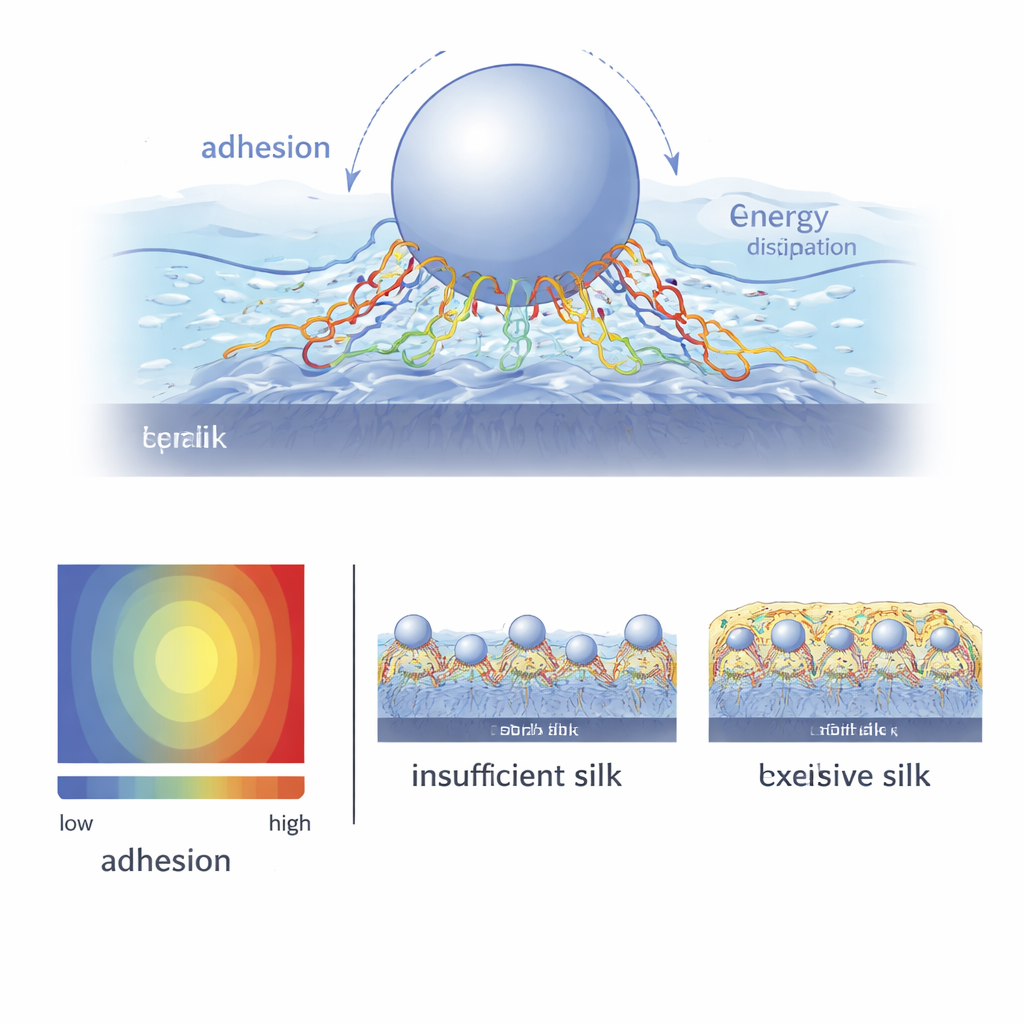
What This Means for Future Bio-Friendly Tech
In simple terms, this study shows that a natural silk protein can act like a smart glue for nanoparticles in water, turning difficult-to-coat surfaces into platforms for high-performance electronics and optical films, all without high temperatures or aggressive chemicals. By carefully tuning how much silk is added, engineers can achieve dense, defect-poor layers that keep the original function of the nanoparticles. This approach could make it much easier to build sensors, displays, and other devices that safely touch or integrate with living tissue, supporting future technologies at the boundary between biology and machines.
Citation: Kim, T., Kim, C., Gogurla, N. et al. Enabling water-based high-density nanoparticles assembly by using silk fibroin as an adsorbate. Nat Commun 17, 1791 (2026). https://doi.org/10.1038/s41467-026-68499-w
Keywords: silk fibroin, nanoparticles, water-based fabrication, bioelectronics, flexible electronics