Clear Sky Science · en
Atomic-scale mechanism unlocks thermal-stable high-κ performance in HfO2 via coherent interfaces
Why the tiniest layers matter for future electronics
As our phones, computers, and data centers keep shrinking and speeding up, the insulating layers inside their chips are being pushed to their limits. These ultrathin layers must store electric charge reliably, even as devices heat up during operation. This paper explores a new way to design hafnium‑oxide–based materials—already used in today’s chips—so they can store more charge (high κ, or high dielectric constant) while staying stable over a wide temperature range.
Balancing power and stability in next‑generation chips
Modern memory and logic devices, such as DRAM and transistors, need insulators that act like very efficient “electrical cushions”: they must let circuits respond quickly without leaking current. Hafnium oxide (HfO2) has become a favorite because it works well with silicon technology. In theory, one particular form of HfO2, called the tetragonal phase, should offer an excellent ability to store charge, much better than older silicon dioxide layers. In practice, however, real devices rarely reach this theoretical performance, and the material’s behavior can drift when heated, threatening long‑term reliability.
Using a hidden interface to boost performance
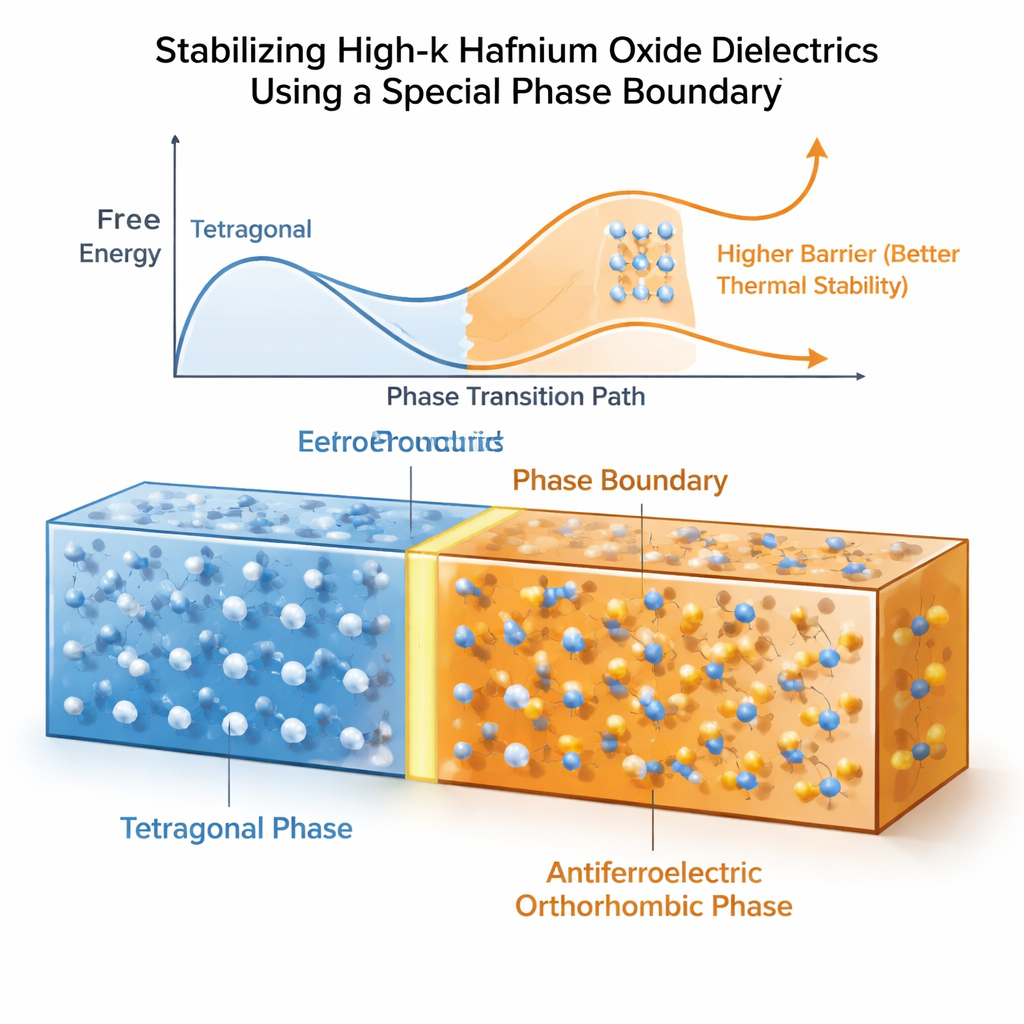
The authors focus on a subtle internal feature called a morphotropic phase boundary—a thin region where two different crystal structures inside the same solid meet. Here, they engineer a boundary between the tetragonal phase and a special orthorhombic phase that is antiferroelectric (its tiny electric dipoles align in alternating, canceling patterns). By carefully tuning the chemical recipe (adding lutetium and zirconium to HfO2) and using a high‑temperature growth technique followed by rapid quenching, they “freeze in” this boundary inside bulk crystals at room temperature. This boundary acts like a built‑in performance enhancer, raising the dielectric constant to about 57, similar to the best competing designs that use a ferroelectric phase, but without the same stability problems.
Seeing strain and vibrations at the atomic scale
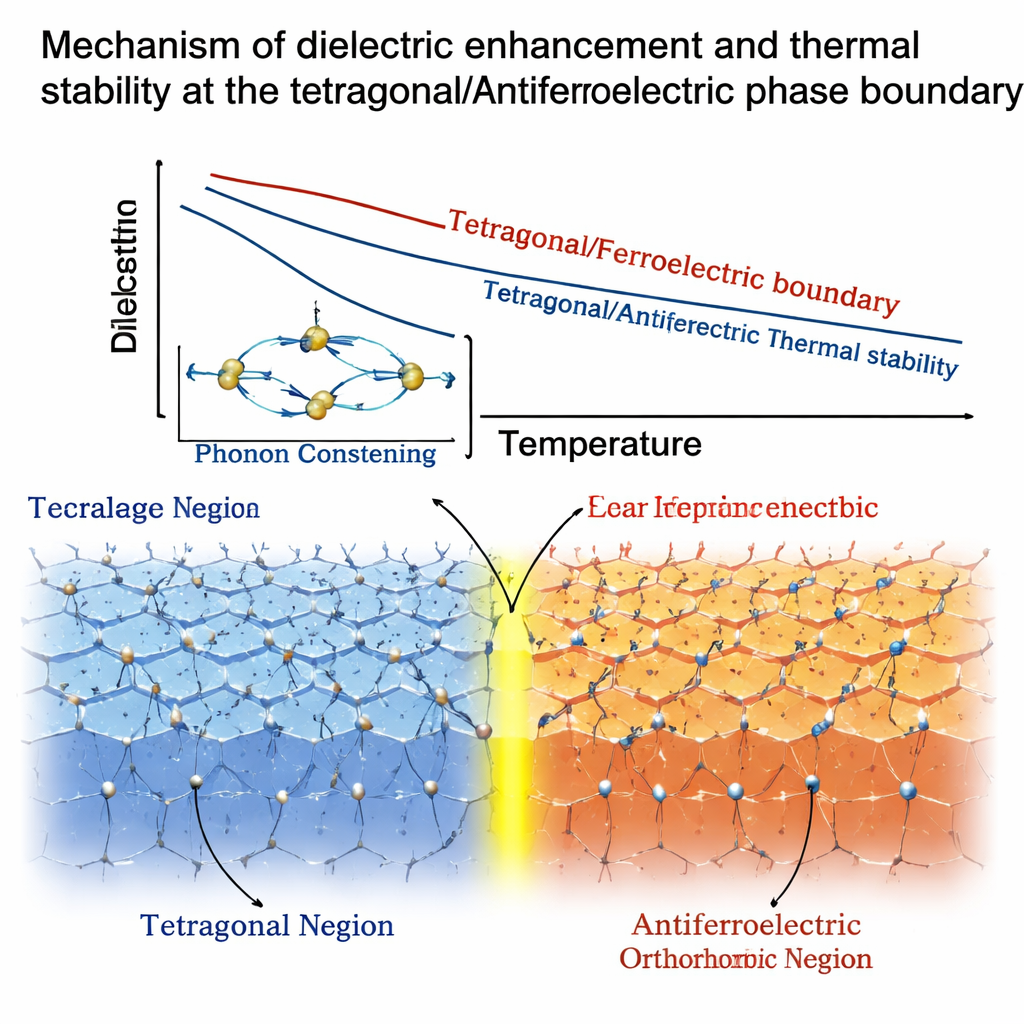
To understand why this boundary is so effective, the team uses advanced electron microscopy capable of visualizing both heavy and light atoms. They map how the crystal structure changes from the tetragonal side to the antiferroelectric side and find that the atoms near the boundary are stretched—under tensile strain—rather than squeezed. This strain subtly changes how atoms vibrate, especially a low‑frequency vibration mode that strongly influences how well the material stores electric energy. When this vibration “softens” (its frequency decreases), the material’s ability to polarize in response to an electric field increases, which directly boosts the dielectric constant.
Holding steady under heat
The study also compares how different types of internal boundaries behave as the material is heated from about 30 °C to 200 °C, a range relevant for real devices. Boundaries involving a ferroelectric phase tend to change more with temperature because it is easier for the material to switch structure under heat or electric fields. In contrast, the tetragonal/antiferroelectric boundary has a higher energy barrier for such switching. As a result, its dielectric constant changes by only about 7% over this temperature range—roughly half the variation seen in the ferroelectric‑based design—while still keeping a high κ value even after repeated heating and months of aging.
What this means for future electronic materials
In simple terms, the authors show that carefully engineered internal boundaries can make hafnium‑oxide–based insulators both stronger and steadier: they store more electrical energy and keep doing so reliably as devices heat up. By revealing how atomic‑scale strain and vibrations at these boundaries control performance, the work offers a blueprint for designing robust, high‑κ materials not only for memory chips but also for energy harvesting, sensing, and photonics. Instead of relying on unstable switching phases, this strategy uses a more rugged antiferroelectric partner to unlock high performance with superior thermal stability.
Citation: Shen, Y., Wang, H., Ma, X. et al. Atomic-scale mechanism unlocks thermal-stable high-κ performance in HfO2 via coherent interfaces. Nat Commun 17, 1789 (2026). https://doi.org/10.1038/s41467-026-68496-z
Keywords: high-k dielectrics, hafnium oxide, phase boundaries, CMOS technology, thermal stability