Clear Sky Science · en
Cascading chirality from molecule to twisted microstructures with amplified circularly polarized luminescence
Twisted Light from Tiny Building Blocks
Imagine materials that can twist light itself, acting like ultra-precise filters or information carriers for next‑generation displays, sensors, and data storage. This paper shows how chemists can coax simple molecules in solution to organize themselves into long, visible, corkscrew-shaped fibers that glow strongly and twist light in a preferred direction. By watching these structures form in real time, the authors reveal a recipe nature itself might approve of for building complex, functional materials from the bottom up.
From Simple Molecules to Visible Spirals
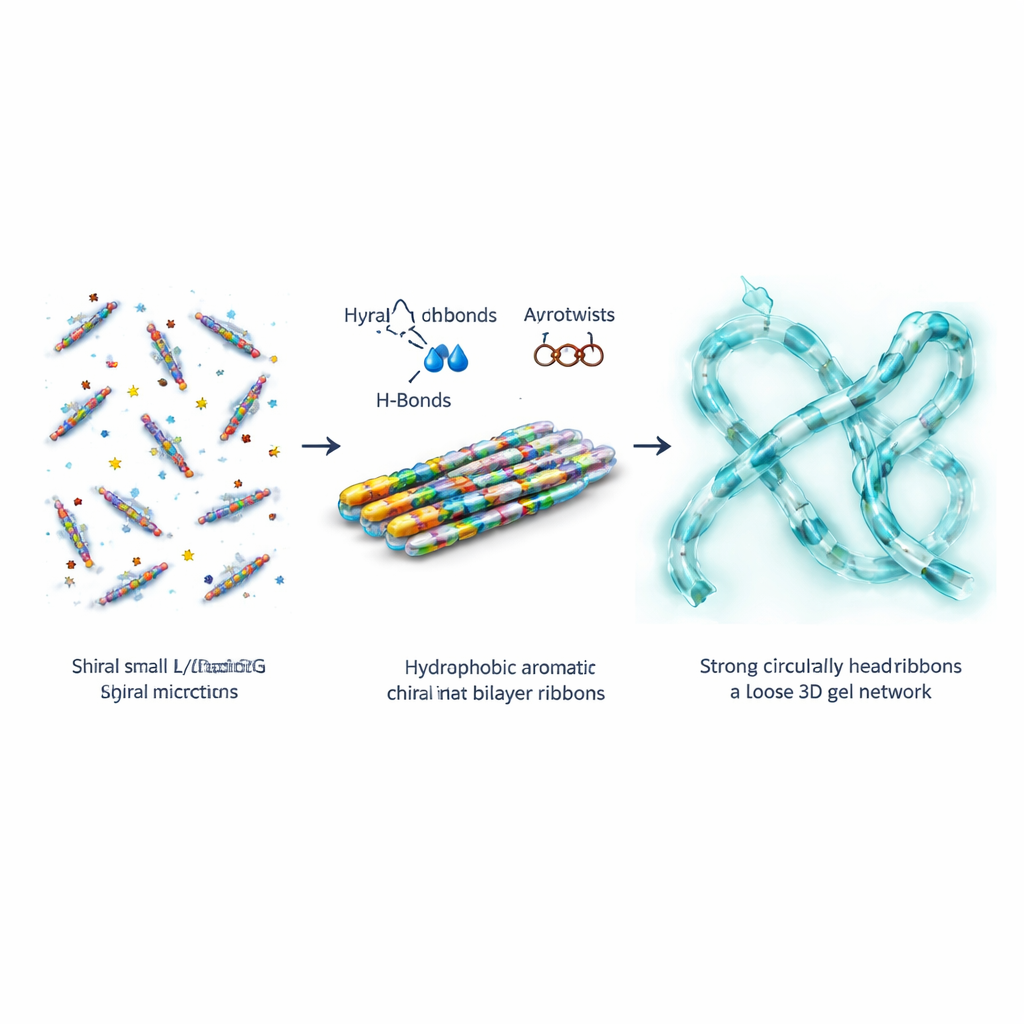
The researchers designed a pair of mirror-image molecules, called L-SPG and D-SPG, that behave a bit like soap: one end likes oil, the other likes water, and the whole molecule carries a positive charge. Each version is chiral, meaning its 3D shape comes in left- and right-handed forms, much like a pair of gloves. When these molecules are mixed in a water–organic solvent blend and gently heated and cooled, they do not stay isolated. Instead, they seek each other out and organize into larger structures, ultimately forming microscopic, needle-like twists more than 100 micrometers long—big enough to see under an ordinary optical microscope.
Hierarchical Self-Building Across Scales
The twist formation does not happen in one jump. First, the oily tails of the molecules huddle together to avoid water, bringing the molecules into close contact. Then, hydrogen bonds between their amide groups help them line up into small clusters. As the temperature falls, these clusters merge into flat bilayers in which the aromatic, light-absorbing headgroups stack face-to-face. Under just the right solvent conditions, these bilayers pack into a slightly tilted, layered arrangement that naturally curves into a spiral. The authors show that each level of this “hierarchy”—from single molecules, to small oligomers, to bilayers, and finally to multi-layered microtwists—locks in and strengthens the original molecular handedness.
Watching Twists Grow in Real Time
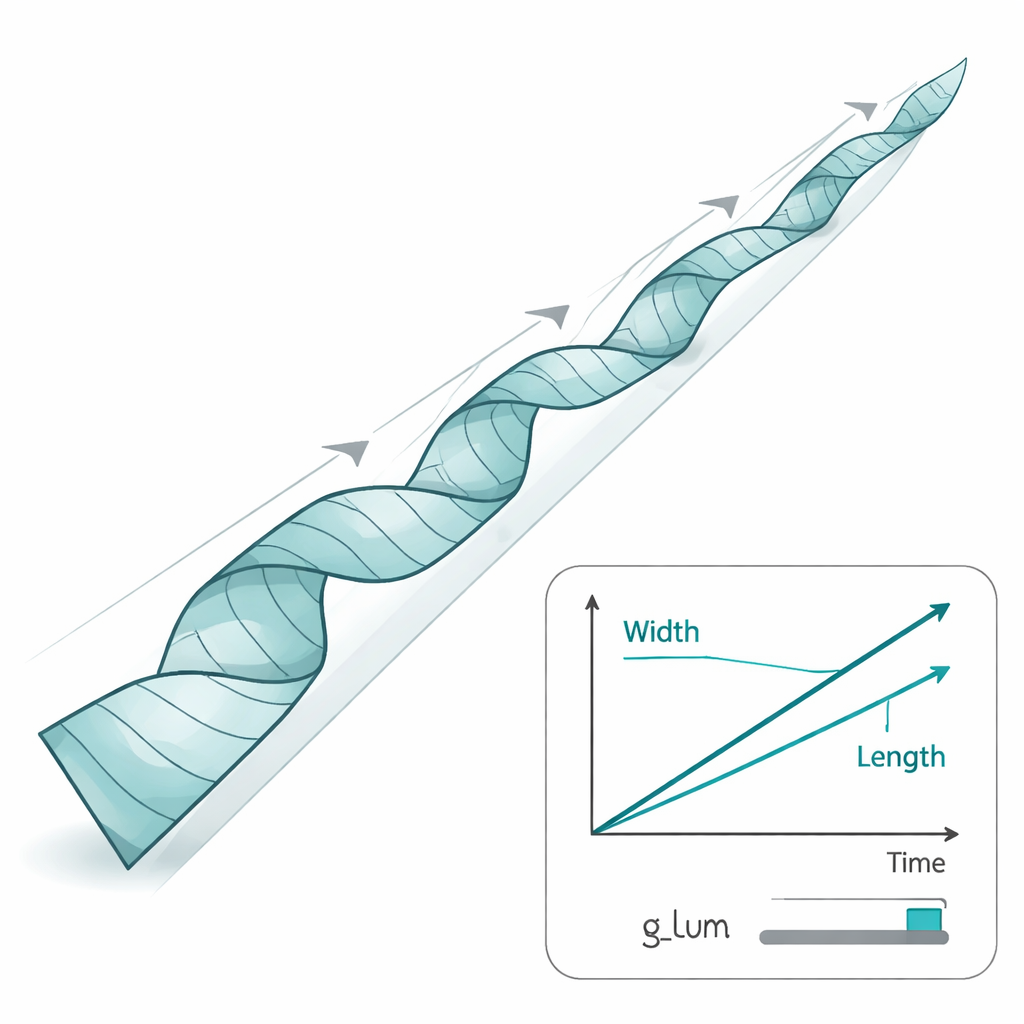
Because the final structures are micron-sized, their growth can be followed directly with a conventional optical microscope, rather than only with more complex high-resolution tools. The team built a heated microscope setup and filmed the emergence of the twists as the solution cooled. They observed that once a filament appears, it elongates in both length and width at nearly constant rates, yet its twist pitch—the spacing of each spiral turn—remains fixed. This pattern signals an interface-controlled process: pre-formed building blocks snap onto the growing ends in an orderly way, rather than randomly colliding and sticking. When both left- and right-handed molecules are mixed together, this order disappears, and the system forms floppy, untwisted belts that bend and buckle easily, highlighting how crucial pure handedness is for maintaining a rigid spiral form.
Turning Structure into Twisted Light
These spirals are not just pretty shapes; they are powerful optical devices at the microscopic scale. The stacked aromatic headgroups make the material strongly fluorescent, emitting bright cyan light when excited with ultraviolet radiation. More importantly, the way these units are arranged in a chiral environment causes the emitted light to become circularly polarized—it rotates as it travels, like a corkscrew. The authors quantify this effect with a parameter called the luminescence dissymmetry factor, glum. While individual molecules show practically no circular polarization and simple, non-hierarchical nanostructures show only a tiny effect, the fully developed gel of twisted fibers boosts glum by about 40 times, reaching a value (0.11) that outperforms most known single-component systems.
Why This Matters for Future Technologies
In plain terms, this work shows how to translate a tiny molecular twist into a large, visible spiral that powerfully twists light, all through careful control of weak forces such as hydrogen bonding, stacking of flat rings, and solvent conditions. By mapping both the step-by-step growth and the resulting optical behavior, the study provides a blueprint for designing new soft materials that can control light with high precision. Such hierarchically organized, light-twisting gels could inform future developments in advanced display technologies, secure optical communications, and chiral sensors, where strong, tunable circularly polarized luminescence is highly sought after.
Citation: Pan, Y., Wang, T., Wang, R. et al. Cascading chirality from molecule to twisted microstructures with amplified circularly polarized luminescence. Nat Commun 17, 1786 (2026). https://doi.org/10.1038/s41467-026-68494-1
Keywords: chirality, self-assembly, circularly polarized luminescence, supramolecular gels, twisted microstructures